SaaS MVP Development Company for Founders Who Need to Ship
We take your SaaS idea from scope to paying users: sign-up and auth, multi-tenant data, Stripe or Razorpay subscription billing, an admin dashboard and production hosting on AWS. One senior Python team owns the whole build, demos every week and hands over code you fully own.
- Team in Jaipur, India
- MSME & GST registered
- Live product demos you can try
Most founders who look for a SaaS MVP development company already know the idea; what they need is a team that will say no to the right things. A minimum viable product is not a smaller copy of the final product. It is the narrowest slice that proves people will sign up, use the core workflow and pay. Everything else — SSO, a native app, a marketplace, an AI assistant — waits until real usage shows it matters. Our job is to protect that scope while building the parts underneath it properly.
Properly means the unglamorous foundations are right from day one: tenant isolation that cannot leak one customer’s data to another, subscription states that survive failed payments and webhooks arriving twice, role-based access, audit trails and tested backups. These are cheap to build in week two and expensive to retrofit in month nine, when you have paying customers and no test coverage. We build the MVP as a well-structured monolith on Django or FastAPI with PostgreSQL, quick to change now and easy to split later.
We work with first-time founders, agencies with a SaaS client, and established businesses turning an internal tool into a product. MicroSaaS builders get the same discipline at a smaller scope: one sharp workflow, one pricing plan, Stripe or Razorpay checkout and hosting sized for early customers rather than imaginary scale. Standard builds run 2–8 weeks depending on scope, with a working demo at the end of every week so you can show investors or pilot users early.
What our SaaS MVP development company builds
Sign-up, auth and team roles
Email and password, magic links, Google or Microsoft sign-in via OAuth, email verification, password reset and team invitations. Organisation owners invite colleagues and assign roles, and permissions are enforced on the server for every request, not merely hidden in the UI. Enterprise SSO is designed for but deferred until a paying customer asks.
Multi-tenant SaaS data model
Every record belongs to a tenant and every query is scoped to it by default. We choose between shared tables with a tenant key, PostgreSQL row-level security or schema-per-tenant based on your compliance needs, and write tests that deliberately try to read across tenants, so any leak fails the build.
Stripe or Razorpay subscription billing
Plans, free trials, upgrades and downgrades with proration, coupons, GST- or VAT-ready invoices and a customer billing portal. Webhooks are signature-verified and idempotent, so an event delivered twice never double-credits an account. For Indian customers we add Razorpay Subscriptions and UPI AutoPay mandates.
Admin and back-office dashboard
A back office for your team: search tenants, impersonate a user to debug (with an audit log entry), extend trials, issue refunds, watch sign-ups and churn, and switch feature flags. Founders spend more time here than they expect, so we make it fast and practical rather than decorative.
The core workflow, done well
The one workflow customers pay for, built in React or Next.js on a clean component system: an onboarding checklist, empty states that teach, sensible defaults and forms that work on a phone. We instrument it with product analytics events so you can see exactly where new users drop off.
Emails, notifications and an API
Transactional emails for invites, receipts, failed payments and trial endings, in-app notifications and optional WhatsApp or Slack alerts. If customers need to integrate, we expose outgoing webhooks and a documented REST API with per-tenant API keys from the start, rather than bolting one on later.
AWS hosting, CI/CD and monitoring
Containerised deployment on AWS — ECS Fargate, or something simpler when that is enough — with managed PostgreSQL and automated backups, separate staging and production, CI that runs tests on every pull request, error tracking and uptime alerts. Everything is provisioned in your own AWS account.
Monolith or microservices for a SaaS MVP?
For almost every MVP the answer is a modular monolith: one deployable codebase and one PostgreSQL database, with clear internal modules for accounts, billing and each product area. Microservices solve an organisational problem — many teams needing to deploy independently — that a small product team does not have yet. What they add instead is network calls that fail, distributed transactions, duplicated auth, more infrastructure to pay for and slower feature work. That trade is rarely worth making before product-market fit.
The skill is building the monolith so it can be split later. Modules talk through service functions rather than reaching into each other’s tables, background work goes through a queue such as Celery or SQS, and anything slow or bursty — PDF generation, AI calls, video processing — runs in workers that can move to Lambda or Fargate without touching the core. When a module genuinely needs to scale on its own, it is extracted along a seam that already exists.
- Start with one database; add caching and read replicas before adding services.
- Keep all subscription state inside one billing module.
- Push slow work to a queue from day one, even if a single worker runs it.
Multi-tenancy and subscription billing: where MVPs usually break
Tenant isolation is the security property that matters most in B2B SaaS, and one missing filter breaks it. We scope data access at the lowest layer — a tenant-aware query manager or PostgreSQL row-level security — so a forgotten filter in a new endpoint returns nothing rather than another customer’s records. Shared-schema multi-tenancy suits most MVPs; schema- or database-per-tenant is worth its extra operational cost only when contracts demand physical separation or per-customer data residency.
Billing breaks more quietly. The payment provider is the source of truth for what was paid, but your database must know what each tenant is entitled to right now, and the two drift when webhooks arrive late, out of order or twice. We model an explicit subscription state machine (trialing, active, past due, cancelled), process every webhook idempotently, reconcile nightly and define dunning rules. Stripe suits global card billing, Razorpay with UPI AutoPay suits Indian customers, and some products need both.
- Write cross-tenant access tests that are expected to fail.
- Store entitlements (seats, limits, features) separately from prices.
- Grant access only after the verified webhook, never from the checkout redirect.
How we work
- 1Scoping call and ROI blueprint
We map users, the core workflow, pricing model and must-have integrations, then cut scope to what proves the idea. You receive a written scope, milestone plan and fixed quote, typically within the first three days.
- 2Architecture and security design
Data model, tenancy approach, billing state machine, hosting plan and threat model are agreed in week one, so expensive decisions are made deliberately instead of being discovered mid-build.
- 3Design of the key screens
Onboarding, the core workflow and billing screens are designed and reviewed with you before development starts, so your feedback costs a comment rather than a rebuild.
- 4Weekly build and demo
We build in one-week increments on a staging URL you can use yourself. Every week you see working software, re-prioritise the backlog and approve what ships next.
- 5Launch hardening
Cross-tenant and payment tests including failures and refunds, security checks, backups verified by an actual restore, monitoring and alerts switched on, then go-live in your AWS account.
- 6Support and iteration
After launch we fix issues, watch errors and usage, and move to a retainer or hourly arrangement for the features your first customers actually ask for.
Why teams choose us
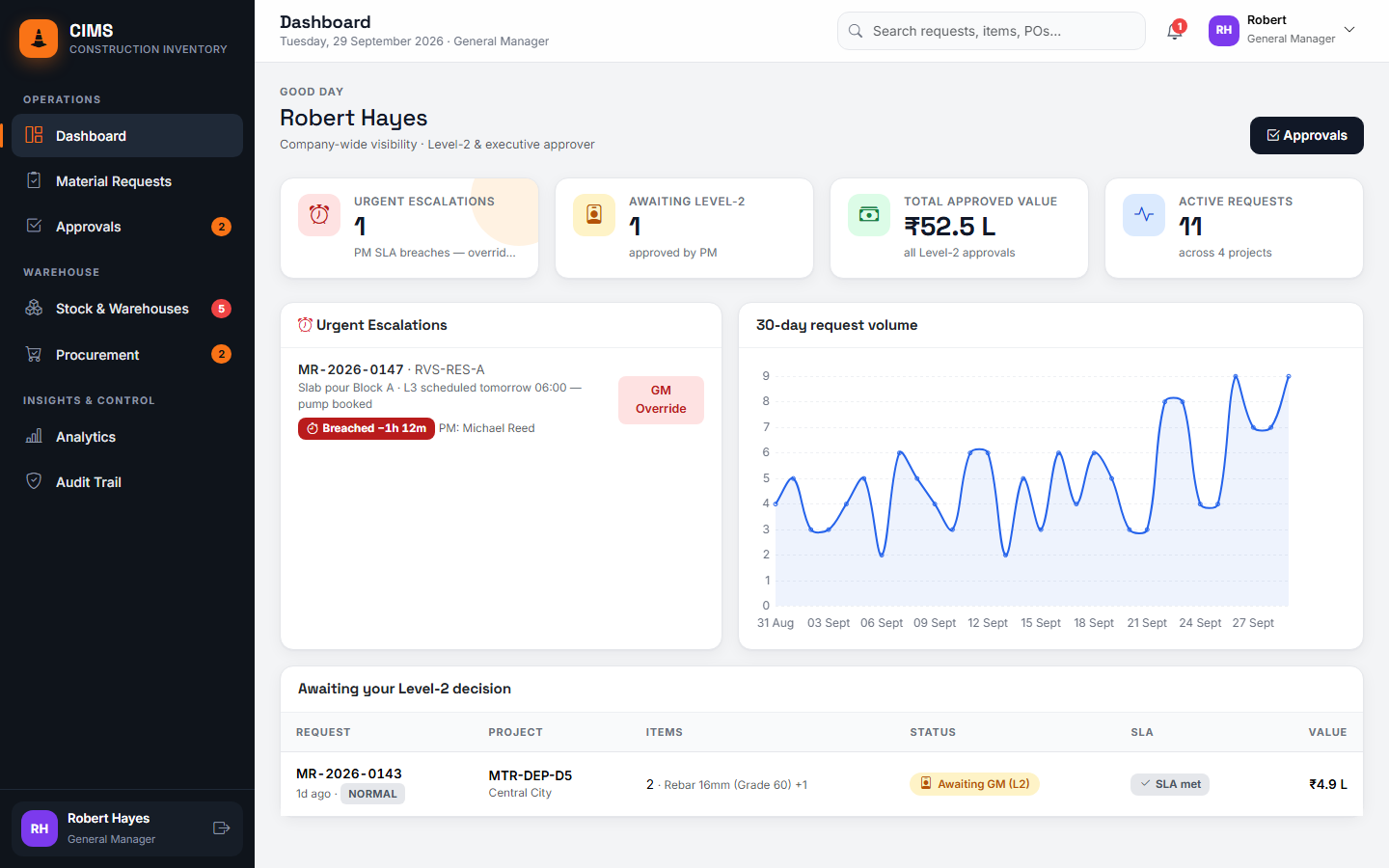 CIMS — construction inventory managementA multi-role platform with requests, approvals with SLAs, stock, dispatch and audit trail across eight role cockpits. It shows how we model permissions and workflow state — the foundations every B2B SaaS needs.Open →
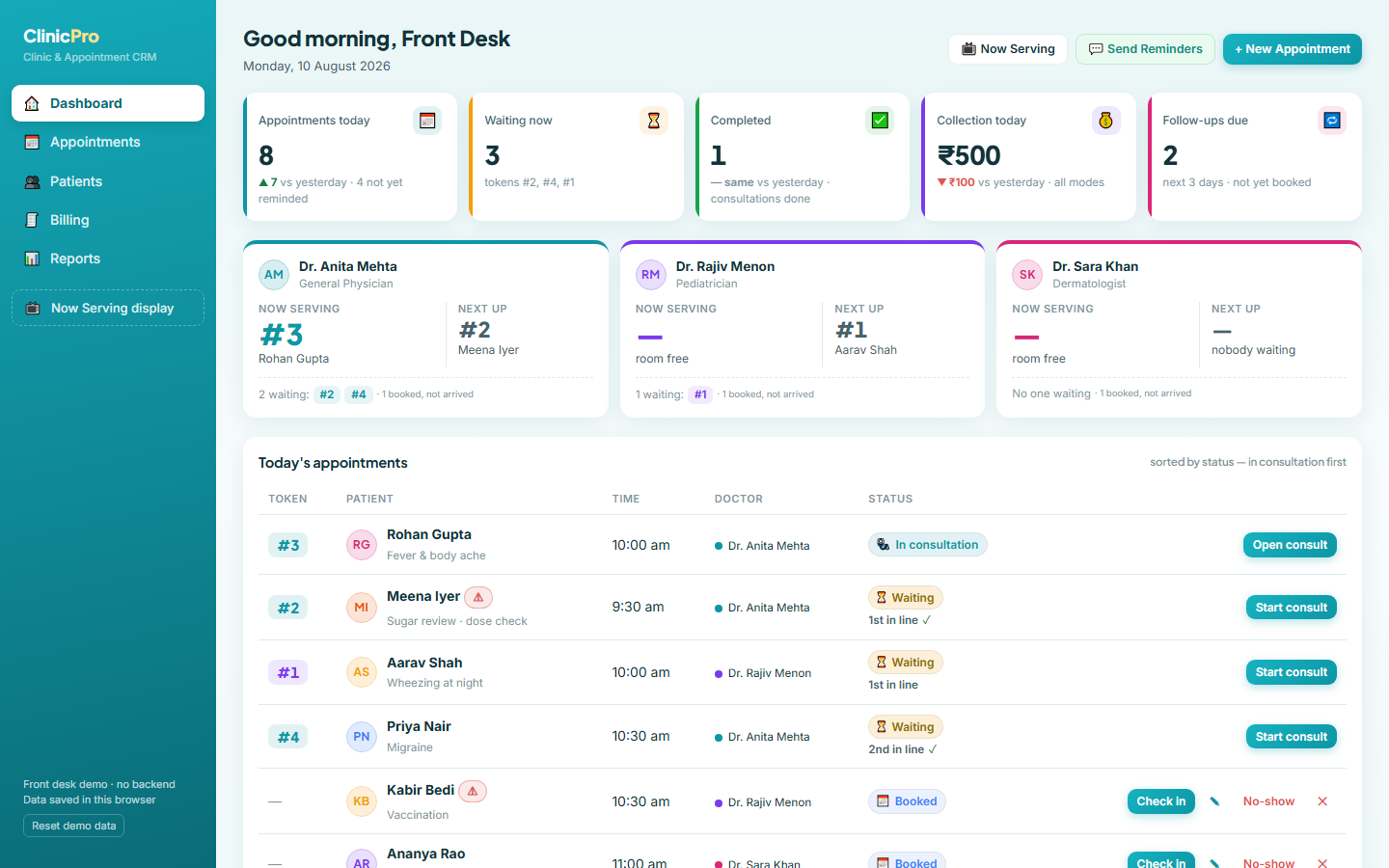 ClinicPro clinic CRMAn industry CRM built around how a clinic’s front desk and staff work. A good reference for vertical SaaS: one industry, one core workflow, done thoroughly rather than broadly.Open →
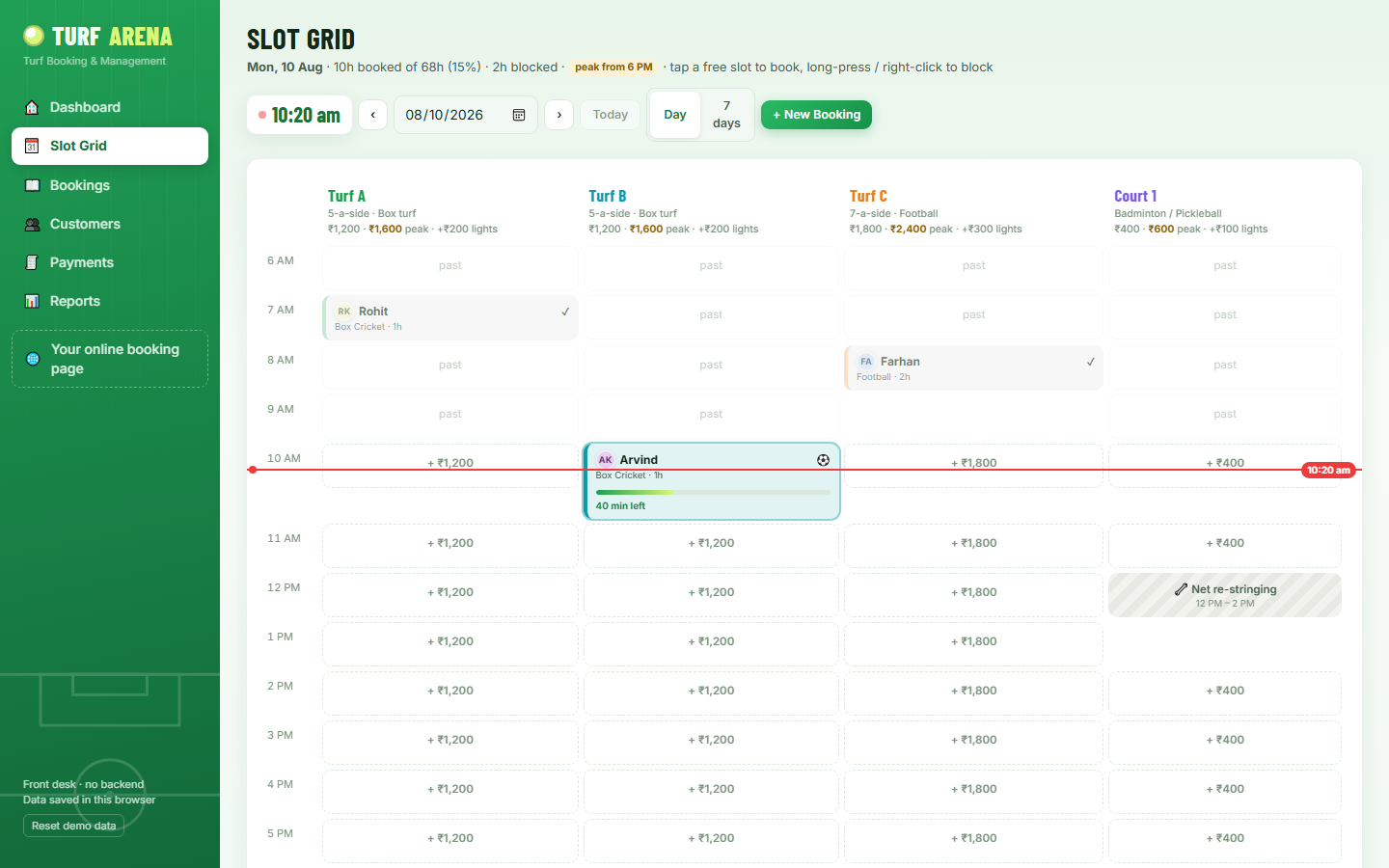 TurfArena turf booking CRMA booking product for sports turf owners. Narrow, high-frequency workflows like this are exactly the shape that makes a strong MicroSaaS with a clear buyer and a simple plan.Open →
Our stack for this work
What drives the cost of a SaaS MVP
We do not publish price lists, because two ‘SaaS MVPs’ can differ several-fold in effort. Share your scope and we send a fixed quote. These are the factors that move it most.
One sharp workflow is far cheaper than three loosely related ones. Each extra user journey adds design, backend logic, tests and support surface.
Owner and member is simple. Custom roles, approval chains and field-level permissions multiply screens, rules and test cases.
A single monthly plan is quick. Usage-based metering, per-seat pricing, multiple currencies, both Stripe and Razorpay, or GST-compliant invoicing add real work.
Each third-party system — accounting, CRM, WhatsApp, calendars, ERPs — needs auth, error handling, retries and monitoring. Poorly documented APIs cost more.
GDPR- or HIPAA-style controls, detailed audit logs, data residency or physical tenant separation increase architecture and testing effort.
LLM features need prompt design, evaluation, guardrails and per-tenant cost controls. They are worth it only when AI is central to the value.
Saas mvp development company: questions people ask
How much does a SaaS MVP cost in India?
It depends on scope, so we give a fixed quote after a scoping call instead of a range quoted blind. The biggest drivers are the number of core workflows, roles and permissions, the billing model, integrations, compliance needs and any AI features. Cutting one secondary workflow usually saves more than any rate negotiation. Send a short description on WhatsApp or email and we will reply with questions, then a written fixed quote.
How long does it take to build a SaaS MVP?
Standard SaaS MVPs take 2–8 weeks from approved scope to launch; larger or regulated products take longer. A focused MicroSaaS with one workflow and one plan sits at the short end. You see a working demo every week, so pilot conversations can start well before launch. The usual causes of delay are late scope additions, slow feedback and waiting on third-party API approvals.
What features should a SaaS MVP include?
Only what proves people will use and pay for the core workflow: sign-up and auth, tenant-scoped data, that one workflow, subscription billing, a basic admin panel and analytics events. Backups, error tracking and legal pages are non-negotiable hygiene. SSO, native mobile apps, granular permissions and most AI extras can wait until paying customers ask for them.
Can you set up Stripe and Razorpay subscription billing?
Yes. We implement Stripe Billing for global card customers and Razorpay Subscriptions with UPI AutoPay for Indian customers, or both behind one internal entitlement model. That covers trials, upgrades, downgrades, coupons, failed-payment retries, billing portals and invoices. Webhooks are verified and idempotent, and access is granted only after the provider confirms payment. More on our payment gateway integration page.
Who owns the code and IP of my SaaS product?
You do. On full payment, all source code, designs, documentation and intellectual property are assigned to your company, and we sign an NDA before you share details. Code lives in your Git repository from day one, infrastructure runs in your own cloud account and payment-provider accounts are in your name. We never reuse your proprietary business logic for anyone else.
Do you provide support after launch?
Yes. Every launch includes a stabilisation period for fixing issues found in production. After that you choose: a monthly retainer for ongoing features and monitoring, hourly support for occasional changes, or a full handover to your own developers with documentation and a walkthrough. Error tracking and uptime alerts are set up at launch, so problems are spotted early.
Should a SaaS MVP use a monolith or microservices?
A modular monolith is the right default. It is faster to build, cheaper to host and easier to debug, and a small team gains nothing from distributed services. We split the codebase into clear modules and push slow work to background queues, so any part that later needs independent scaling can be extracted cleanly. We explain why in our monolith-first article.
Is your SaaS MVP development company a fit for a MicroSaaS?
Yes, as long as the scope is genuinely micro: one user type, one workflow, one plan and minimal integrations. We reuse well-tested building blocks for auth, billing and hosting, so most of the effort goes into what makes your product different. We will also tell you when a no-code tool or an existing product would validate the idea faster than custom code.
Ready to scope your SaaS MVP?
Send a short note on what you want to build and who will pay for it. We reply with sharp questions, then a written scope and fixed quote. WhatsApp or call +91 63774 18934, or email team@ezibelltech.com.