React JS Development Company in India for SaaS and Web Apps
Ezibell Tech is a React JS development company in India building React and Next.js front ends for SaaS dashboards, customer portals and web apps — fast, accessible and SEO-ready — with Django or FastAPI back ends from the same team when you need them.
- Team in Jaipur, India
- MSME & GST registered
- Live product demos you can try
A good React JS development company in India should leave you with a front end your next developer can understand. Plenty of React apps work on launch day and become hard to change six months later: business logic buried in components, server data copied into global state, no types, no tests and a bundle that grows with every feature. We build React and Next.js applications with typed API clients, a clear split between server state and UI state, reusable components and tests on the flows that matter.
Most of our front-end work sits on a Python back end, often one we built: Django with Django REST Framework, or FastAPI. Owning both sides means API shapes are designed for the screens that use them, authentication is done properly (httpOnly cookies, CSRF protection where needed, sensible token refresh) and performance problems are fixed where they start. We also build React front ends for existing APIs in other languages, as long as they are documented or we can document them together.
Typical projects: SaaS admin dashboards with role-based access, customer and partner portals, internal tools replacing spreadsheets, Next.js marketing sites that need to rank, and rebuilds of ageing jQuery or AngularJS front ends. Ezibell Tech is MSME and GST registered, based in Jaipur and working with clients across India and worldwide. Engagements are fixed-price for a defined scope, or hourly and retainer when you want React developers embedded in your own team.
What we build with React and Next.js
SaaS dashboards and admin panels
Role-based React dashboard development: data tables that handle thousands of rows, filters saved in the URL, charts, bulk actions, CSV exports and audit trails, built with TanStack Query and TanStack Table so server data stays fresh without hand-written caching.
Customer and partner portals
Self-service portals for orders, bookings, invoices, documents and support tickets, with secure login, multi-tenant data separation enforced by the API rather than the browser, file uploads, and notifications by email or WhatsApp, so your team answers fewer ‘where is my order’ calls.
Next.js development for sites that rank
Marketing sites, content hubs and product pages rendered on the server or statically, with clean metadata, structured data, sitemaps and healthy Core Web Vitals, so Google sees full content rather than an empty JavaScript shell.
React front ends on existing APIs
A modern interface for an API you already run, whether Django, FastAPI, Node, Java or .NET. Where possible we generate a typed client from your OpenAPI spec, and we fill documentation gaps together with your team.
React + Django or FastAPI, full stack
One team owning UI, API and database: endpoints designed around the screens that use them, permissions checked on the server, background jobs in Celery, and front end and back end deployed from a single pipeline. Fewer hand-offs, faster changes.
AI features in the interface
Streaming chat interfaces, copilots inside your product, document Q&A with citations, and forms that fill themselves from uploaded files, built on our RAG and agent back ends with clear loading, error and thumbs-up/down feedback states.
Accessibility and performance fixes
Audits and fixes for existing React apps: keyboard navigation, focus management, screen-reader labels and colour contrast against WCAG 2.2 AA, plus route-level code splitting, image optimisation and render profiling for slow screens, with before-and-after measurements.
Front-end modernisation
Incremental migration from jQuery, AngularJS, class components or Create React App to modern React with TypeScript on Vite or Next.js, screen by screen, with old and new running side by side so feature work continues during the move.
React vs Next.js: which does your project need?
React is a UI library; Next.js is a framework built on it that adds routing, server rendering, static generation and server-side code. For a logged-in dashboard where every page is personal and nothing needs to rank, a plain React single-page app built with Vite is simple, quick to develop and easy to host as static files behind a CDN. Adding Next.js there brings server infrastructure you don’t need.
For anything public — marketing pages, docs, listings, a marketplace, a blog — Next.js is usually the right call. Pages can be generated statically or rendered on the server, so search engines and social previews see real content and first load is fast on mid-range phones. Many products end up with both: a Next.js public site and a React app behind login, sharing a component library and an API client.
- Logged-in dashboard or internal tool: React with Vite
- Public, content-led or SEO-dependent pages: Next.js
- Public site plus app: Next.js for the site, shared components for the app
- Heavy business logic already in Django or FastAPI: keep it there rather than duplicating it in Next.js API routes
Are React sites SEO-friendly? Only if rendered right
A client-only React app sends the browser an almost empty HTML page and builds the content with JavaScript. Google can render JavaScript, but rendering is deferred and less dependable, many other crawlers and link previews see nothing, and slow devices show a blank screen first. That is why single-page marketing sites often underperform in search even when the content is good.
With Next.js we choose a rendering mode per page: static generation for pages that rarely change, incremental regeneration for catalogues and listings, and server rendering for content that must be fresh. We add per-page titles and descriptions, canonical URLs, structured data, image optimisation and sitemaps, and we watch Core Web Vitals — Largest Contentful Paint, Interaction to Next Paint and Cumulative Layout Shift — because they affect both rankings and conversions.
Front-end architecture that stays maintainable
Most React codebases become painful for the same reason: server data is copied into global stores and kept in sync by hand. We keep server state in TanStack Query, which handles caching, refetching and invalidation, and use component state or a small store such as Zustand only for genuine UI state. Forms use React Hook Form with schema validation that matches the API types, and TypeScript runs everywhere in strict mode.
Components are built as a small design system — buttons, inputs, tables, modals — documented and reused, so new screens are assembled rather than reinvented. Tests focus on behaviour: React Testing Library for components and Playwright for critical journeys such as sign-up, checkout and permissions. Performance work is driven by measurement: code splitting by route, virtualised long lists, and memoisation only where the profiler shows a real problem.
- TypeScript strict mode and a generated API client
- TanStack Query for server state, minimal global state
- Shared component library with accessibility built in
- Playwright tests on revenue and permission flows
- A bundle-size budget checked in CI
How we work
- 1Discovery
We review users, roles, key screens, the API (existing or planned) and SEO needs, then recommend React, Next.js or both, with a written scope and a fixed quote.
- 2UX and design system
Wireframes for core flows, then a visual design and a small component library in your brand, so screens stay consistent as the product and the team grow.
- 3API contract
We agree endpoints and data shapes with the back-end team — ours or yours — and generate typed clients, so front end and back end are built in parallel.
- 4Build in short cycles
Features reach a staging URL every week or two, with a preview deployment for each change so you can review it, and your feedback folded into the next cycle.
- 5Quality pass
Automated tests, accessibility checks, performance budgets and cross-browser and mobile testing run before each release, not only at the end of the project when fixes cost more.
- 6Launch and support
Production deployment with error tracking and analytics in place, followed by post-launch support and monitoring, or a retainer if you want us to keep building features.
Why teams choose us
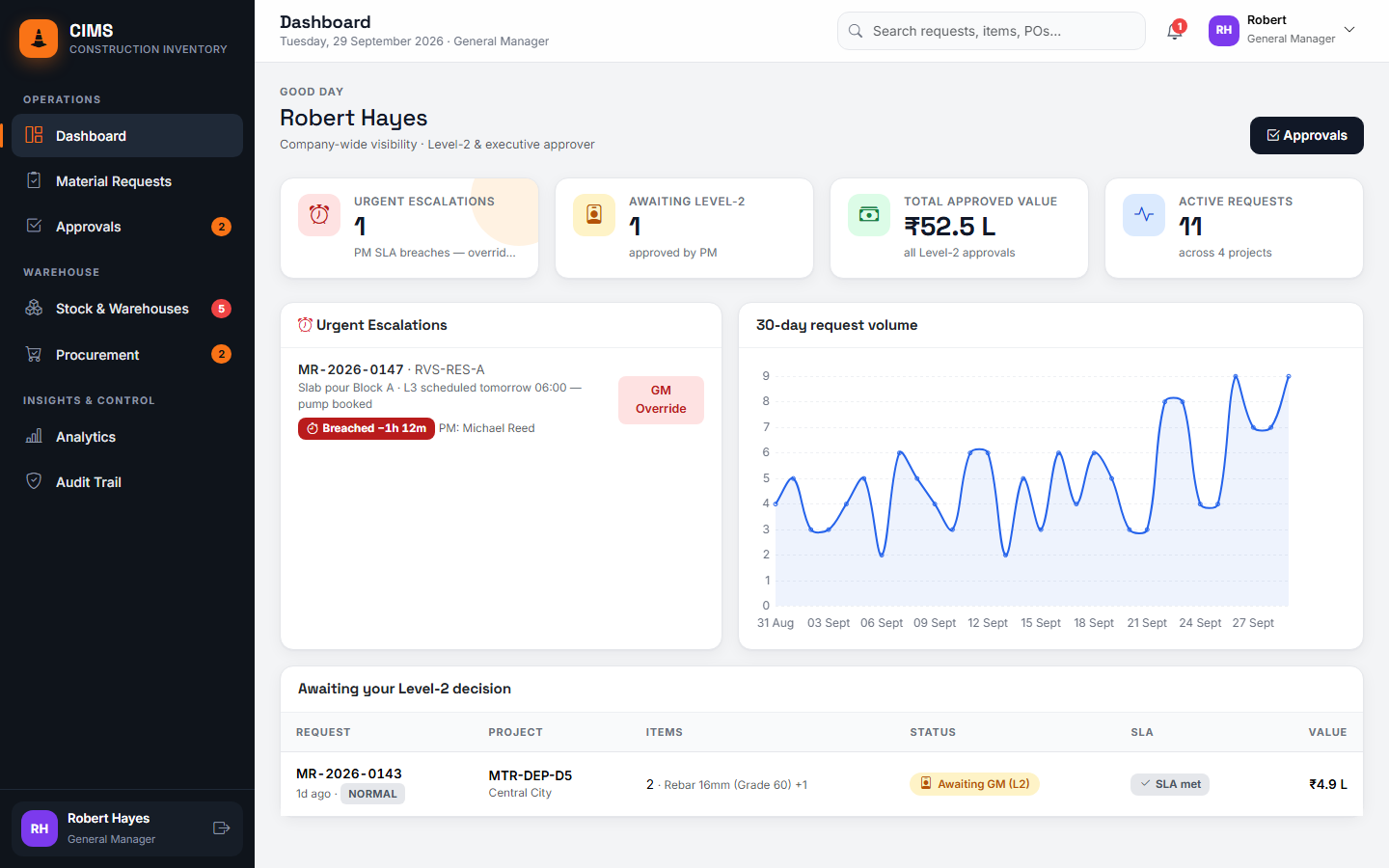 CIMSEight role cockpits, from requesters to project and general managers, with approvals, SLAs, stock and audit — a good look at how we design role-based dashboards for complex workflows.Open →
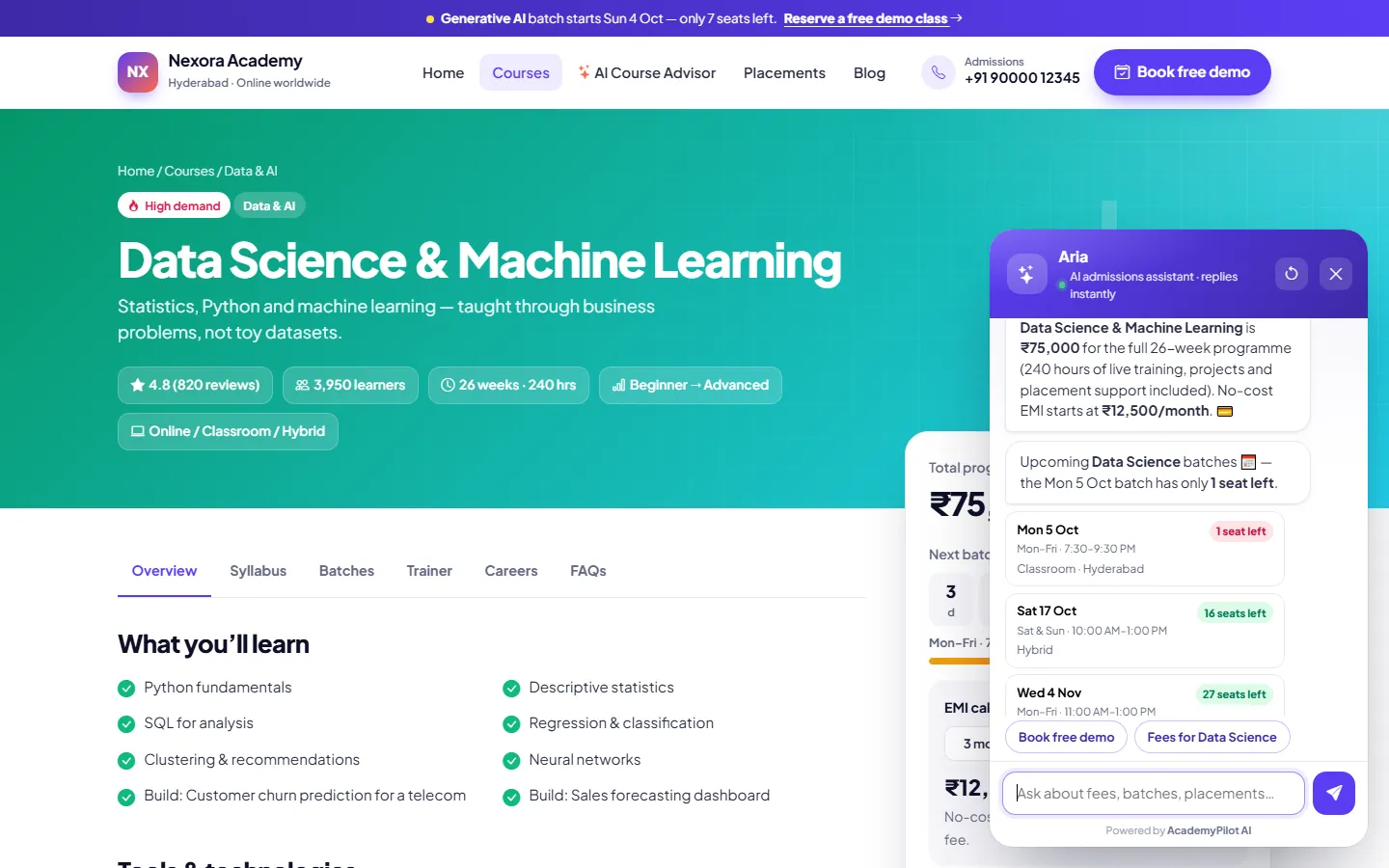 AcademyPilotAn AI website plus a lead CRM with AI scoring and an AI blog writer, showing how we combine public, SEO-led pages with a logged-in operator dashboard in one product.Open →
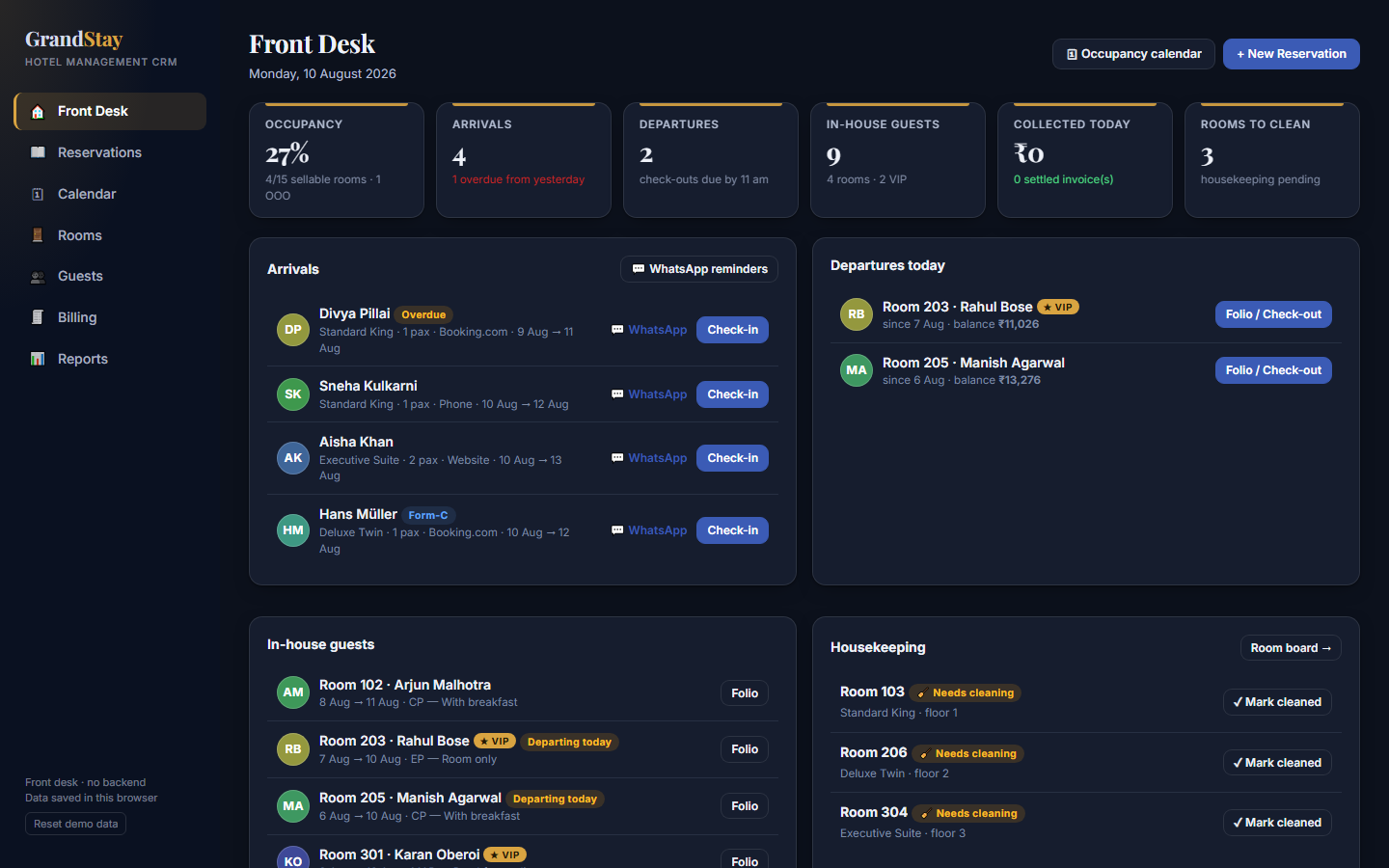 GrandStayA hotel management CRM demo with dense, data-heavy operator screens — the kind of admin interface we design for SaaS products, where clarity matters more than decoration.Open →
Our stack for this work
Cost of hiring a React JS development company in India
We quote per project rather than from a rate card, because React work varies widely. These factors decide the effort; send your screens or requirements and we reply with a fixed quote, or an hourly estimate for ongoing work.
Each distinct screen, and each user role with different permissions, adds design, build and test effort.
Large tables, live updates, complex filters, bulk edits and exports take more work than read-only pages.
A logged-in SPA is simple to host; public Next.js pages with SEO, structured data and caching need more setup.
A documented, stable API speeds things up. A missing or shifting API means back-end work alongside the front end.
Working within an existing design system is quicker than a bespoke brand system with custom components and motion.
A senior developer on a short project and a dedicated developer by the month are priced differently; we recommend what the scope needs.
React js development company india: questions people ask
Should we use React or Next.js?
Use plain React with Vite for logged-in dashboards and internal tools where nothing needs to rank on Google. Use Next.js for public, content-led pages — marketing sites, listings, docs, marketplaces — where server rendering or static generation helps SEO and first load. Many products use both, sharing components and an API client. We recommend after looking at your pages, not before.
Can you build a React front end on our existing API?
Yes. We build React front ends for Django, FastAPI, Node, Java, .NET and other APIs. If you have an OpenAPI spec we generate a typed client; if not, we document the endpoints with your team first. Where the API is missing something the screens need, we propose small API changes rather than working around the gap in the browser.
Are React websites SEO-friendly?
They can be, if rendered correctly. A client-only React app gives crawlers an almost empty page and relies on JavaScript rendering, which is slower and less dependable. With Next.js we use static generation or server rendering so search engines see full content, add metadata, structured data and sitemaps, and keep Core Web Vitals healthy.
How much does it cost to hire a React developer in India?
It depends on seniority, engagement model and scope, so we don’t quote a flat rate. A fixed-price project, a dedicated developer by the month and hourly support are priced differently, and Next.js, complex dashboards or AI features need more senior people. As a React JS development company in India, we send a fixed quote or monthly rate once we understand your needs.
Do you build admin dashboards and SaaS UIs?
Yes, it is a core part of our React work. We build role-based dashboards with large data tables, saved filters, charts, bulk actions, exports, audit logs and multi-tenant views, connected to Django or FastAPI back ends. Permissions are enforced on the server and reflected in the UI, so users only see what they are allowed to change.
How do you handle performance and accessibility?
Both are built in rather than bolted on. We set a bundle budget, split code by route, optimise images, virtualise long lists and profile slow screens before optimising. For accessibility we use semantic HTML, keyboard navigation, focus management, labels and contrast checks against WCAG 2.2 AA, tested with automated tools and a screen reader.
Can you modernise our old front end?
Yes. We migrate jQuery, AngularJS, older React with class components and Create React App projects to modern React with TypeScript, on Vite or Next.js. We usually work screen by screen, running old and new side by side, so your team keeps shipping features while the migration progresses.
Can we hire React developers to join our team?
Yes. Alongside fixed-price projects we offer React developers on hourly or monthly engagements, working in your repository, tools and stand-ups. You can interview the developer before they start, and our team leads review code and stay involved, so quality doesn’t depend on one person.
Discuss your React project
Share your screens, Figma file or requirement document on WhatsApp (+91 63774 18934) or at team@ezibelltech.com. We’ll recommend React, Next.js or both and send a fixed quote.