AWS DevOps Consulting Services: CI/CD, Serverless, Cost Control
Our AWS DevOps consulting services give startups and SMEs a cloud setup they can trust: automated CI/CD pipelines, Docker or serverless deployments, least-privilege security, monitoring that alerts the right person, and an AWS bill you actually understand — for teams in India and abroad.
- Team in Jaipur, India
- MSME & GST registered
- Live product demos you can try
Most teams don’t need a platform team; they need AWS set up properly once and a pipeline that makes deploying boring. Our AWS DevOps consulting services start with an audit of what you already run — accounts, IAM, networking, databases, deployments and the bill — and end with infrastructure defined as code, deployments triggered by a merge, and dashboards showing what is healthy and what costs money. We fix the risky things first: open security groups, shared root credentials, untested backups and manual deploys over SSH.
We are a Python-first engineering company, so we also understand the applications running on the infrastructure: Django and FastAPI services, Celery workers, scheduled jobs, LLM workloads and data pipelines. That matters, because many AWS problems are really application problems — a chatty ORM driving database cost, a missing queue causing timeouts, logs nobody set a retention period on. We work across ECS on Fargate, Lambda and Step Functions, RDS, DynamoDB, S3, CloudFront and Bedrock, and on Azure and GCP when that is where you are.
Typical clients are startups whose first developer set up AWS in a hurry, SMEs moving off shared hosting or a single VPS, and product teams whose cloud bill has grown faster than their revenue. Everything we build runs in AWS accounts owned by your company and is defined in a repository you own, so our recommendations are about your bill and your risk, and you can run the setup without us whenever you choose.
What our AWS DevOps consulting services include
AWS account and cost audit
A written review of your accounts, IAM, networking, security groups, backups and bill, with every finding ranked by risk and potential saving. You get a prioritised fix list you can action with us or with your own team.
CI/CD pipeline setup
GitHub Actions, GitLab CI or AWS CodePipeline pipelines that run tests, build Docker images, push to ECR, run database migrations safely and deploy with rolling or blue/green releases — authenticated through OIDC roles instead of long-lived access keys.
Docker and ECS on Fargate
Containerising Django, FastAPI and worker processes into lean, reproducible images, then running them as ECS services on Fargate behind a load balancer, with autoscaling, health checks and zero-downtime deploys. Docker deployment without servers to patch, and the same image locally and in production.
AWS serverless development
Lambda, API Gateway, Step Functions, SQS, EventBridge and DynamoDB for event-driven and spiky workloads: file processing, webhooks, scheduled jobs and AI pipelines that cost very little when idle and scale without capacity planning. Packaged and deployed through the same pipeline as everything else.
AWS cost optimisation
Rightsizing, Graviton instances, Savings Plans, storage lifecycle rules, log retention, NAT and data-transfer fixes, idle-resource clean-up and scheduled shutdown of non-production environments, plus budgets and anomaly alerts so surprises are caught in days rather than at month end.
Cloud migration
Moves from shared hosting, a single VPS, on-premise servers or another cloud to AWS: inventory, target architecture, rehearsed data migration, a DNS cutover plan and a tested rollback path, keeping downtime to a planned window.
Security hardening
IAM least privilege, SSO and MFA for your team, secrets in Secrets Manager or Parameter Store, databases in private subnets, encryption at rest, CloudTrail and GuardDuty, and backups that have actually been test-restored. Each change is documented so your team knows why it exists.
Monitoring and support
CloudWatch dashboards and alarms, structured logs, tracing, uptime checks and error tracking with Sentry, routed to the right person instead of a shared inbox nobody reads. An optional monthly retainer covers patching, incidents, cost reviews and pipeline changes.
Where AWS bills actually leak
AWS bills tend to leak in the same few places, and they are rarely the big compute line everyone stares at. NAT Gateways charge for every gigabyte they process, so containers pulling images or calling S3 through a NAT can cost more than the containers themselves; VPC endpoints often fix that. CloudWatch log groups without a retention policy grow forever. Old EBS snapshots, unattached volumes, idle load balancers and public IPv4 addresses all bill quietly every hour.
Then come the structural savings. Development and staging environments rarely need to run at night and over weekends. Many workloads run happily on Graviton (ARM) instances at a lower price. Once usage is steady, Compute Savings Plans cut the cost of the baseline without locking you to an instance type. Databases are often oversized ‘to be safe’, so we size from actual metrics. And tagging every resource by product and environment is what turns the bill from a mystery into a report.
- Turn on Cost Explorer, budgets and cost anomaly detection on day one
- Tag by environment, product and owner, and enforce it in code
- Check NAT Gateway and data-transfer lines before touching compute
- Set retention and lifecycle rules for every log group and S3 bucket
- Commit to Savings Plans only once usage is stable
Serverless or containers? A decision guide
Lambda is excellent for event-driven, bursty or low-traffic work: webhooks, file and image processing, scheduled jobs, queue consumers and glue between services. You pay per request and duration, scale to zero and never patch a server. The trade-offs are cold starts, a hard limit on execution time, awkward local development and costs that climb under sustained heavy traffic. Step Functions add reliable orchestration for multi-step jobs with retries, waits and human approvals.
Containers on ECS Fargate suit long-running web apps, steady traffic, WebSockets, background workers and anything with heavy dependencies — a typical Django or FastAPI monolith, for example. The same image runs on a laptop and in production, which makes debugging easier. Many sound designs are hybrid: the core app on Fargate, with Lambda handling events around it. For small teams we rarely recommend Kubernetes; ECS delivers most of the benefit with far less to operate.
- Spiky, event-driven or mostly idle: Lambda
- Steady web traffic or long-running processes: ECS on Fargate
- Multi-step workflows with retries and waits: Step Functions
- Large team, many services and existing Kubernetes skills: then consider EKS
CI/CD for existing projects without a big-bang rewrite
Most pipeline work happens on projects that already exist and are deployed by hand. We don’t stop feature work to rebuild everything. First we containerise the app and get the same build running locally and in CI. Then we wire in the tests that already exist (or a thin smoke-test suite if none do), a build that produces one versioned artefact, and a deployment to a staging environment that mirrors production.
Production comes last, with guard rails: database migrations run as a separate step and are written to be backward compatible, health checks stop a bad release before it takes traffic, and rollback to the previous image is one click. Credentials move out of the repository into Secrets Manager, CI authenticates to AWS with short-lived OIDC roles, and infrastructure is captured in Terraform or AWS CDK so environments are rebuilt from code rather than from memory.
How we work
- 1Audit
With read-only access to your AWS accounts and repositories, we review security, architecture, deployments and recent billing, and deliver a written report with ranked findings.
- 2Plan and quote
We agree the target setup — containers, serverless or hybrid — the migration or pipeline steps, and a fixed quote. Quick wins such as cost leaks and exposed credentials are scheduled first.
- 3Infrastructure as code
Networking, compute, databases, IAM and monitoring defined in Terraform or AWS CDK, reviewed in pull requests like application code and applied to staging before production.
- 4Pipeline and cutover
CI/CD is built and proven on staging; production cutover happens in a planned window with rollback ready. For migrations, data moves are rehearsed and DNS TTLs lowered in advance.
- 5Observe and tune
Dashboards, alarms and budgets go live. Over the following weeks we tune autoscaling, rightsize from real metrics and confirm the bill is moving in the right direction.
- 6Hand over or retain
Runbooks, an architecture diagram and an access review go to your team, with a walkthrough. An optional monthly retainer covers monitoring, patches, incidents and regular cost reviews.
Why teams choose us
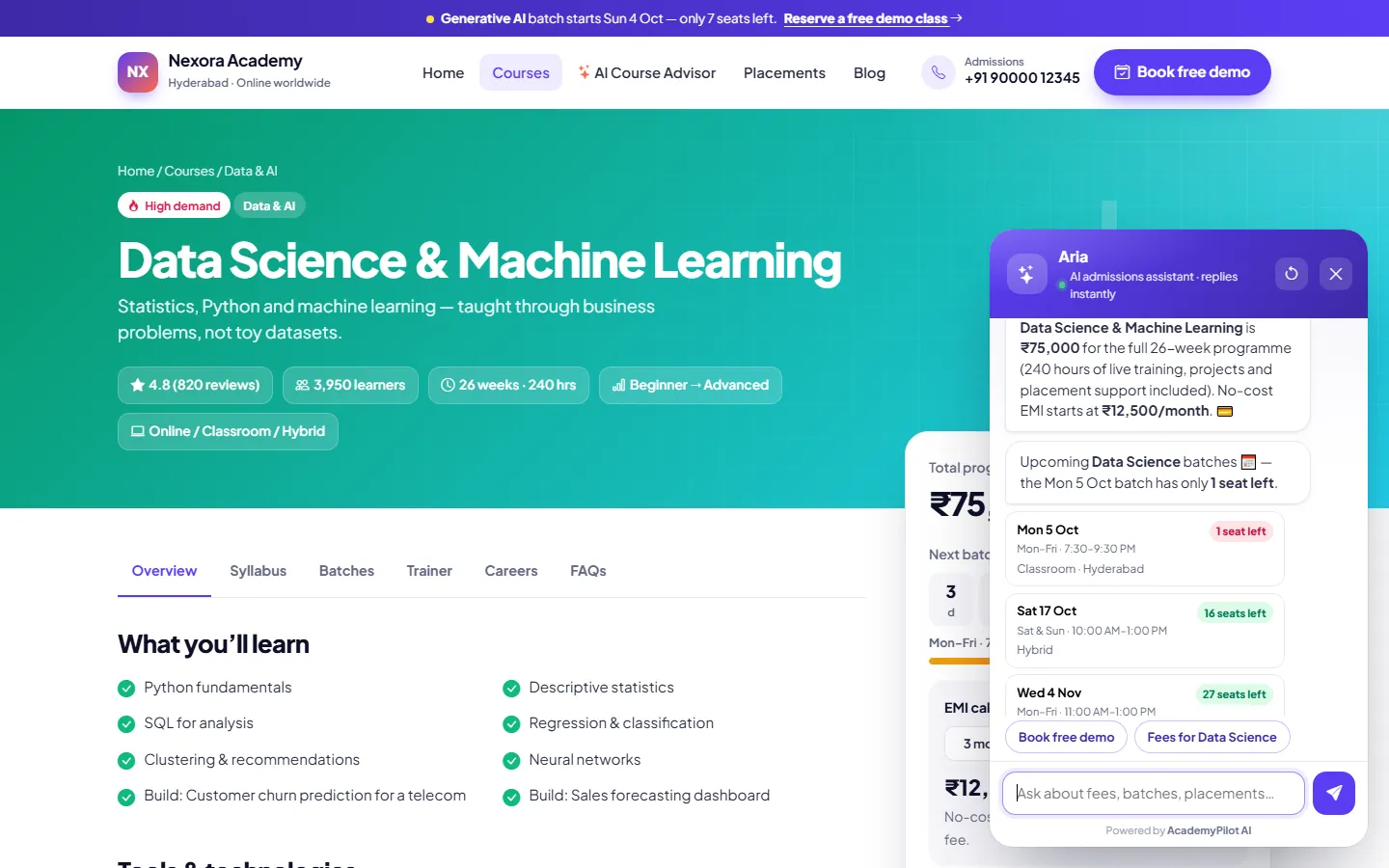 AcademyPilotAn AI website with an admissions chatbot, lead CRM and AI blog writer — the mix of web app, background jobs and LLM calls that needs queues, secrets management and cost-aware hosting.Open →
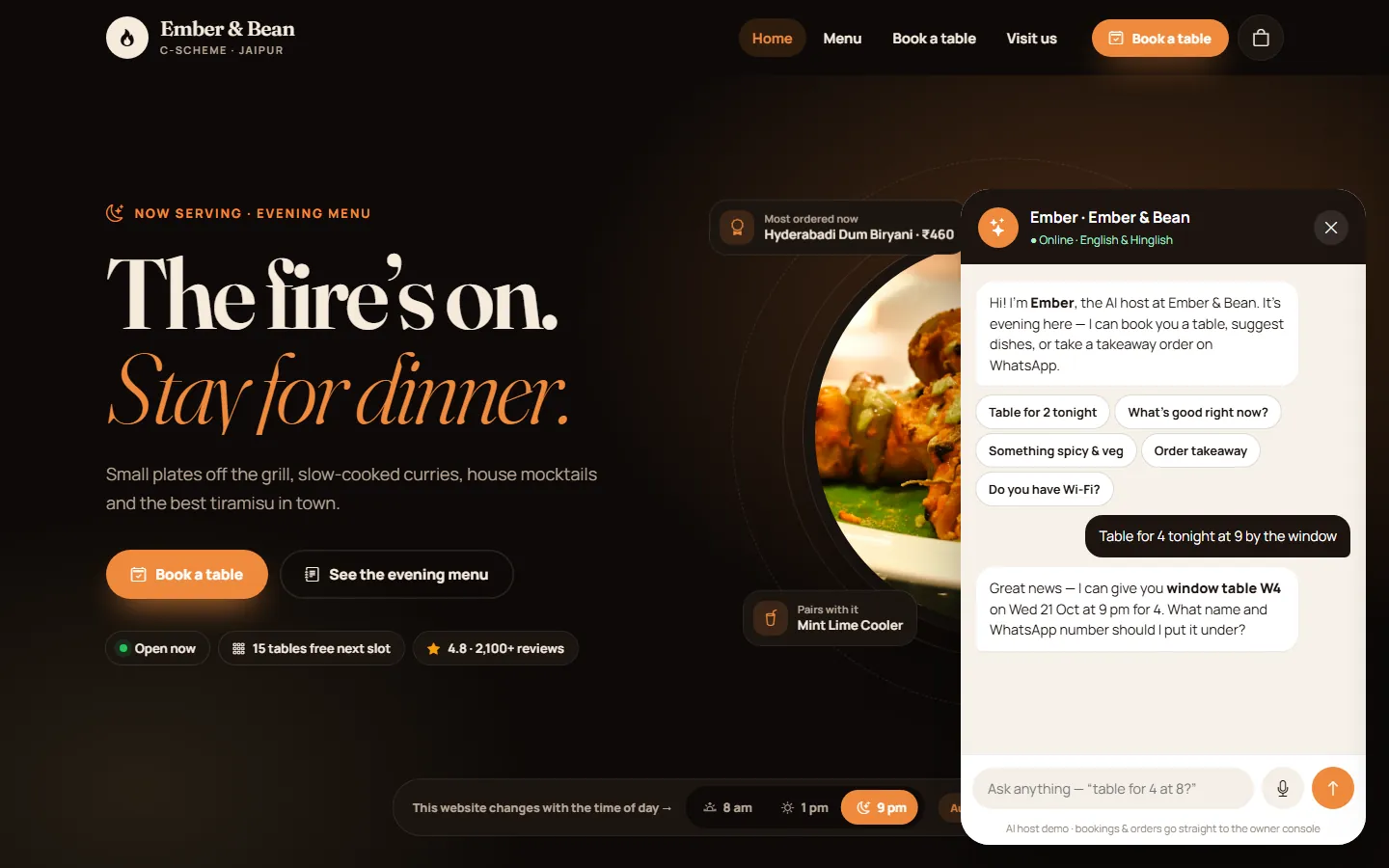 DinePilotA time-aware restaurant website with an AI host and owner console. Live bookings and WhatsApp orders are the kind of webhook-driven workload where serverless and containers work side by side.Open →
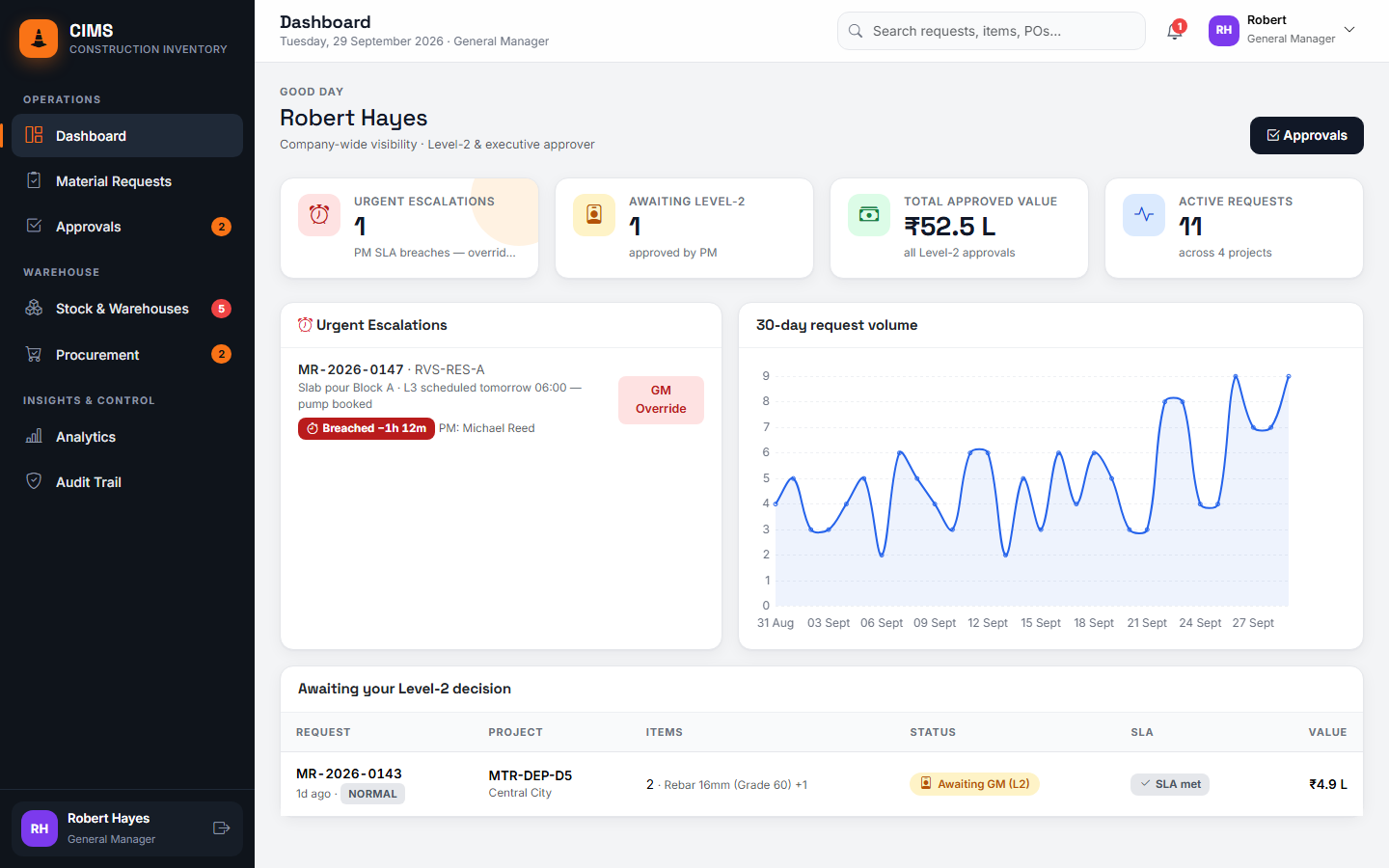 CIMSConstruction inventory with approvals, SLAs, stock and audit across eight roles — a typical multi-role business application that depends on reliable deployments, backups and an audit trail.Open →
Our stack for this work
What drives the cost of AWS DevOps work
Our fees depend on the state of what you have and how far you want to go. An audit is a small, fixed piece of work; a full migration is a project. Share your setup and we send a fixed quote.
A single app on one server is quicker to move than several services with undocumented manual steps and no staging environment.
Each service, worker and environment — development, staging, production — adds pipeline, configuration and testing work.
Large databases, zero-downtime requirements and very large file stores need rehearsal and a careful cutover.
Multi-account setups, audit logging, encryption requirements and GDPR or HIPAA-style controls add design and review time.
Business-hours support with monthly reviews costs less than tight response times and out-of-hours incident cover.
Aws devops consulting services: questions people ask
How can we reduce our AWS bill?
Start with visibility: tag resources, turn on budgets and anomaly detection, and read the bill by service. The quickest savings usually come from NAT Gateway and data-transfer fixes, idle resources, log retention and switching off non-production environments out of hours. Then rightsize from real metrics, move suitable workloads to Graviton and buy Savings Plans for the stable baseline. Our audit ranks each saving by effort.
Can you set up CI/CD for an existing project?
Yes — that is the common case. We containerise the app, run your existing tests or add smoke tests, build a versioned image and deploy to staging, then add production with backward-compatible migrations, health checks and one-click rollback. Feature work continues in parallel, so there is no big-bang rewrite or freeze.
Should we use serverless or containers?
Use Lambda for event-driven, spiky or mostly idle workloads such as webhooks, file processing and scheduled jobs. Use containers on ECS Fargate for steady web traffic, long-running processes, WebSockets and typical Django or FastAPI apps. Many good architectures combine both. Kubernetes is rarely worth its operating cost for a small team.
Can you migrate us from shared hosting or another cloud to AWS?
Yes. We inventory everything you run, design the AWS target, rehearse the data migration, lower DNS TTLs ahead of time and cut over in a planned window with a tested rollback path. Moves from shared hosting, a VPS, on-premise servers, Azure or GCP follow the same method; effort depends mainly on data size and how much downtime you can accept.
Do you provide monitoring and ongoing support?
Yes. We set up CloudWatch dashboards and alarms, structured logging, error tracking and uptime checks routed to the right people. After launch you can keep us on a monthly retainer for monitoring, patching, incident response, pipeline changes and regular cost reviews, or take over with our runbooks and architecture notes.
How do you handle AWS security?
We start with the basics attackers look for first: no day-to-day root account use, MFA and SSO for every person, IAM roles with least privilege, short-lived credentials for CI, secrets in Secrets Manager or Parameter Store rather than code, databases in private subnets, encryption at rest, CloudTrail logging and GuardDuty alerts. Then we prove that backups actually restore.
What do your AWS DevOps consulting services start with?
An audit. With read-only access we review your accounts, IAM, networking, deployments, backups and recent bills, and deliver a written report with findings ranked by risk and saving. Some teams fix the top items themselves; others ask us to implement. Either way, you know exactly where you stand before committing to a larger project.
Do we need Kubernetes?
Probably not yet. Kubernetes on EKS makes sense for larger teams running many services with dedicated platform engineers. For most startups and SMEs, ECS on Fargate or Lambda delivers autoscaling, zero-downtime deploys and isolation with far less to operate and upgrade. Our article on why Kubernetes is not a strategy explains the trade-off in detail.
Get your AWS bill and pipeline audited
WhatsApp or call +91 63774 18934, or email team@ezibelltech.com. Tell us what you run on AWS today and what worries you — cost, security or deployments — and we’ll propose an audit with a fixed quote.