AI Agent Development Company for Real Business Workflows
We are an AI agent development company that builds agents which do work, not just chat: read the email, check the CRM, draft the reply, update the ticket and ask a person before anything irreversible. Typed tools, approval steps, audit logs and evaluations come as standard.
- Team in Jaipur, India
- MSME & GST registered
- Live product demos you can try
As an AI agent development company, we build software that takes a goal, decides which steps to take, calls your systems through tools and reports back, all within guardrails on what it is allowed to do. That is different from a chatbot, which answers questions, and from classic automation, which follows a fixed script. Agents earn their keep in the messy middle: inboxes, ticket queues, lead qualification, invoice matching, report preparation. This is work that needs judgement on unstructured input but follows rules your team could write down.
The uncomfortable truth about custom AI agents is that most failures are not model failures. They come from vague goals, tools with far too much permission, no definition of done, no way to replay what went wrong and no human in the loop where the stakes are high. We design agents the way we design any production system: explicit state, typed tool contracts, idempotent actions, retries, timeouts and budgets. The LLM decides only where judgement is genuinely needed, and deterministic steps stay deterministic.
We are an AI automation agency in India with senior Python engineers, working with teams across India and worldwide on fixed-price, hourly or retainer terms. Most engagements start with one workflow, ideally the boring, high-volume one, proven against a measured baseline and then extended. You own the code and the infrastructure in your AWS, Azure or GCP account, and your data is never used to train public models. Standard projects run 2–8 weeks; larger multi-system programmes take longer.
Custom AI agents we build
Support and inbox agents
Agents that triage emails and tickets, detect intent and urgency, pull order or account data, draft replies grounded in your policies and route the rest. Low-risk categories can be resolved automatically; refunds, escalations and anything customer-visible can wait for one-click human approval.
Sales ops and lead agents
Enrich and qualify inbound leads, update CRM fields, draft personalised follow-ups, book meetings and turn call notes into structured CRM records. Scoring rules stay visible and editable, so your sales team understands why a lead was ranked hot instead of trusting a black box.
Back-office and finance agents
Extract data from invoices, purchase orders and statements, match it against your ERP or accounting records, flag exceptions with the evidence attached and prepare reconciliation reports. Nothing is posted to your books without a person approving it, and every decision is logged.
AI workflow automation (n8n or code)
For deterministic glue such as a webhook in, a transform and a push to a sheet or CRM, we use n8n or plain Python with Celery and add an LLM step only where language understanding is needed. We choose the tool on volume, testability and who will maintain it.
MCP servers and tool integrations
We expose your CRM, ERP, databases and ticketing system as Model Context Protocol servers with narrowly scoped, typed tools. Your own agents, Claude and other MCP-aware assistants can then use them safely, with authentication, rate limits and a log of every call.
Multi-step and multi-agent systems
LangGraph workflows with planner and worker roles, research agents and long-running document pipelines. State is checkpointed so runs survive failures and resume after human approval. We split work across several agents only when the separation genuinely improves reliability, not because it looks impressive.
Agent evaluation and observability
Tracing of every step, tool call, token and rupee spent; evaluation datasets built from real cases; dashboards for success rate, cost per run and failure types. If you already run agents that misbehave, we audit the traces and fix the root causes.
How an AI agent development company should architect agents
An agent is a loop of model, tools and state. We model that loop as an explicit graph in LangGraph with named nodes such as intake, classify, retrieve, act, approve and report, rather than one giant prompt that is told to figure it out. State is persisted in PostgreSQL, so a run can pause for human approval or recover from a crashed worker without starting over. Every tool has a typed schema validated with Pydantic, separates reads from writes and accepts an idempotency key, so a retry never sends the same email or refund twice.
MCP, the Model Context Protocol, is a standard way to expose tools and data to models. Build an MCP server for your CRM once and any compliant agent can use it. But MCP is a transport, not a security model: authentication, per-user scoping and rate limits are still our job. For hosting we choose between FastAPI with Celery workers, AWS Step Functions and Lambda for long-running orchestrations, or Bedrock AgentCore when you want a managed runtime, memory and identity inside AWS.
- If a step can be written as an if-statement, it should be one
- Give each tool the narrowest permission: read-only by default, writes behind approval
- Cap steps, tokens and spend per run, and fail loudly rather than silently
- Make every write idempotent so retries cannot double-charge or double-email
- Prefer one capable agent with good tools over a swarm of chatty agents
Human-in-the-loop design: autonomy is a dial, not a switch
We rarely launch an agent fully autonomous. It starts as a copilot: the agent prepares the action and a person approves, edits or rejects it. We record the approval and edit rate per category. Where people approve unchanged almost every time, we turn the dial towards autopilot. Where money moves, legal commitments are made or a customer would see a mistake, approval usually stays permanently. You get automation quickly without betting on the model being right every time.
Approval is a product design problem. The reviewer sees the proposed action, the evidence the agent used and a clear diff of what will change, then acts in one click from Slack, email, WhatsApp or a web console. Every decision is captured and becomes evaluation data for the next iteration. Escalation rules route low-confidence cases, unknown intents and frustrated customers straight to a person, and the audit log records who or what did each thing, when, with which inputs and why.
- Copilot first, autopilot per category once the data supports it
- Approval cards that show evidence and the exact change
- Confidence thresholds and escalation rules for edge cases
- Complete audit trail of inputs, tool calls, outputs and approvers
Evaluation, observability and measuring ROI
Agents need tests like any other software. We build datasets of real cases with expected outcomes and evaluate both the final result and the trajectory: did it call the right tools, in a sensible order, without touching anything it should not? LLM-as-judge scoring is calibrated against human reviews before we trust it. The suite runs on every prompt, tool or model change, so improvements in one category cannot silently break another.
In production every run is traced end to end, with cost, latency, tool errors and a failure taxonomy that tells us what to fix next. ROI starts before the build: we baseline handling time, volume, error rate and the cost of errors for the target workflow, then measure the same things after launch with the same definitions. Running costs (tokens, infrastructure and human review time) go into the calculation, so the business case is honest.
How we work
- 1Workflow selection
We map candidate processes by volume, rule clarity, data access and risk, then pick the first workflow where an agent can show measurable value quickly and safely.
- 2Baseline and design
We measure the current process, define what done and correct mean, list the tools and permissions needed, and decide where humans approve. This becomes the agent specification and test plan.
- 3Tools and integrations
We build typed, scoped tools or MCP servers for your CRM, ERP, email, WhatsApp and databases, with sandbox credentials first and production access only after review.
- 4Agent build and evaluation
We implement the graph, prompts and guardrails, then run them against the evaluation set until both outcomes and tool-use trajectories meet the bar we agreed with you.
- 5Supervised launch
The agent goes live in copilot mode with approvals, tracing and alerts. We review real runs with your team daily at first and tune quickly.
- 6Expand autonomy and scope
With real usage data in hand, we raise autonomy where it is safe, extend the agent to neighbouring workflows and report results against the original baseline.
Why teams choose us
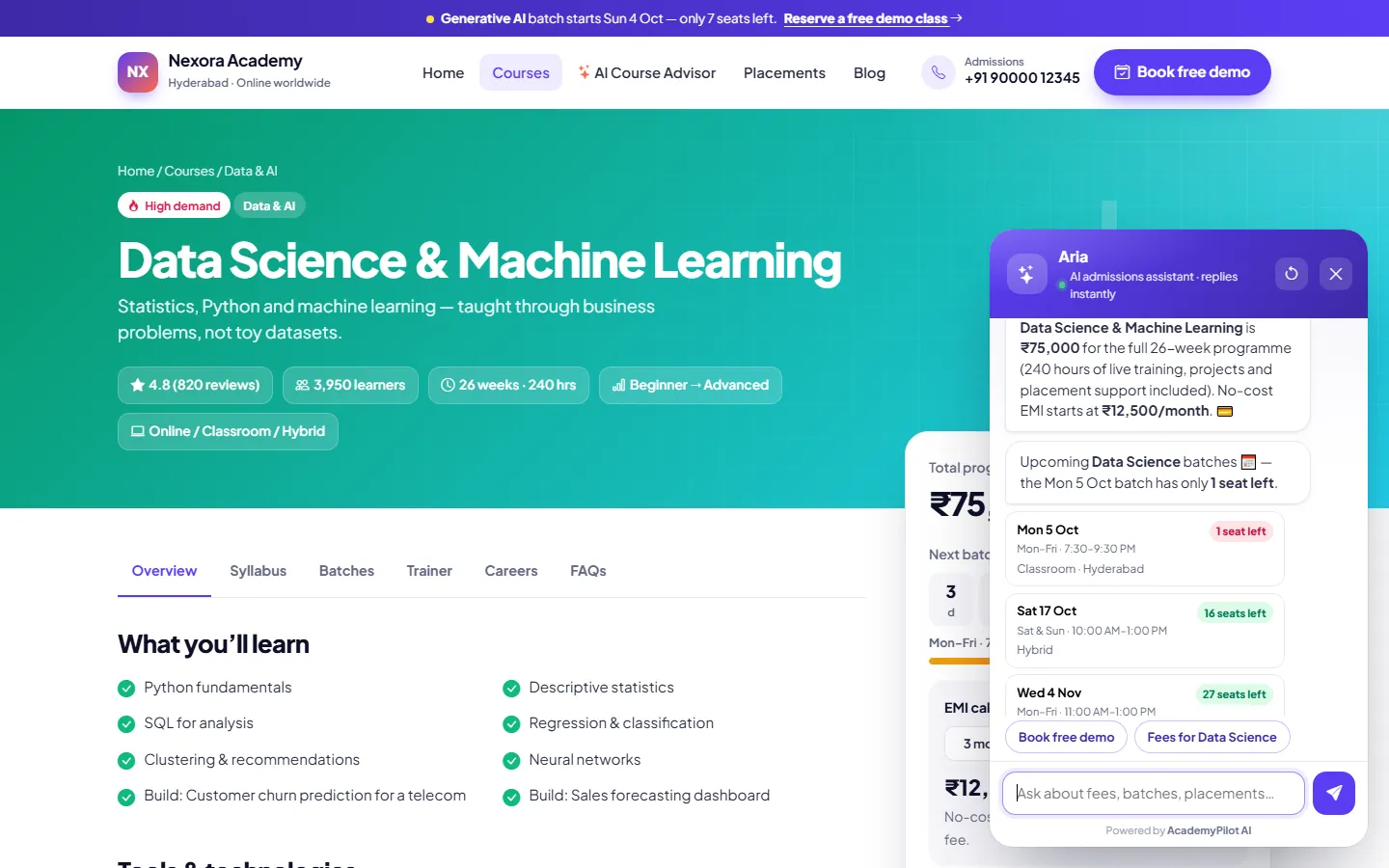 AcademyPilotAdmissions chatbot, AI course advisor, a lead CRM with AI scoring and an AI blog writer. It shows AI taking real actions across a sales pipeline, not just answering questions.Open →
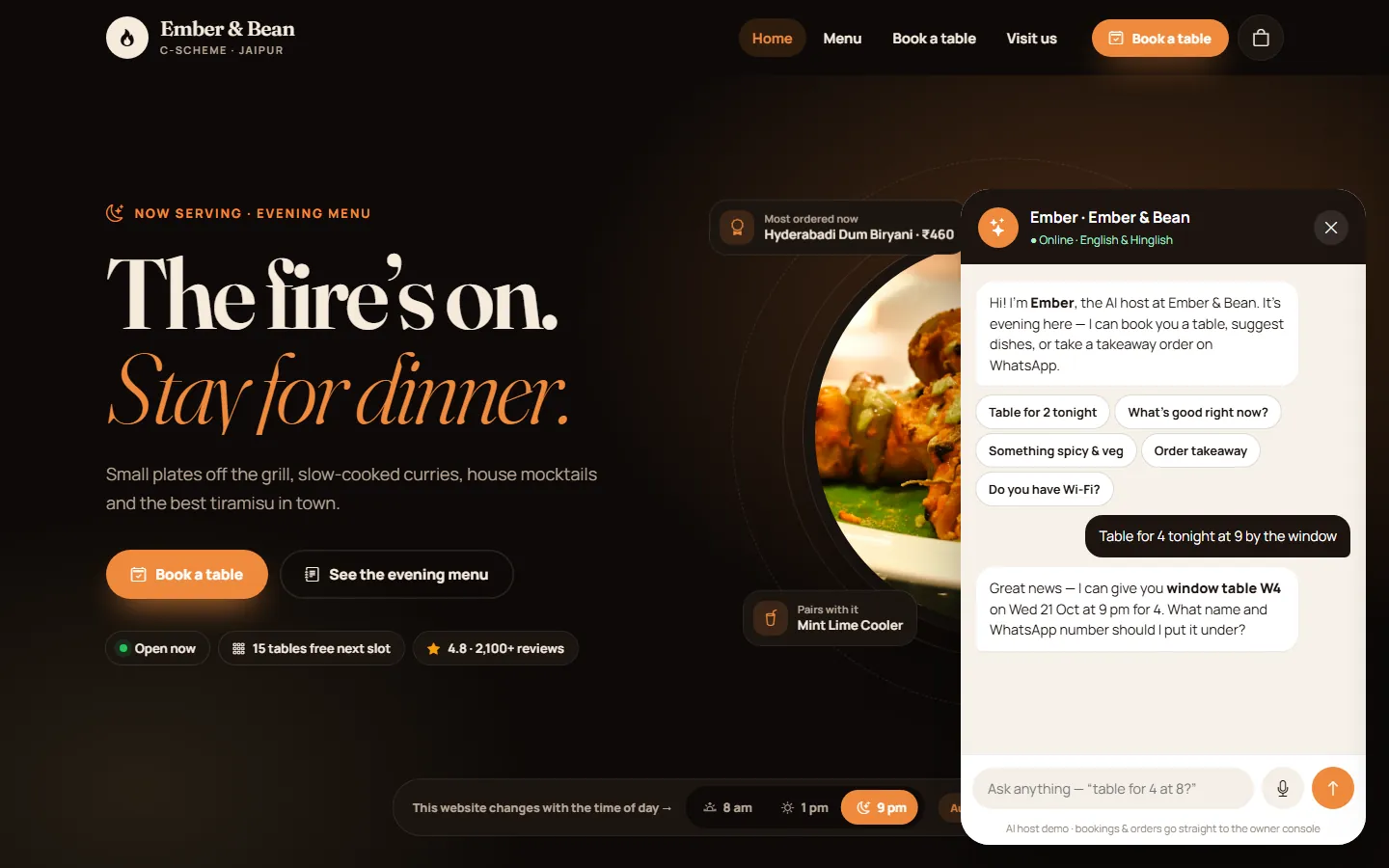 DinePilotAn AI host that turns a conversation into a table booking on a live floor plan or a WhatsApp takeaway order, in English and Hinglish, with an owner console to oversee it.Open →
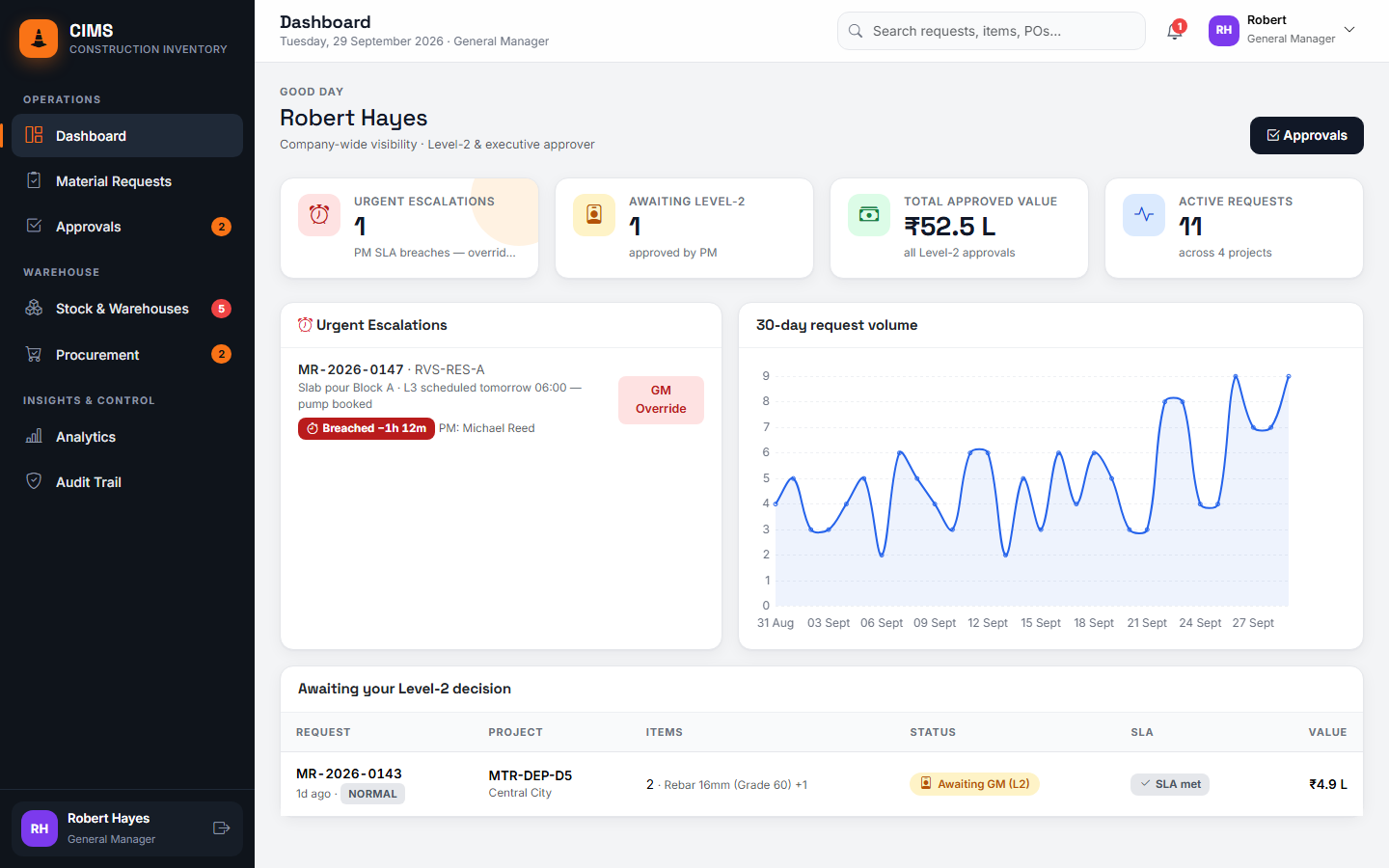 CIMSConstruction inventory with approval chains, SLAs, dispatch and a full audit trail across eight role cockpits: the kind of approval and audit backbone that safe agents plug into.Open →
Our stack for this work
What drives AI agent development cost
We quote fixed prices from a defined scope. Describe the workflow, systems and risk level, and we send a written quote. These factors matter most.
A single classify-and-route agent is far simpler than a multi-step process with branching, long waits and several decision points. The number of distinct cases the agent must handle drives design and testing effort.
Modern systems with clean APIs and webhooks are quick to connect. Legacy ERPs, scraped portals, missing sandboxes or inconsistent data add integration and hardening work.
Draft-only copilots are lighter. Agents that act on their own need approval flows, escalation rules, rollback paths and richer monitoring.
Touching money, health data or legal commitments means stricter permissions, audit trails, data residency choices and security review before launch.
High volumes or real-time responses shape model choice and infrastructure; varied, high-stakes cases need larger evaluation sets before autonomy is safe.
Ai agent development company: questions people ask
What is an AI agent, and how is it different from a chatbot?
A chatbot answers questions; an AI agent completes tasks. An agent can read an email, look up the customer in your CRM, check an order, draft a reply, update the ticket and ask for approval before issuing a refund. It decides which steps and tools to use towards a goal, within the permissions and guardrails we give it.
Which business processes should we automate with agents first?
Start with high-volume, repetitive work that follows rules you could write down but involves unstructured input: support triage, lead qualification, invoice matching, report preparation. Avoid starting with rare, high-stakes decisions. A good first workflow has clear data access, a measurable baseline and a low cost of mistakes while the agent is supervised.
How much does it cost to hire an AI agent development company?
We quote a fixed price after understanding the workflow, so there is no generic number. Cost depends on workflow complexity, the number and quality of systems to integrate, how much autonomy the agent has, compliance and audit needs, volume and latency, and evaluation depth. Running costs (model usage and hosting) are estimated separately from your expected volume.
Can agents connect to our CRM, ERP, email and WhatsApp?
Yes, if the system has an API, a database we can access safely, or webhooks. We regularly integrate CRMs, ERPs and accounting tools, Gmail and Outlook, the WhatsApp Business API, Slack and custom internal systems. Each connection becomes a scoped tool or MCP server, with read-only access by default and write actions behind approval where appropriate.
How do you keep AI agents safe?
Through architecture, not hope. Tools get the narrowest permissions possible, irreversible actions require human approval, every run has step, token and spend limits, inputs and outputs are validated against schemas, and the audit log records every tool call and decision. We also test agents against prompt-injection and edge cases before and after launch.
Should we use n8n or Make, or custom-coded agents?
Use n8n or Make for deterministic, moderate-volume workflows where speed of change matters more than complex logic. Choose custom-coded agents when you need branching decisions, long-running state, rigorous testing, multi-tenant security or high volume. Many good solutions mix both: n8n for the plumbing, a coded agent for the judgement step. We recommend whichever is simpler to run and maintain.
How do we measure the ROI of an AI agent?
Measure the workflow before building: volume, handling time, error rate and the cost of errors. After launch, track the same metrics with the same definitions, plus approval and edit rates, escalations and running costs including human review time. That comparison, not a demo, tells you whether to extend the agent or rethink it.
Pick one workflow, and we will scope the agent
WhatsApp or call +91 63774 18934, or email team@ezibelltech.com. Describe the process, the systems it touches and roughly how often it runs. We will reply with a suggested design, the approval points we recommend and a fixed quote.