FastAPI Development Services for AI, SaaS and Mobile Back Ends
We design and build FastAPI back ends that stay fast and correct under load: async REST APIs, authentication, background jobs, streaming LLM endpoints and clean OpenAPI documentation, deployed on AWS. Hire our Python team for a defined project, or a dedicated FastAPI developer by the month.
- Team in Jaipur, India
- MSME & GST registered
- Live product demos you can try
Teams look for FastAPI development services when they need an API that is quick to build, quick to run and documents itself. FastAPI combines Python type hints, Pydantic validation and an async core, so request and response contracts are explicit, invalid data is rejected at the edge and interactive OpenAPI docs come for free. That makes it a natural fit for AI and LLM back ends, mobile and single-page app APIs, webhook receivers and internal microservices.
The same features that make FastAPI pleasant can hurt when misunderstood. One blocking call inside an async endpoint stalls every request on that worker. Database sessions shared across tasks corrupt state. Background tasks that belonged in a durable queue silently vanish on restart. We have built and repaired enough Python APIs to design around these from the start, and we test the failure paths — timeouts, retries, cancelled streams — not just the happy path.
Ezibell Tech is a Python-first team, and FastAPI sits alongside Django in our everyday stack. We build new FastAPI services, add AI endpoints to existing products and migrate Flask or Django APIs where it genuinely helps. Engagements are fixed-price for defined projects or a monthly retainer for a dedicated developer. Teams who want to upskill can look at our live online backend Django and FastAPI programme; this page is about building it for you.
FastAPI development services we offer
Async REST API development
Resource-oriented REST APIs with Pydantic models, dependency-injected auth and database sessions, pagination, filtering, consistent error formats and versioning. Async where the I/O path benefits, synchronous where libraries require it — chosen deliberately per endpoint rather than applied everywhere by default.
LLM and AI back-end development
Endpoints for chat, RAG, document extraction and agents using OpenAI, Claude, Bedrock or open-source models, with streaming responses, structured outputs validated by Pydantic, token and cost tracking per user, retries with backoff and fallbacks when a provider is slow or down.
Auth, permissions and rate limiting
OAuth2 and JWT flows, social login, API keys for partners, role- and tenant-scoped permissions enforced in dependencies, and Redis-backed rate limiting per user or key, so one noisy client cannot exhaust your capacity or your LLM budget.
Background jobs and real-time events
Durable job queues with Celery, SQS or Step Functions for emails, file processing, AI pipelines and scheduled work; webhook receivers that verify signatures, acknowledge quickly and process idempotently; and WebSockets or server-sent events for live updates.
Back ends for mobile and SaaS apps
APIs for Flutter, React Native, React and Next.js clients: auth, profiles, direct uploads to S3 with pre-signed URLs, push notifications, Razorpay or Stripe payments, and an OpenAPI schema that generates typed client code for your front-end team.
Migration from Flask or Django REST
Incremental migration of existing Python APIs to FastAPI, endpoint by endpoint behind the same gateway, with contract tests confirming responses match before traffic moves. We advise against migrating when the current API works and the gain would not repay the effort.
Testing, docs and AWS deployment
pytest suites with async test clients and data factories, OpenAPI docs reviewed like a product, Docker images and CI/CD, deployed on ECS Fargate with Uvicorn workers or on Lambda for spiky traffic, with structured logs, tracing and alerts.
Async FastAPI pitfalls we design around
Async is not automatically faster. An async def endpoint runs on the event loop, so any blocking call inside it — a synchronous database driver, requests, boto3, heavy JSON or PDF work — blocks every other request on that worker until it finishes. FastAPI runs plain def endpoints in a threadpool, which is often the safer choice for code built on synchronous libraries. We decide per endpoint: async drivers such as asyncpg and httpx where the whole path is non-blocking, the threadpool or a worker queue where it is not.
The other classic traps concern lifecycles. Database sessions must be scoped per request through dependencies, never shared globally. HTTP clients should be created once at startup and reused, not opened per request. FastAPI’s BackgroundTasks run in the same process after the response, so they disappear if the container restarts — fine for a log line, wrong for sending invoices. CPU-bound work such as image processing or local model inference belongs in separate workers, never on the event loop.
- Never call blocking libraries inside async def; use def, a threadpool or async equivalents.
- Scope database sessions per request via dependencies and always close them.
- Reuse one HTTP client with connection pooling and explicit timeouts.
- Use a durable queue such as Celery or SQS for anything that must not be lost.
- Load-test at realistic concurrency before launch, not after the first incident.
Pydantic v2 validation and streaming LLM responses
Pydantic v2 is the backbone of a FastAPI service: request bodies, query parameters, settings and responses are typed models validated by a fast Rust-based core. Used well, invalid input is rejected with a clear 422 before business logic runs, and response models stop internal fields — password hashes, internal IDs, other tenants’ data — from leaking out. For AI features the same models validate LLM output: we request structured JSON, parse it into a Pydantic model and retry or fall back when it does not conform, rather than trusting free text.
Streaming is what makes an AI chat feel responsive. We stream tokens with server-sent events or a StreamingResponse, forward provider events as they arrive, and handle the awkward parts: detecting client disconnects so you stop paying for tokens nobody reads, timeouts on slow providers, saving the final message once the stream completes, and emitting tool-call or citation events alongside text. Behind a load balancer or CloudFront, buffering and idle timeouts must be configured so streams are neither held back nor cut off.
- Separate input, database and output models; never return ORM objects directly.
- Validate LLM JSON against Pydantic schemas and log failures for evaluation.
- Cancel upstream LLM calls when the client disconnects.
- Meter tokens per user or tenant to enforce plan limits.
Deploying FastAPI: Uvicorn, Gunicorn, Lambda or Fargate
For steady traffic and streaming, we run FastAPI in containers on ECS Fargate with Uvicorn workers, either directly or managed by Gunicorn, sized by CPU and memory and autoscaled on load. Containers keep long-lived connections, WebSockets and server-sent events simple. For spiky or low-volume APIs, AWS Lambda behind API Gateway with an adapter such as Mangum can cost less and needs no servers, but cold starts, response limits and PostgreSQL connections need care; RDS Proxy or DynamoDB help there.
Whatever the target, the essentials are the same: configuration from environment variables via Pydantic settings, secrets in AWS Secrets Manager, health and readiness endpoints, structured JSON logs with request IDs for tracing, Alembic migrations run as a separate deploy step, and zero-downtime rolling releases. Our AWS DevOps services page covers infrastructure as code, CI/CD pipelines and cost control in more depth.
How we work
- 1API discovery
We identify API clients, data, integrations, expected traffic shape and any AI features, then recommend FastAPI, Django or a mix, with reasons you can check.
- 2Contract-first design
Endpoints, Pydantic schemas, auth model, error formats and versioning are agreed as an OpenAPI draft before implementation, so front-end and mobile teams can start in parallel.
- 3Scope and quote
A written scope with milestones and acceptance tests, quoted fixed-price, hourly or as a monthly retainer for a dedicated FastAPI developer or a small team working with yours.
- 4Build and test
Weekly increments with pytest coverage, async integration tests, senior code review and a staging environment you can call, plus load tests for latency-sensitive or streaming endpoints.
- 5Deploy
Containerised deployment in your AWS account with CI/CD, secrets management, monitoring, alerts and documented runbooks, with zero-downtime rolling releases from the very first production version.
- 6Operate and extend
Performance tuning, model provider and dependency updates, new endpoints and AI features on retainer or hourly terms, or a clean handover to your own team.
Why teams choose us
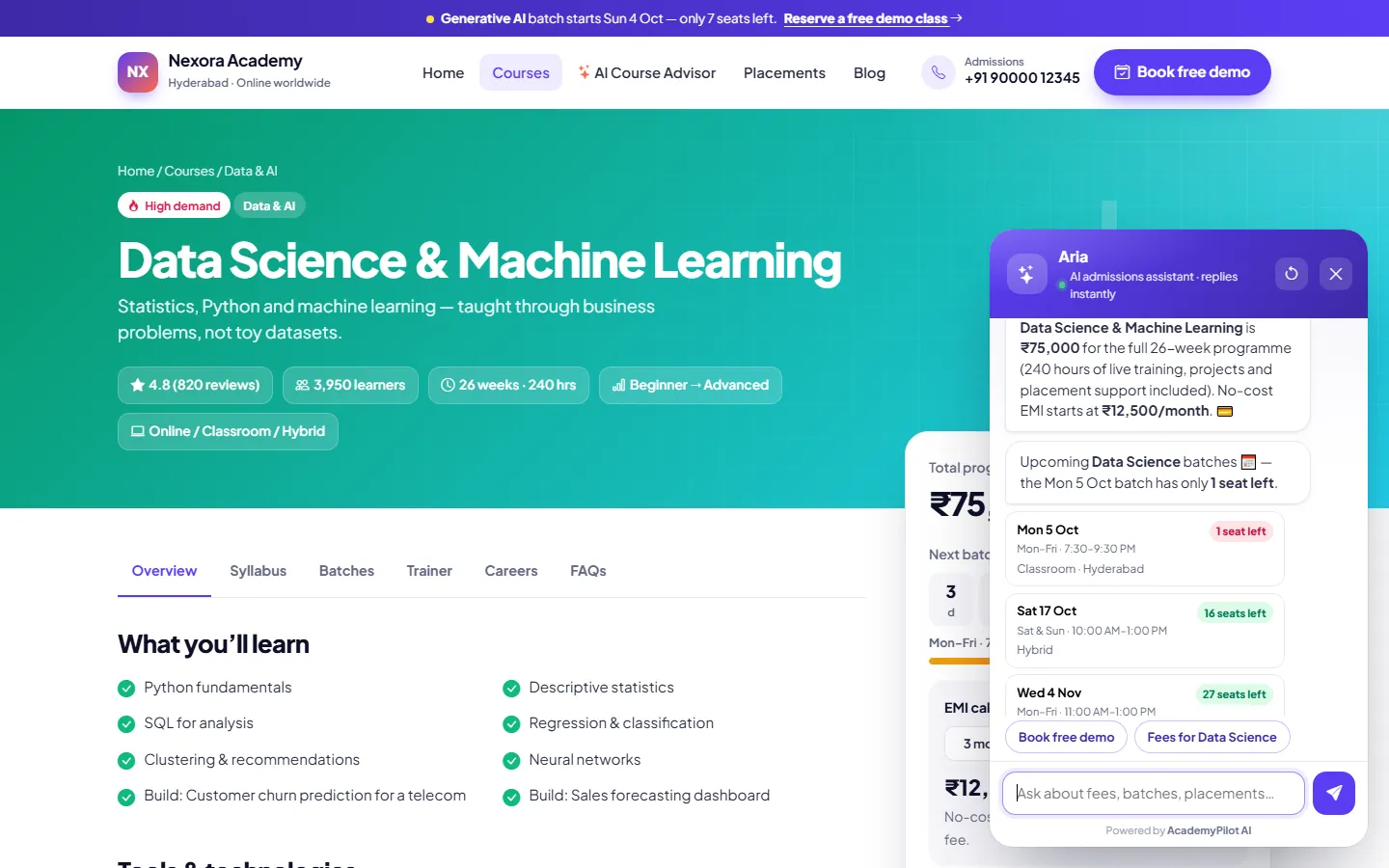 AcademyPilot for training institutesAn AI admissions chatbot, AI course advisor, lead CRM with AI scoring and an AI blog writer. It shows the kind of LLM endpoints, scoring and content pipelines a FastAPI back end typically serves.Open →
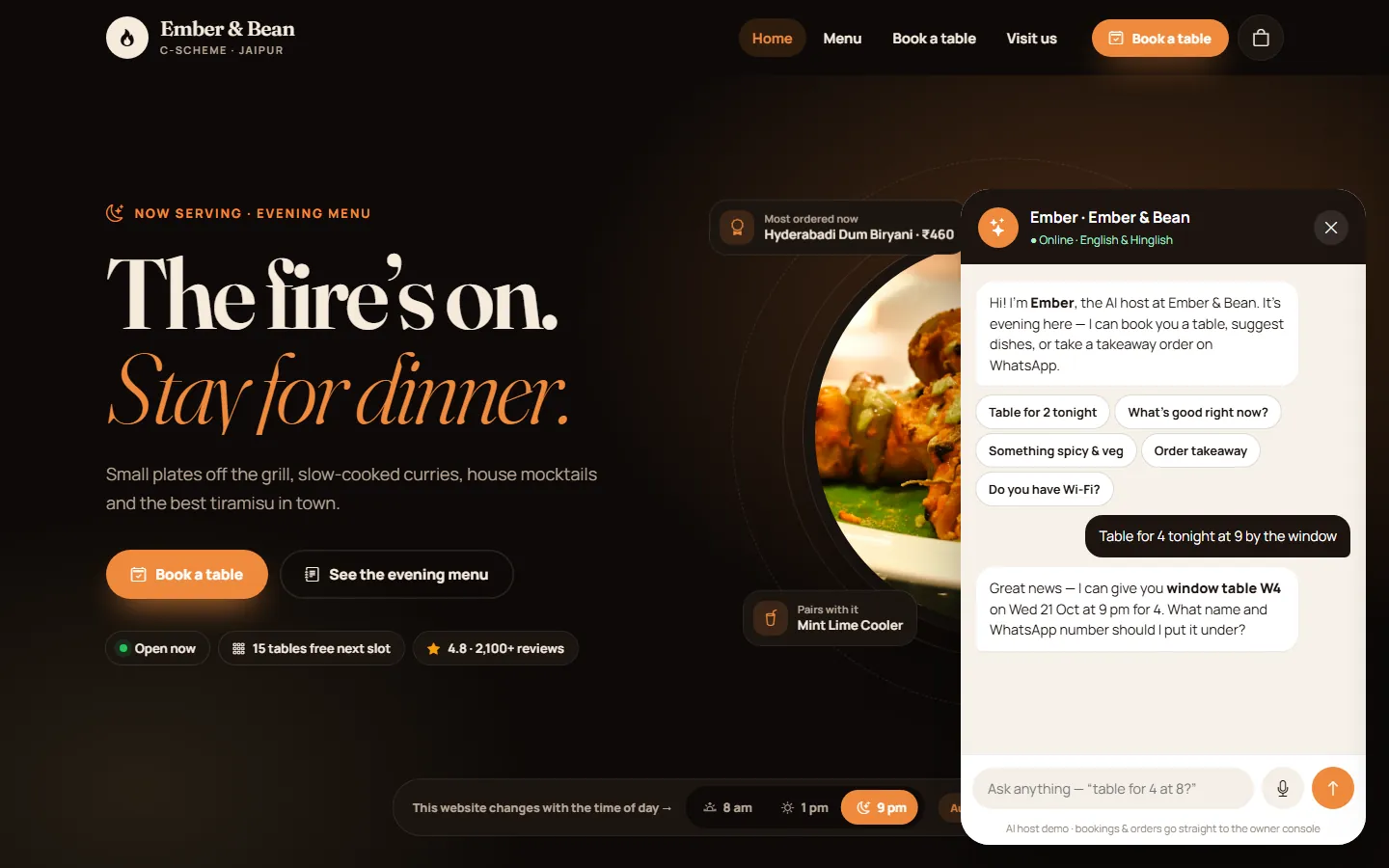 DinePilot for restaurants and cafésAn AI host that takes bookings on a live floor plan and WhatsApp takeaway orders in English and Hinglish — a reference for conversational AI that performs real actions through APIs.Open →
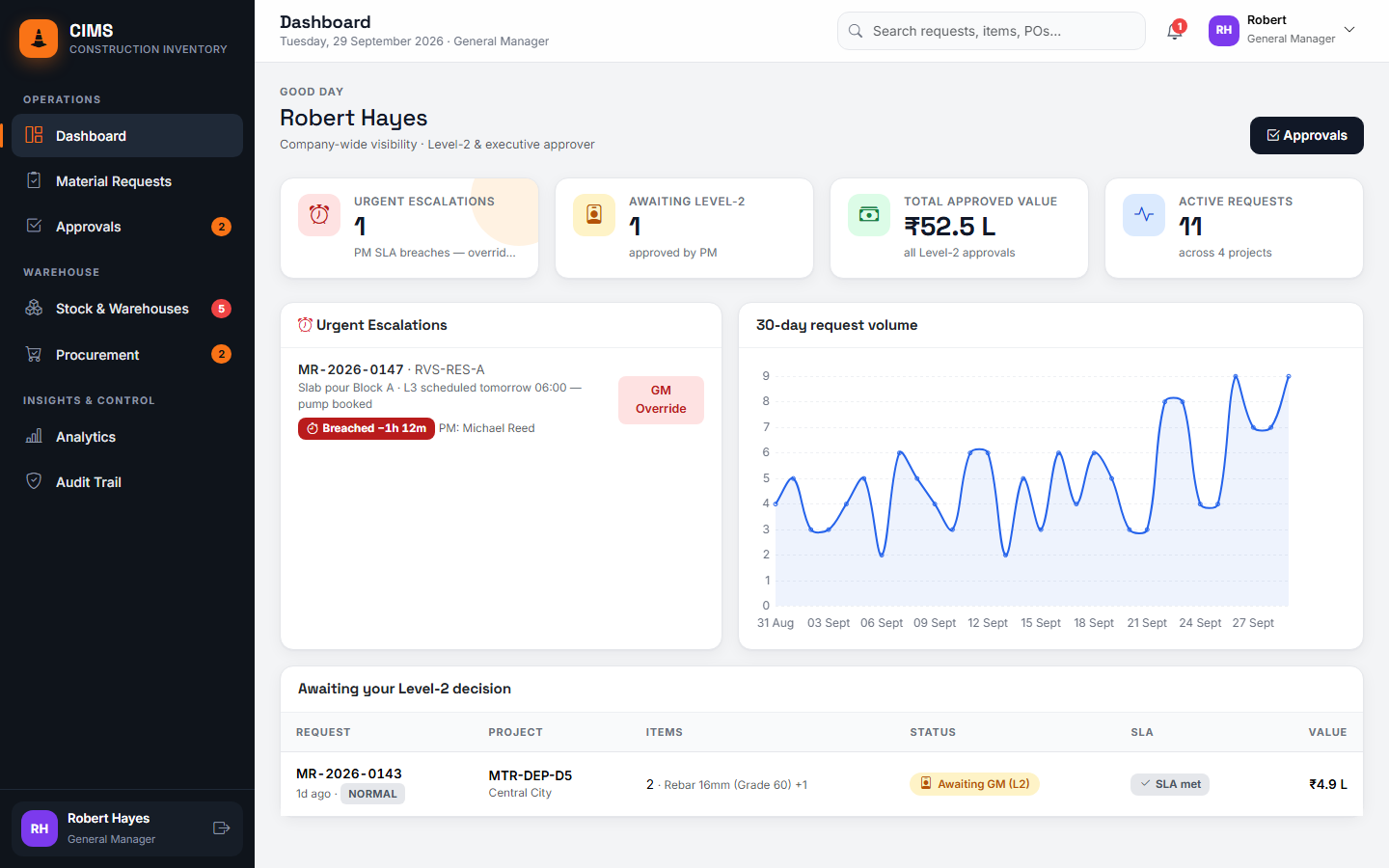 CIMS — construction inventory managementRole-based approvals, SLAs and audit trails across eight cockpits — the kind of permission and workflow rules an API layer must enforce consistently for every client that calls it.Open →
Our stack for this work
What drives the cost of a FastAPI project
An API with ten endpoints can be a few days’ work or a serious engineering effort, depending on what sits behind it. Share your requirements and we send a written quote. Key drivers:
Simple CRUD endpoints are quick; endpoints with multi-step business logic, transactions and complex validation take longer to build and test.
Streaming, RAG retrieval, structured outputs, evaluation, guardrails and cost metering add real engineering beyond calling a model API.
API keys, OAuth with several providers, tenant isolation and fine-grained permissions increase design and testing effort.
Each external API, webhook source or long-running job needs retries, idempotency, monitoring and clear failure handling.
Strict latency, high concurrency or high-availability requirements call for load testing, caching, autoscaling and more careful infrastructure.
Moving an existing Flask or Django API needs contract tests, parallel running and client coordination, all proportional to the size of the current API.
Fastapi development services: questions people ask
FastAPI or Django: which is better for my project?
Neither is better in general; they fit different workloads. FastAPI suits async, high-concurrency APIs, AI and LLM back ends, streaming and lean microservices. Django suits data-rich business applications that benefit from its ORM, migrations, auth and admin out of the box. Many products combine them, with Django for the core app and FastAPI for AI or real-time services. See our Django development page.
Is FastAPI good for AI and LLM back ends?
Yes, it is one of the most common choices. Its async core handles many concurrent calls to model providers efficiently, StreamingResponse and server-sent events deliver tokens as they are generated, and Pydantic validates structured LLM output. Combined with Python’s AI ecosystem — the OpenAI and Anthropic SDKs, LangChain, LangGraph and vector databases — one team can own the whole AI back end.
Can you migrate our Flask or Django API to FastAPI?
Yes, incrementally. We place FastAPI behind the same gateway or domain, move endpoints one group at a time and use contract tests to confirm responses match before switching traffic. Shared database models are reused or ported carefully. We will also say when migration is not worth it: if the current API is stable and fast enough, a separate FastAPI service for new needs is often smarter.
How do you handle authentication, rate limiting and background jobs?
Authentication uses OAuth2 with JWT, or API keys, implemented as reusable dependencies with role and tenant checks on every protected route. Rate limiting is enforced per user or key using Redis. Background work goes to a durable queue such as Celery or SQS instead of in-process BackgroundTasks, so jobs survive restarts and can be retried, monitored and scaled independently.
Can I hire a FastAPI developer monthly?
Yes. On a monthly retainer a dedicated FastAPI developer, or a small team, works inside your repository, tools and stand-ups, with a senior engineer from our side reviewing design and code. It suits products with an evolving roadmap. For a defined API or feature, a fixed-price project is usually simpler. Either way, all code and IP belong to you.
How do you test FastAPI apps and document the API?
We write pytest suites using FastAPI’s test client and async HTTP clients, with factories for test data, a real PostgreSQL instance in CI and mocked external providers. Contract tests protect response shapes. FastAPI generates OpenAPI documentation automatically; we add descriptions, examples and error schemas so the Swagger and ReDoc pages are genuinely usable by front-end and partner developers.
How long do FastAPI development services take to deliver?
Standard projects run 2–8 weeks from an approved scope, depending on endpoints, integrations and AI features; larger platforms are delivered in phases. Contract-first design lets your front-end or mobile team build against the agreed OpenAPI schema from week one, so the overall product timeline shortens even while the back end is still being built.
Need a fast, reliable Python API?
Tell us what the API must do, who will call it and what it connects to. We reply with design questions and a fixed or monthly quote. WhatsApp or call +91 63774 18934, or email team@ezibelltech.com.