Custom Software Development Company in India for Global Teams
We design and build bespoke web platforms, internal tools, CRMs and AI features for businesses in India and worldwide. Senior Python engineers lead every project, scope is written down before code is written, and you see working software every week — with full IP transfer at the end.
- Team in Jaipur, India
- MSME & GST registered
- Live product demos you can try
Choosing a custom software development company in India should be about lower risk, not just lower rates. Rates start the conversation; what decides success is whether the team understands your business, writes down what will be built, shows progress you can verify and leaves you with code another team could maintain. Ezibell Tech is a Jaipur-based, MSME- and GST-registered software company whose senior Python developers and team leads handle strategy, design, engineering, launch and support in one place.
We build software that off-the-shelf products do not fit: operations platforms with approval chains, industry CRMs, customer portals, booking and inventory systems, integration layers connecting your ERP, payment gateway and WhatsApp, and AI features grounded in your own data. Sometimes the right answer is extending a SaaS tool you already pay for; we look at buy versus build honestly before quoting, because bespoke software is an asset only when it does something your competitors’ tools cannot.
Most offshore software development clients reach us through one of three doors: a new product to build, an internal tool that has outgrown spreadsheets, or legacy software that is slow, fragile and understood by one person who is about to leave. Each needs a different engagement model, so we offer fixed-price, hourly and monthly retainer arrangements to match the commercial structure to the uncertainty in the work.
Custom software we design and build
Internal tools and operations platforms
Replace spreadsheets and email chains with role-based apps: requests, approvals with SLAs, inventory, dispatch, field reports and audit trails. We model your real workflow — including the exceptions people currently handle on WhatsApp — so the tool gets adopted instead of quietly bypassed.
CRM development
CRMs shaped around your sales or service process rather than a generic pipeline: lead capture from WhatsApp and web, assignment rules, follow-up reminders, quotations, payments and reporting. Useful when Salesforce or HubSpot is too heavy, too costly per seat or too generic for your industry.
Web platforms and customer portals
Customer portals, marketplaces and B2B ordering systems with secure login, account management, documents, payments and notifications. Built with Django or FastAPI on the back end and React or Next.js on the front end, and responsive for customers who only ever use a phone.
Integrations and APIs
Connect the systems you already run — ERPs, accounting, payment gateways, Zoom, WhatsApp Business API, Twilio, Google Workspace — through documented REST APIs, webhooks and scheduled sync jobs with retries, logging and alerts, so data moves reliably instead of by copy-paste.
AI features inside your software
Document extraction, chat over your knowledge base, summarisation, classification and AI-assisted workflows using OpenAI, Claude or open-source models. Grounded in your data, protected by role-based access and validated outputs. Your data stays yours — never used to train public models.
Legacy modernisation
Move ageing PHP, .NET, Access or outdated Django applications to a maintainable stack without a risky big-bang rewrite: document what the system really does, wrap it with tests and APIs, then replace modules one at a time while the business keeps running.
Security, QA and cloud deployment
Peer code review, automated tests, dependency scanning, OWASP checks, role-based access, encryption and audit logs, deployed on AWS, Azure or GCP. Compliance-minded controls for GDPR, HIPAA or ISO-style requirements are added when your industry needs them.
Working with a custom software development company in India: what makes it work
Offshore projects rarely fail on coding skill. They fail on ambiguity: a requirement understood two ways, a decision nobody wrote down, a demo that looks finished but is not deployed anywhere. We counter that with written scope and acceptance criteria for each feature, a shared backlog you can see, a staging environment you can log into, and a short written update at the end of each working day. Weekly demos show real, running software, not slides.
Time zones help when they are planned. Our hours are Monday to Friday 9:00–18:00 and Saturday 10:00–14:00 IST, which overlaps comfortably with the Gulf and South-East Asia, gives UK and European clients a shared morning, and lets US clients review at the start of their day what was built during ours. We agree a fixed overlap window for calls at the outset and keep everything else asynchronous and written down.
- One named project lead as your single contact.
- Written acceptance criteria before each feature is built.
- Change requests logged with their cost and time impact stated before work starts.
Fixed price, dedicated team or hourly: choosing an engagement model
The right model depends on how well the work is understood. Fixed price suits a clearly scoped build — an MVP, a defined module, a migration with known boundaries. You get budget certainty and we carry the estimation risk, which is why we insist on a written scope and a change process. Hourly suits small or unpredictable work such as fixes, audits and short integrations. A monthly retainer — effectively a dedicated developer or small team — suits evolving products whose priorities shift every sprint.
Many clients combine them: a fixed-price first release, then a retainer for continuous improvement. Whatever the model, governance stays the same — visible backlog, weekly demos, code in your repository — so changing the commercial model later does not mean changing the process. Be wary of a fixed price on a vague brief: either scope gets read narrowly or quality absorbs the gap.
- Fixed price: clear scope, budget certainty, changes priced separately.
- Hourly: small or exploratory tasks, pay only for time used.
- Retainer: evolving roadmap, reserved capacity, flexible priorities.
Legacy modernisation without a big-bang rewrite
Rewriting a working system from scratch is the most tempting and most dangerous option in software. Old code encodes years of business rules nobody documented, and a rewrite rediscovers them one production incident at a time. We prefer the strangler pattern: put an API or routing layer in front of the legacy system, build new modules alongside it, move traffic across feature by feature, and retire old code only once its replacement is proven in production.
The first step is always discovery — reading the code, database and logs to document what the system actually does, odd cases included. Then we add characterisation tests that pin current behaviour, so every change is safe. GenAI tools speed up reading unfamiliar code and drafting documentation, but each generated explanation is checked by an engineer before anyone relies on it.
- Map data flows and hidden business rules before planning the migration.
- Migrate data incrementally with reconciliation reports, not one weekend cut-over.
- Run old and new side by side until their outputs match.
How we work
- 1Discovery call
We learn the business problem, users, current tools and constraints, and give an honest view on buy versus build. An NDA is signed before you share anything sensitive.
- 2Scope and estimate
A written scope covering user roles, features, acceptance criteria, integrations and assumptions, with a milestone plan and a quote in the engagement model that fits the work.
- 3Architecture and design
Data model, system architecture, security approach and the key screens are designed and reviewed with you before full development begins, so costly decisions are made deliberately and early.
- 4Iterative build
One-week cycles with daily written updates, a staging environment you can log into and a live demo every week. You re-prioritise the backlog as you learn more.
- 5Testing and launch
Automated and manual testing, security checks, a rehearsed data migration, user acceptance testing with your own team and a carefully planned go-live with documented rollback steps.
- 6Handover and support
Documentation, credentials and a walkthrough for your team, followed by post-launch support, monitoring and improvements on retainer or hourly terms, or a clean handover to your developers.
Why teams choose us
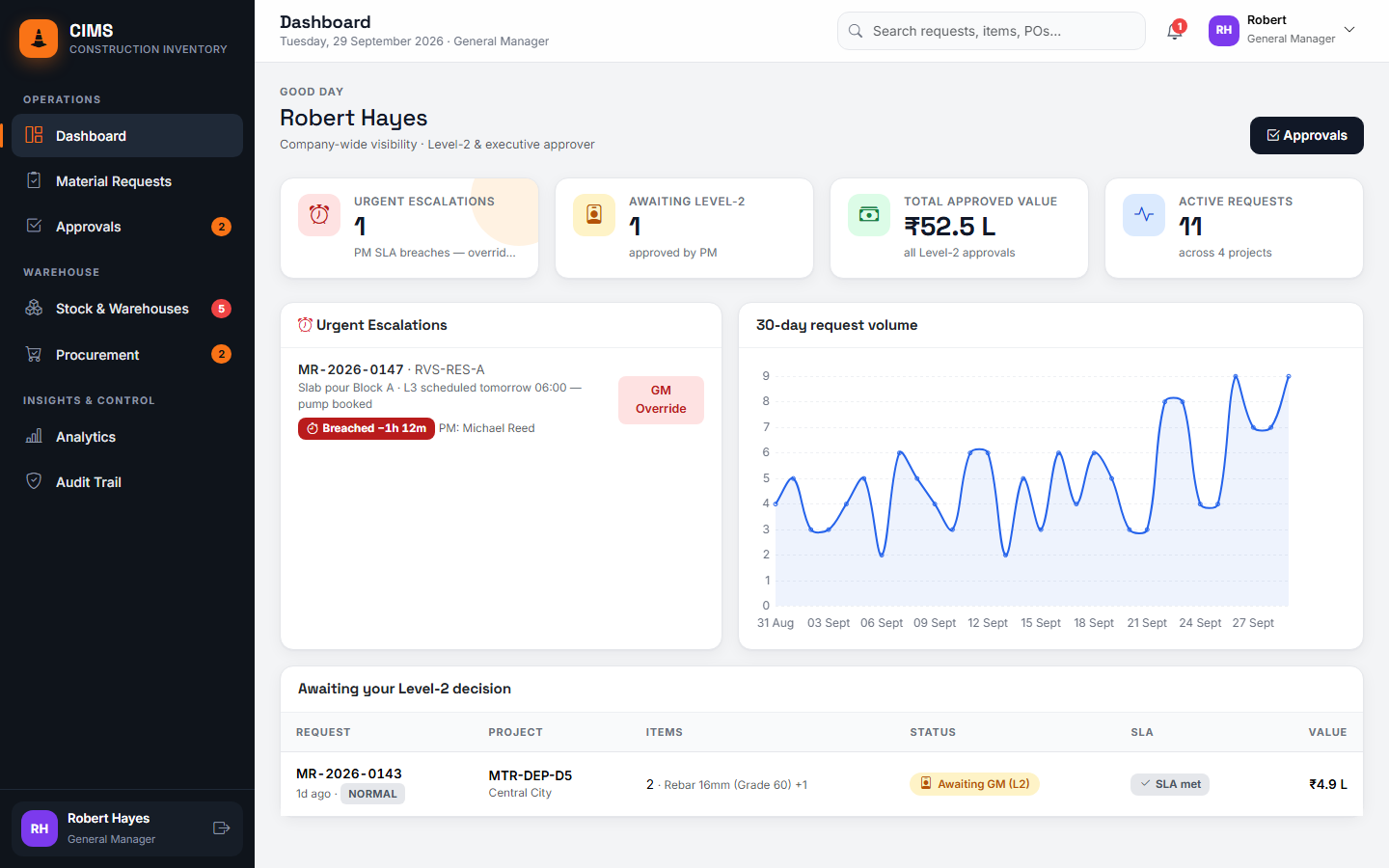 CIMS — construction inventory managementRequests, PM and GM approvals with SLAs, stock, dispatch, site receipt and audit across eight role cockpits — a typical example of the operations software businesses commission when spreadsheets stop scaling.Open →
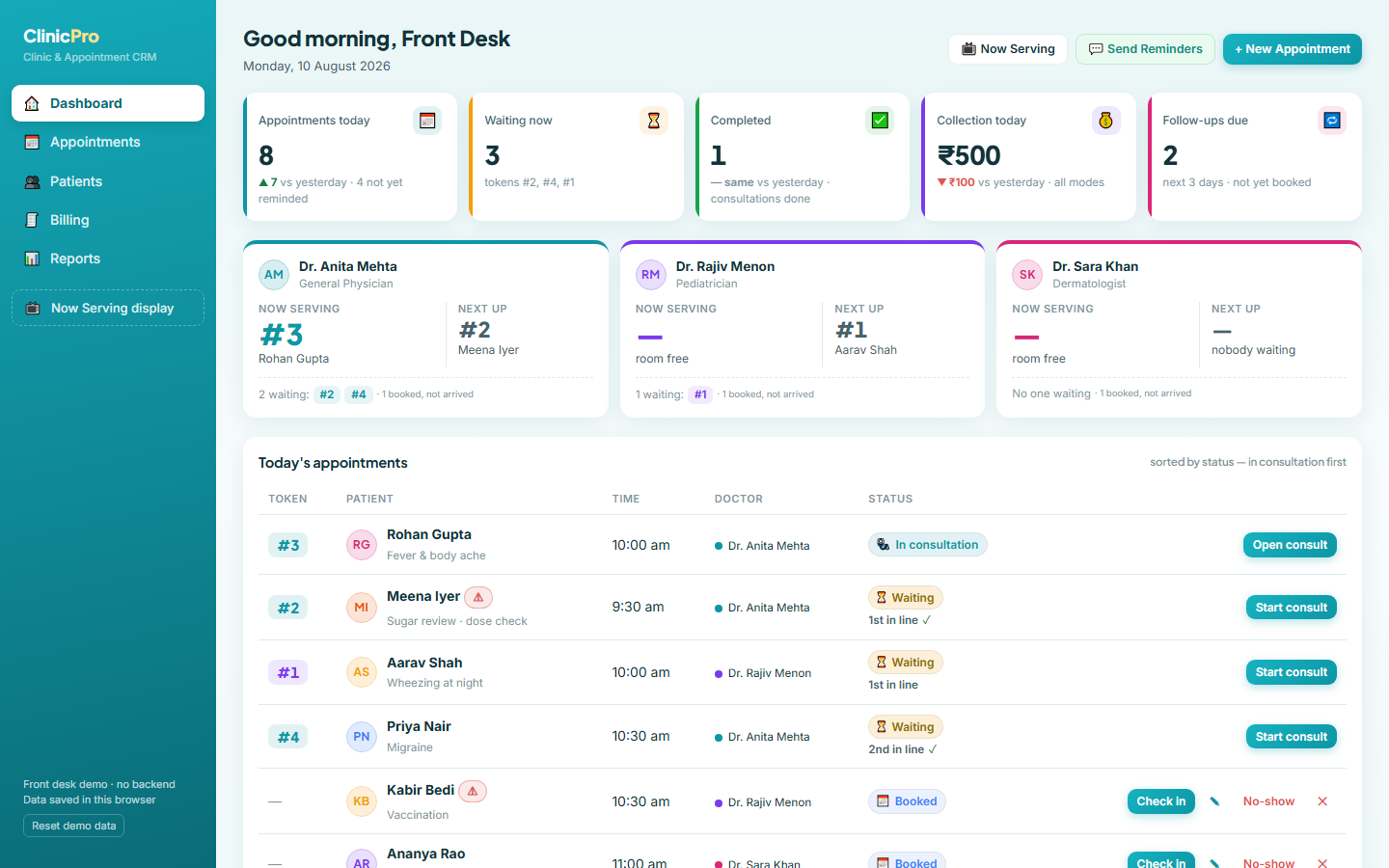 ClinicPro clinic CRMA CRM shaped around how a clinic’s front desk and staff work day to day. It shows how we turn an industry’s routine into a focused tool instead of a generic, configure-everything CRM.Open →
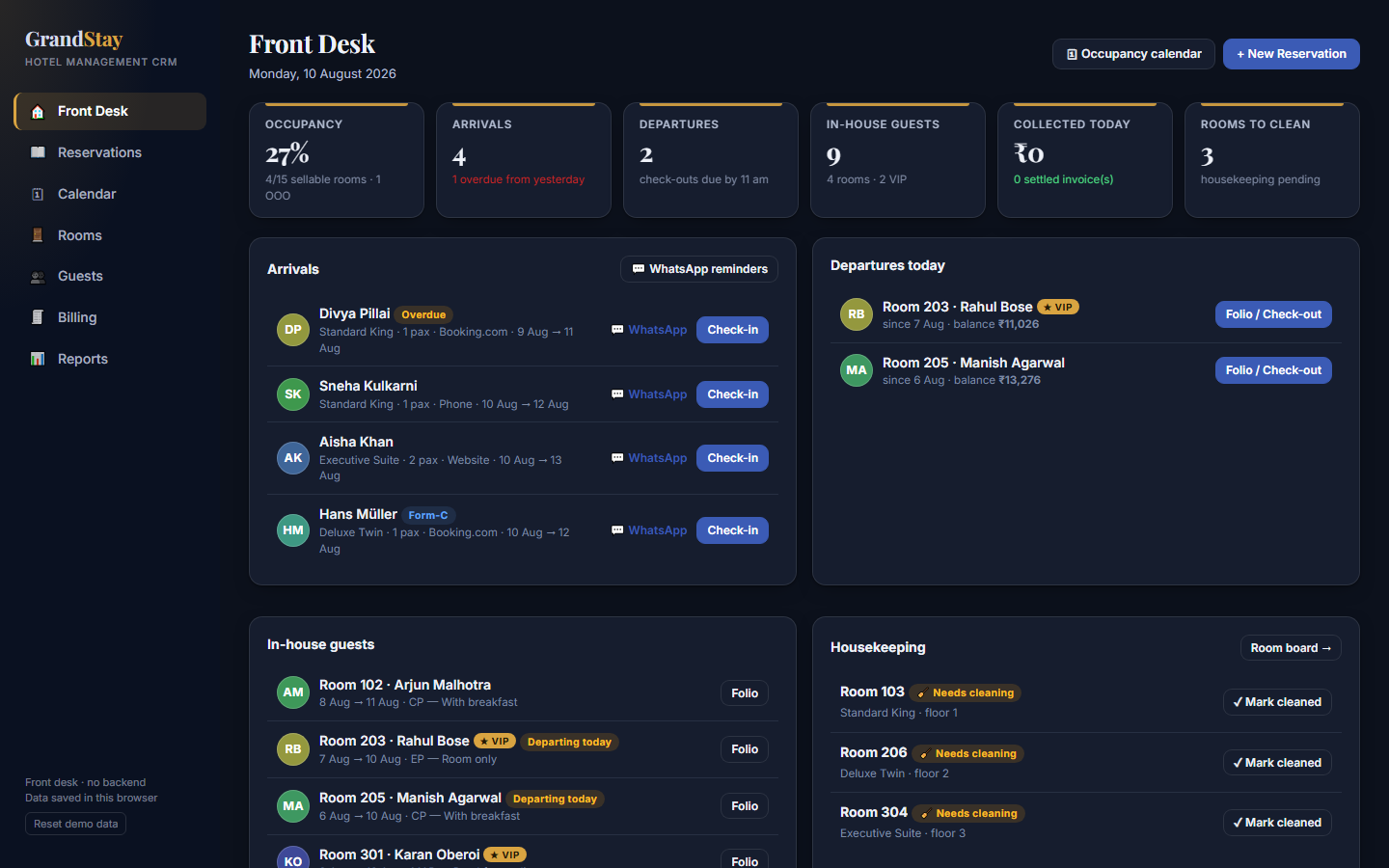 GrandStay hotel management CRMA hotel CRM for a booking-heavy hospitality workflow. A useful reference for software where several staff roles must share one accurate, live view of availability and guests.Open →
Our stack for this work
What decides the cost of custom software
Custom software has no list price: the same idea can be built lean or enterprise-grade. Share your requirements and we send a written quote. These factors drive it.
Each role brings its own screens, permissions and edge cases. A two-role tool and an eight-role operations platform are very different builds.
Approval chains, SLAs, conditional rules and exception handling need more design and testing than straightforward data entry and reports.
Connecting ERPs, payment gateways or legacy databases, and migrating historic data cleanly, often takes as much effort as building new features.
Audit trails, data residency, encryption requirements and GDPR- or HIPAA-style controls add architecture, documentation and testing work.
A clean admin-style interface is quicker to build than a fully branded customer experience with custom interactions and repeated usability testing.
Fixed price includes estimation risk, and compressed deadlines need more parallel developers and coordination. Flexible timelines usually cost less.
Custom software development company india: questions people ask
Why hire a custom software development company in India?
Because you can get senior engineering at a sustainable cost, provided the company runs a disciplined process. India has a deep Python and web engineering talent pool and long experience serving overseas clients. The real value comes from written scope, visible progress and clean code you own. Ezibell Tech pairs that process with an MSME- and GST-registered company, so contracts, invoices and accountability are straightforward.
How do you handle time zones and communication?
We agree a fixed daily overlap window for calls and keep everything else written. Our hours are Monday to Friday 9:00–18:00 and Saturday 10:00–14:00 IST. You get a named project lead, daily written updates, a shared backlog, staging access and a live demo every week. Urgent production issues reach us by WhatsApp or phone on +91 63774 18934.
What engagement models do you offer?
Fixed price, hourly and monthly retainer. Fixed price suits well-defined builds and gives budget certainty. Hourly suits small or unpredictable tasks such as fixes and audits. A retainer reserves a dedicated developer or small team for an evolving roadmap. Many clients start with a fixed-price first release and move to a retainer afterwards, with the same reporting and governance.
Do you sign NDAs and transfer full IP?
Yes. We sign an NDA before you share confidential details, and on full payment the contract assigns all source code, designs, documentation and intellectual property to your company. Code is committed to your repository throughout, so you never depend on us for access. Open-source components keep their own licences, and we list them for you at handover.
How do you ensure code quality and security?
Every change goes through peer code review and automated tests in CI before reaching staging. We follow framework security defaults, check against OWASP risks, scan dependencies, keep secrets out of code, enforce role-based access on the server and log sensitive actions. For regulated industries we add GDPR-, HIPAA- or ISO-style controls and support a security audit before go-live.
Can you modernise our legacy software?
Yes, usually without a full rewrite. We first document what the existing system actually does, add tests around its current behaviour, then replace modules incrementally behind an API layer while the old system keeps running. Data moves in stages with reconciliation checks. This keeps the business operating and spreads cost and risk across smaller, verifiable steps.
Should we build custom software or buy an off-the-shelf tool?
Buy when the process is standard and an existing tool covers most of it — accounting, email, generic HR. Build when the workflow is how you compete, when per-seat licences become expensive at scale, or when you are stitching several tools together with spreadsheets. We give an honest buy-versus-build view in discovery, even when the answer is not a project for us.
How long does a custom software project take?
Standard projects run 2–8 weeks from approved scope; larger enterprise platforms take longer and are delivered in phases. We would rather ship a first module your team uses within weeks than a complete system in a year. Timelines depend mainly on scope, integrations, data migration and how quickly decisions and feedback come back to us.
Discuss your software project with a senior engineer
Tell us what you need built and what it must connect to. We reply with questions, an honest buy-versus-build view, then a written scope and quote. WhatsApp or call +91 63774 18934, or email team@ezibelltech.com.