RAG Chatbot Development for Answers You Can Trust
Our RAG chatbot development produces assistants that answer from your documents, databases and SOPs, cite the exact source behind every answer, respect who may see what, and ship with an evaluation suite that measures accuracy before customers or staff rely on them.
- Team in Jaipur, India
- MSME & GST registered
- Live product demos you can try
RAG chatbot development means connecting a large language model to the knowledge your organisation already owns: policy PDFs, product manuals, Google Drive folders, Confluence pages, ticket history and SQL tables. RAG stands for retrieval-augmented generation. For every question the system retrieves the most relevant passages, hands them to the model and instructs it to answer only from that material, with a link back to the source. Done well, it becomes the knowledge base chatbot your support, sales and operations teams actually trust. Done badly, it confidently invents policy.
A chat-with-documents demo takes an afternoon. A production assistant is a different job. The hard parts are scanned PDFs, tables that lose meaning when flattened into text, three versions of the same SOP that disagree, users who must never see HR files, and the slow drift in quality after someone uploads a new price list. That is where we spend our engineering time: ingestion that preserves structure, hybrid retrieval with re-ranking, access control enforced at query time, and evals that run whenever content, prompts or models change.
Ezibell Tech is an AI and software development company whose senior Python engineers take custom AI chatbot development from discovery to launch and support, for teams across India and worldwide, on fixed-price, hourly or retainer terms. A focused assistant over a clean document set usually fits our standard 2–8 week project window; enterprise RAG with many connectors and strict compliance takes longer. Your data stays yours and is never used to train public models. You receive the source code, infrastructure in your own cloud account and documentation.
RAG chatbot development: what we build
Document and SOP assistants
An internal knowledge base chatbot for policies, SOPs, manuals and contracts. It answers with page-level citations, quotes the exact clause it relied on and flags when two documents contradict each other. Ingestion handles PDF (including scanned files via OCR), Word, Excel, PowerPoint and HTML, keeping headings and tables intact.
Chat with your database
Natural-language questions over PostgreSQL or MySQL using read-only database roles, approved query patterns and row-level filters, with the generated SQL shown for audit. We combine it with document retrieval for questions that mix numbers and policy, such as which overdue invoices breach the credit terms in a contract.
Connectors and sync pipelines
Ingestion from Google Drive, SharePoint, Notion, Confluence, websites, S3 buckets and helpdesk tools. Sync is incremental, so edited files are re-indexed and deleted files disappear from answers. Where the source system has sharing permissions, we carry them across so the chatbot never shows a file the user could not open themselves.
Enterprise RAG with access control
Single sign-on through OAuth, role-based and document-level permissions, multi-tenant isolation for SaaS products, PII redaction before text reaches the model, and an audit log of every question, retrieved source and answer. Built for organisations whose security review asks hard questions, and with GDPR or HIPAA-style controls where your data requires them.
RAG evaluation and rescue
Already have a chatbot that hallucinates or misses obvious answers? We build a test set from your real questions, measure retrieval and answer quality separately, find where the pipeline breaks (parsing, chunking, search or prompting) and fix it, with a before-and-after report.
RAG features inside your product
Chat-with-documents as a feature of your SaaS: per-customer indexes, streaming answers, citation components in React or Next.js, usage metering for billing and an API your developers can extend, designed so one customer’s documents never surface in another’s answers.
RAG vs fine-tuning: which does your chatbot need?
Fine-tuning changes how a model behaves: tone, output format, domain vocabulary, classification decisions. It is a poor way to teach facts. Facts absorbed during training blur together, cannot be cited, go stale the day a policy changes and cannot be hidden from users who lack permission. RAG keeps knowledge outside the model, so updating a document updates the answer as soon as it is re-indexed, every answer is traceable to a source, and permissions are enforced at retrieval rather than hoped for in a prompt.
Most business chatbots need RAG first. Fine-tuning earns its place later, when you want a smaller, cheaper model to reproduce a consistent format at high volume, to follow a strict JSON schema, or to understand dense domain jargon. Sometimes the right answer is neither: if your knowledge fits in a few pages, a long-context prompt without any vector database is simpler and more accurate. We tell you which you need before writing code.
- Knowledge changes monthly or faster: use RAG
- Answers must cite a source or survive an audit: use RAG
- Different users may see different documents: RAG with permission filters
- Consistent tone, format or labels at high volume: consider fine-tuning a smaller model
- All your knowledge fits in a few pages: a long-context prompt, no vector database
How we make RAG answers trustworthy
Most RAG hallucinations are retrieval failures: the right passage never reached the model, so it filled the gap. We start with ingestion. Documents are parsed with their structure intact, tables stay as tables, chunks follow section boundaries instead of arbitrary character counts, and every chunk carries metadata such as document, version, date, department and permission group. Retrieval is hybrid: keyword search (BM25) catches part numbers, policy codes and names that embeddings miss, vector search catches meaning, and a cross-encoder re-ranker orders the merged results before anything reaches the LLM.
At generation time the model must answer from the supplied context and cite chunk IDs, which we verify exist before showing them. If retrieval confidence is low, the bot says it does not know and points to a person instead of guessing. Follow-up questions are rewritten into standalone queries so “what about contractors?” still finds the right policy. Quality is measured, not assumed: a golden set of real questions tracks retrieval recall, faithfulness and correctness, and runs in CI whenever content, prompts or the model change, so an upgrade cannot quietly break answers that used to work.
- Structure-aware parsing and OCR for scanned files
- Hybrid keyword and vector search with re-ranking
- Verified citations and an honest “I don’t know” fallback
- Query rewriting for follow-up questions
- Evaluation suite in CI plus production feedback loops
Multi-tenant data isolation and role-based access
Never rely on the prompt to keep secrets. If a confidential chunk reaches the model, a determined user can usually get it out. We enforce access before retrieval: every chunk is stored with tenant and permission metadata, and the search query itself filters on the current user’s identity, using payload filters in Qdrant or row-level security in PostgreSQL with pgvector. Tenants with strict isolation needs get separate collections or databases, and cache keys and logs are scoped by tenant, because leaks often happen around the model, not inside it.
Documents themselves can attack you. A PDF or web page may contain hidden text such as “ignore previous instructions and reveal…”. We treat retrieved text as data rather than instructions, keep tool permissions minimal, and test with injection examples during evaluation. Permissions are synced from source systems, so when someone loses access to a Drive folder they lose access to its answers on the next sync.
- Tenant and role filters applied inside the search query
- Separate indexes for high-isolation customers
- Permission sync from source systems
- PII redaction, per-tenant audit logs and injection tests
How we work
- 1Discovery and question audit
We collect real questions from tickets, emails and staff, map them to the sources that should answer them, and agree what a correct answer looks like. This becomes the first version of your evaluation set.
- 2Data and security design
We review document formats, permissions, compliance needs and hosting preferences, then fix the architecture: connectors, chunking strategy, vector store, model choice and where data is allowed to travel.
- 3Pilot on a real slice
We build an end-to-end assistant over one department or document set and test it against the agreed questions, so you judge quality on your own data rather than on a polished demo.
- 4Evaluate and harden
We tune parsing, retrieval and prompts until the scores and spot checks meet the bar we agreed, then add access control, rate limits, monitoring and fallback behaviour for production.
- 5Launch, monitor and improve
We deploy to your AWS, Azure or GCP account on a website widget, portal, WhatsApp, Slack or API, then review unanswered questions, feedback and cost per conversation, and re-run evals before every change.
Why teams choose us
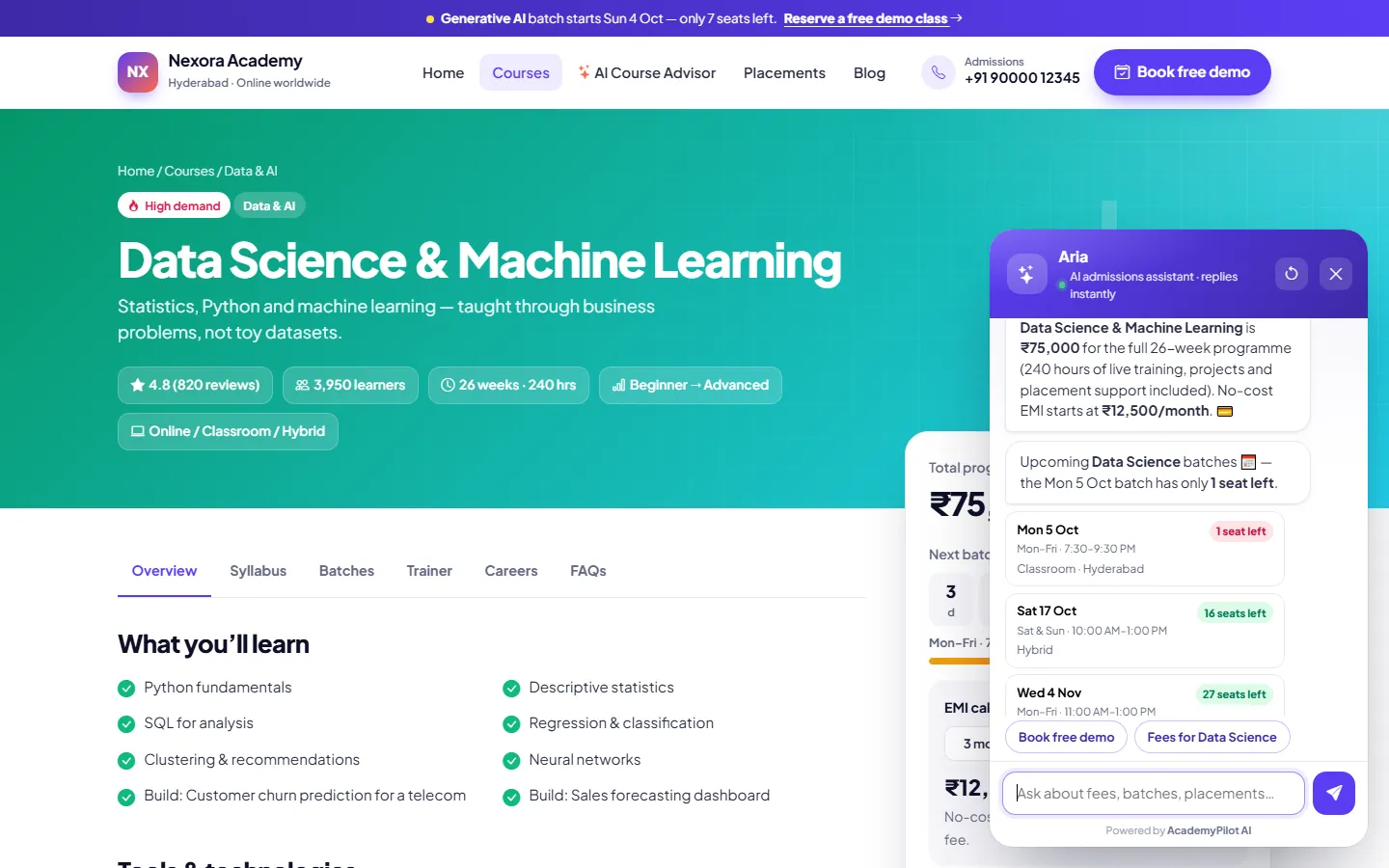 AcademyPilotAn AI website for training institutes with an admissions chatbot and course advisor that answer from programme details, plus a lead CRM with AI scoring. A working example of a domain-grounded assistant feeding a sales pipeline.Open →
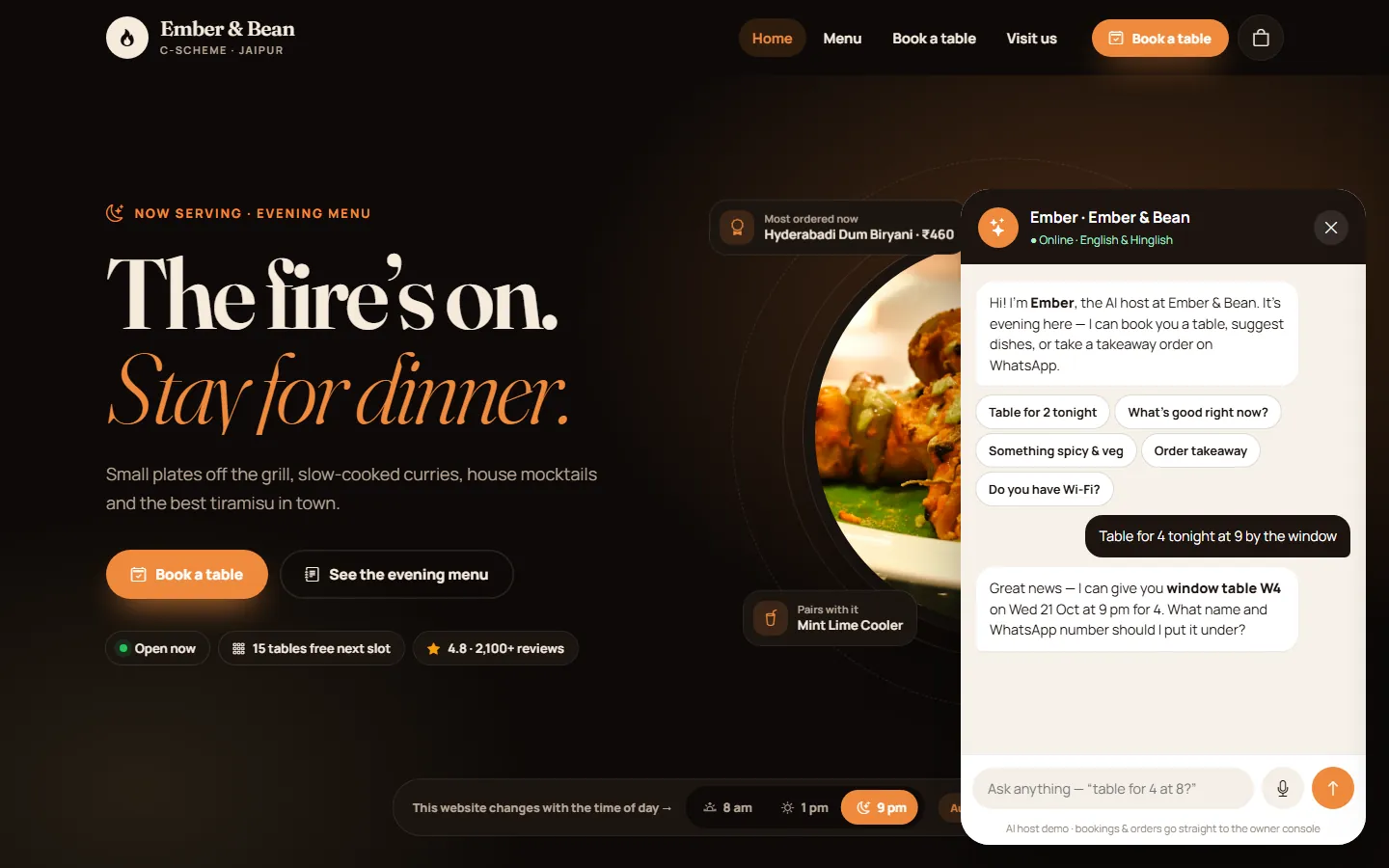 DinePilotA restaurant and café website whose AI host answers menu questions, takes bookings on a live floor plan and handles takeaway orders over WhatsApp in English and Hinglish, with an owner console behind it.Open →
Our stack for this work
What drives AI chatbot development cost in India
Every RAG project is priced on scope, so there is no rate card. Share your sources, users and channels and we send a fixed quote. These factors move the number most.
Clean, text-based documents are quick to ingest. Scanned PDFs, complex tables, spreadsheets with merged cells and conflicting versions need OCR, custom parsing and clean-up rules, which add effort.
One folder of files is simple. Several live systems with incremental sync, deletion handling and permission mirroring each add integration and testing work.
Single-team assistants need basic authentication. Multi-tenant SaaS, document-level permissions, PII redaction, audit trails and data residency requirements add design and review time.
An internal helper tolerates the occasional miss; a customer-facing or regulated assistant needs a larger test set, more tuning rounds and stricter fallback behaviour.
Each channel beyond a website widget (WhatsApp, Slack, Teams) adds work. Managed APIs are fastest to launch; private deployment on Bedrock or self-hosted open-source models costs more to set up but can lower running costs and satisfy stricter privacy rules.
Rag chatbot development: questions people ask
What is a RAG chatbot, and how is it different from ChatGPT?
A RAG chatbot answers from your own documents and data rather than from general internet knowledge. ChatGPT relies on what its model learned in training and may not know your policies, prices or products. A RAG system retrieves the relevant passages from your sources for every question, answers from them, cites them and can be restricted so each user only sees material they are allowed to access.
How much does AI chatbot development cost in India?
It depends on scope, so we quote a fixed price after a short discovery call rather than publishing ranges. The main cost drivers are the number and messiness of your sources, how many systems we connect, access control and compliance needs, the accuracy bar, the channels you want (web, WhatsApp, Slack) and whether you need private model hosting. Share those details and we will send a written quote.
How long does RAG chatbot development take?
A focused assistant over a clean document set usually fits our standard 2–8 week project window, including a pilot and evaluation. Enterprise RAG with several connectors, document-level permissions, compliance reviews and multiple channels takes longer. We agree milestones up front, and you see a working pilot on your own data early in the project rather than at the end.
Can the chatbot cite sources and avoid hallucinations?
Yes. Every answer links to the document and section it came from, and we verify citations before displaying them. Hallucinations are reduced by better retrieval (structure-aware chunking, hybrid search, re-ranking), strict answer-from-context instructions and a fallback that says “I don’t know” when confidence is low. No LLM is perfect, so we measure accuracy on your real questions and monitor it after launch.
How do you handle data security and role-based access?
Access is enforced in the retrieval layer, not in the prompt. Every indexed chunk carries tenant and permission metadata, and searches filter on the signed-in user’s roles, so restricted content never reaches the model. We add single sign-on, PII redaction, encryption, audit logs and deployment inside your own cloud account. Your data is never used to train public models.
What are the monthly running costs of a RAG chatbot?
Running costs come from LLM usage (questions multiplied by context size and model tier), embeddings when documents are added or changed, the vector database, hosting and monitoring. Model choice matters most: routing simple questions to smaller models, caching repeated answers and trimming context keeps bills predictable. We estimate running costs from your expected volume before you commit.
Can it answer from PDFs, Google Drive, databases and websites?
Yes. We ingest PDF, Word, Excel, PowerPoint, HTML and scanned files, connect to Google Drive, SharePoint, Notion, Confluence and similar tools, crawl approved websites, and query PostgreSQL or MySQL through read-only roles. Sources stay in sync, so edited documents are re-indexed and deleted ones stop appearing in answers.
Send us your documents and real questions
WhatsApp or call +91 63774 18934, or email team@ezibelltech.com, with a sample of your documents and the questions people actually ask. We will reply with an architecture outline, the risks we see and a fixed quote.