Django Development Company for Web Apps, APIs and Admin Panels
We build Django web applications, Django REST Framework APIs and admin-driven internal tools for startups and businesses worldwide. Hire our Python-first team by project or by month, pair Django with React or Next.js, and get software that is secure by default and straightforward to maintain.
- Team in Jaipur, India
- MSME & GST registered
- Live product demos you can try
A good Django development company knows when to lean on the framework and when to step around it. Django gives you an ORM, migrations, authentication, an admin interface, forms and strong security defaults in one coherent package, which is why it suits data-heavy business applications so well. The problems we are usually called in to fix come from fighting those conventions — or from ignoring what matters at scale, such as query efficiency, caching and background jobs.
Ezibell Tech is a Python-first team: Django, Django REST Framework and FastAPI are our daily tools, not one line in a long capabilities list. We build new Django web applications, add REST APIs to existing ones, pair Django back ends with React or Next.js front ends, and take over projects whose original developers have moved on. Razorpay or Stripe payments, Celery task queues, PostgreSQL tuning and AWS deployment are part of the normal job.
You can hire Django developers from us in two ways: a defined project at a fixed price, or a developer or small team on a monthly retainer who works as an extension of yours — inside your repository, stand-ups and tools. Either way, a senior developer reviews architecture and code. If your own team wants to learn the stack, our academy runs a live online Django and FastAPI backend programme; this page is about building it for you.
What our Django development company builds
Django web application development
Complete web applications — portals, marketplaces, booking systems and dashboards — with authentication, permissions, file handling, search, notifications and payments. Server-rendered Django templates where that is simplest, or an API-first design when a rich front end or a mobile app is on the roadmap.
Django REST Framework APIs
Versioned REST APIs with DRF serializers, session, token or JWT auth, object-level permissions, filtering, pagination, throttling and OpenAPI documentation. Built for React and mobile clients or for partners integrating with you, with query counts checked so list endpoints stay fast as data grows.
Django + React and Next.js
Django or DRF as the back end and React or Next.js as the front end, with a clear contract between them: auth, CORS and CSRF configured correctly, shared validation rules and API types generated from the schema, so front-end and back-end changes never silently drift apart.
Django admin and CRM development
A customised Django admin as a fast internal tool — filters, bulk actions, inline editing, import and export, change history — or a full custom CRM when staff need a polished, guided workflow. We know where the admin shines and where it should be replaced.
Performance and scaling
Profiling slow pages, removing N+1 queries, adding the right database indexes, caching with Redis, moving heavy work to Celery and setting up connection pooling or read replicas. We measure before and after, so every change is justified by data rather than guesswork.
Upgrades and legacy Django rescue
Upgrading Django and Python across LTS releases, replacing abandoned packages, fixing deprecations, adding tests to untested code and retiring Python 2-era patterns. We take over inherited projects and document them so they become maintainable again.
Payments, integrations and deployment
Razorpay, Stripe and UPI AutoPay with verified, idempotent webhooks, plus WhatsApp, email, Zoom and other third-party APIs. Dockerised deployment on AWS with Gunicorn, managed PostgreSQL, S3 for media files, CloudFront, CI/CD pipelines, error tracking and uptime monitoring.
Is Django good for large, scalable applications?
Yes — Django scales well when the database is treated with respect. The framework itself is rarely the bottleneck; slow Django sites are almost always slow because of query patterns. The usual culprits are N+1 queries in templates and serializers, missing indexes on filtered columns, loading whole objects when a few fields would do, and heavy work inside the request. Fixing these with select_related, prefetch_related, only(), proper indexes and query-count tests often transforms performance without any new infrastructure.
Beyond the database, scaling Django is standard web architecture. Run stateless app servers behind a load balancer and add more as traffic grows. Cache expensive fragments and API responses in Redis and serve static and media files through a CDN. Push emails, reports, imports and AI calls to Celery workers. Pool connections, and add read replicas when reporting competes with transactions. Async views help I/O-bound endpoints, but ORM async support is still partial, so we use async selectively.
- Profile first: Debug Toolbar or Silk locally, APM in production.
- Index every column used for filtering or ordering on large tables.
- Cache at the right layer — view, fragment or low-level — with explicit invalidation.
- Keep requests short; anything slow belongs in a Celery task.
- Scale horizontally with stateless containers before considering microservices.
Security defaults, and Django admin as an internal tool
Django ships with protection against the most common web attacks: CSRF tokens, an ORM that parameterises queries against SQL injection, auto-escaping templates against XSS, clickjacking headers and strong password hashing. Most Django security incidents come from switching those off — raw SQL built with string formatting, user input marked safe, DEBUG left on in production — or from object-level gaps where an API returns a record because the user is logged in, not because they own it. We review for exactly these patterns before every launch.
Django admin is the framework’s most underrated business feature. For internal staff it can deliver a working back office — searchable lists, filters, bulk actions, CSV import and export, change history — in days rather than weeks. Its limits are real: it is designed for trusted staff, not customers, and multi-step workflows quickly feel awkward. Our rule of thumb is admin for operations and data management, and a custom interface for anything customer-facing or workflow-heavy.
- Restrict admin access by network and enforce two-factor login for staff.
- Check object-level permissions in DRF, not just authentication.
- Keep secrets in environment variables or AWS Secrets Manager, never in settings files.
- Pin and scan dependencies, and apply Django security releases promptly.
Django vs FastAPI: how we choose
Both are Python, both are excellent, and they suit different shapes of project. Django is batteries-included — ORM, migrations, auth, admin and a mature ecosystem — ideal for data-rich business applications with many models, roles and back-office needs. FastAPI is a lean, async-first API framework with Pydantic validation and automatic OpenAPI docs, ideal for high-concurrency APIs, AI and LLM back ends, streaming and microservices where you assemble your own components.
In practice we often use both: Django for the core application and admin, and a FastAPI service for an AI or real-time component that benefits from async I/O. If you already run Django, adding DRF endpoints or async views is usually wiser than a rewrite, and a new FastAPI service can share the same PostgreSQL database. Our FastAPI development page covers the API side in depth.
How we work
- 1Scoping call
We discuss the product, users, integrations and any existing code, then recommend Django, FastAPI or a combination, with reasons. An NDA is available before you share details.
- 2Code audit or architecture plan
For existing projects we audit code, dependencies, tests, security settings and performance. For new builds we design the models, apps, permissions, API contracts and deployment approach.
- 3Scope and quote
A written scope with milestones and acceptance criteria, quoted fixed-price, hourly or as a monthly retainer for a dedicated Django developer or a small team working with yours.
- 4Build in weekly increments
Pull requests with tests and senior code review, a staging environment, migrations checked for safety on large tables, and a live demo for you every week.
- 5Launch
We run Django’s deployment checklist, verify security settings, put backups and monitoring in place, use zero-downtime releases where needed and keep a tested rollback plan ready.
- 6Maintain and improve
Ongoing version upgrades, security patches, performance tuning and new features on retainer or hourly terms, or a fully documented handover to your own in-house team.
Why teams choose us
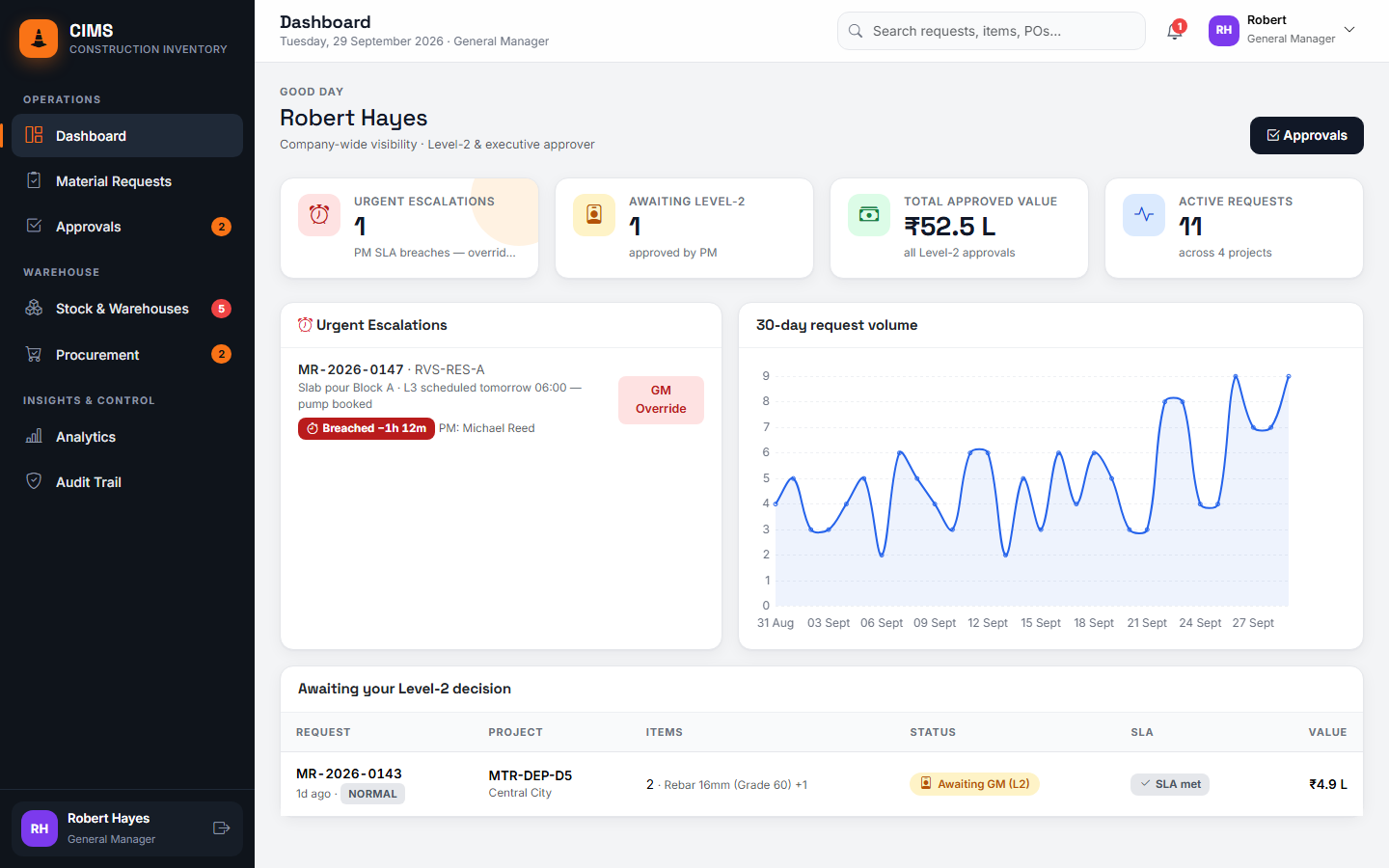 CIMS — construction inventory managementEight role cockpits, approvals with SLAs, stock movements and a full audit trail. It shows the permission, workflow-state and audit patterns that data-heavy Django applications depend on.Open →
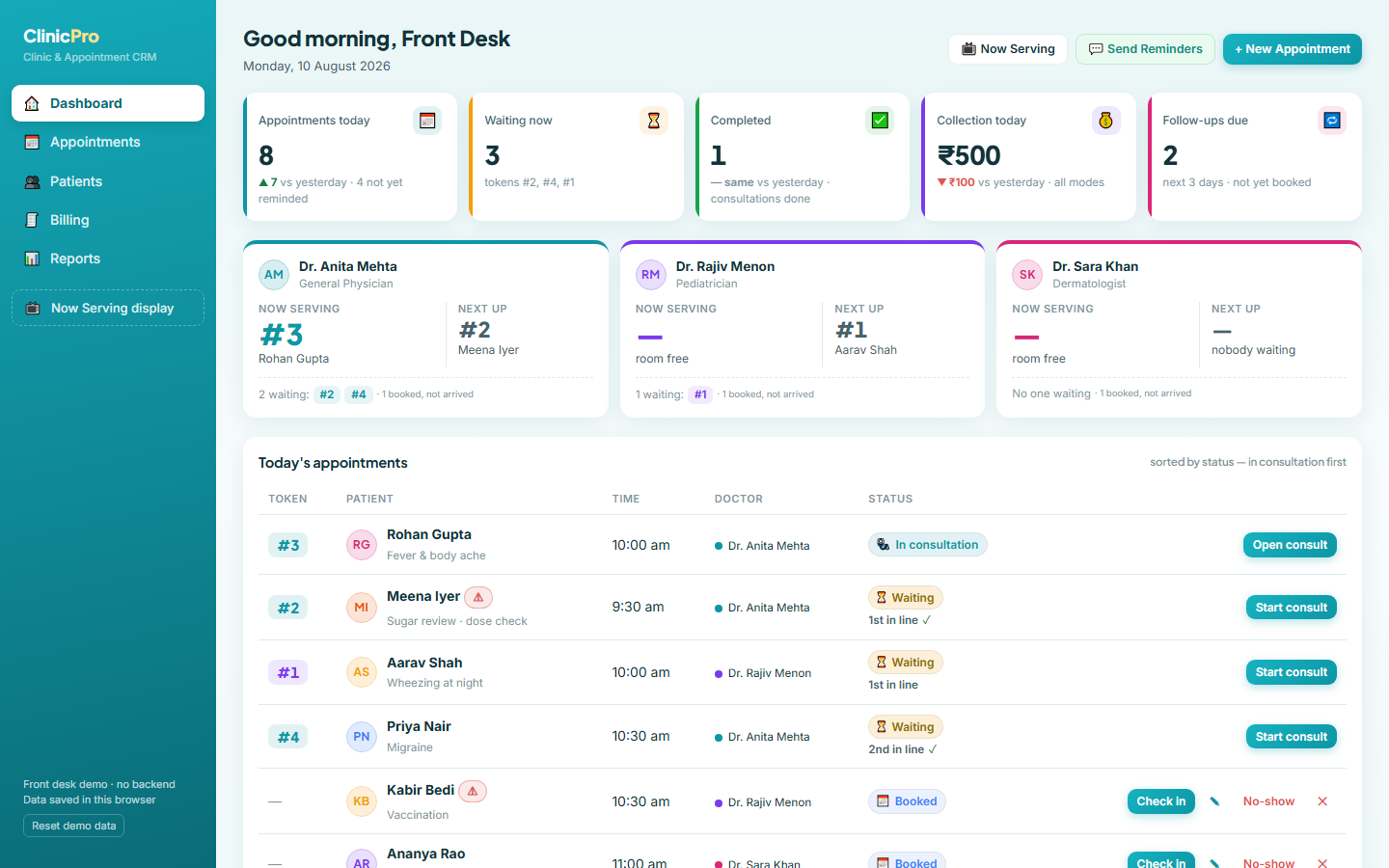 ClinicPro clinic CRMAn industry CRM for clinics. A useful reference if you are weighing a custom Django CRM or admin-driven back office for one industry against a generic off-the-shelf tool.Open →
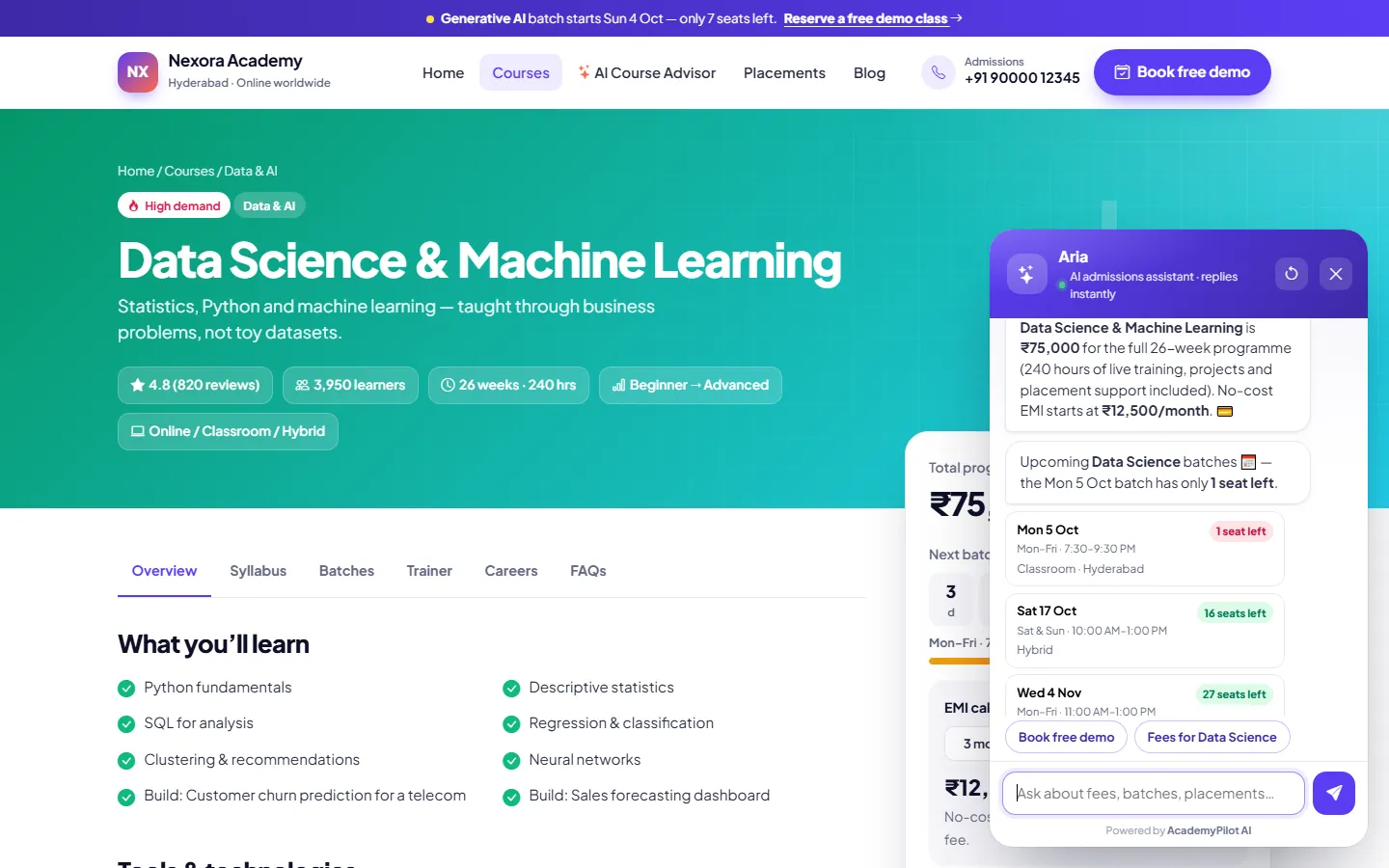 AcademyPilot for training institutesA lead CRM with AI scoring, an AI admissions chatbot and an AI blog writer — an example of combining a business back office with AI features in one product.Open →
Our stack for this work
What affects the cost of Django development
Rates alone say little: a senior developer who avoids a rewrite costs less than a junior one who causes it. Share your scope or repository and we quote fixed-price or monthly. The main drivers:
Greenfield work is easier to estimate. Inherited code needs an audit first, and missing tests, outdated packages or unclear business rules add effort.
Many interrelated models, multi-tenancy and object-level permissions take more design and testing than simple create-read-update-delete apps.
Django templates are quickest. A separate React or Next.js front end adds an API layer, auth handling and a second codebase to build and maintain.
Each gateway, ERP or messaging API adds auth, webhook handling, retries and monitoring. Supporting both Razorpay and Stripe, or UPI AutoPay mandates, adds more.
Retainers for dedicated developers are priced by seniority and commitment; fixed-price projects include estimation risk and a defined change process.
High-traffic or regulated applications need load testing, caching design, audit logging and security reviews beyond a standard build.
Django development company: questions people ask
What frameworks do your developers specialise in?
Our developers specialise in Python back ends: Django, Django REST Framework and FastAPI, with Celery, Redis and PostgreSQL. On the front end we use React and Next.js, and for mobile Flutter or React Native. For AI features we work with OpenAI and Claude APIs, LangChain, LangGraph and vector stores such as pgvector and Qdrant. Deployment is usually Docker on AWS.
Is Django good for large, scalable applications?
Yes. Django scales horizontally like any stateless web framework, and performance problems almost always come from database access patterns — N+1 queries, missing indexes, heavy work inside requests — rather than from Django itself. With query optimisation, Redis caching, Celery for background work, connection pooling and read replicas, a well-built Django application handles serious growth without a rewrite.
Can you build a Django back end with a React front end?
Yes, it is one of our most common set-ups. Django or Django REST Framework provides the API, authentication and admin, and React or Next.js provides the interface. We configure session or JWT auth, CSRF and CORS correctly, generate API types from the OpenAPI schema and deploy both together so releases stay in sync. See our React development page for the front-end side.
How much does it cost to hire a Django developer in India?
It depends on seniority, commitment and scope, so we quote after understanding the work rather than publishing a rate card. A monthly retainer for a dedicated Django developer is priced by experience level and hours; a fixed-price project is priced from a written scope. Codebase condition, integrations and performance or compliance needs move the number most. Share your requirement on WhatsApp for a clear quote.
Can you maintain and upgrade a legacy Django project?
Yes. We start with an audit of Django and Python versions, dependencies, tests and deployment, then upgrade step by step through LTS releases instead of jumping versions blindly. Deprecation warnings are fixed, abandoned packages replaced and tests added around critical flows before each step. Projects stuck on very old versions or Python 2-era code get the same careful treatment.
Django or FastAPI — which should I choose?
Choose Django for data-rich business applications that benefit from its ORM, migrations, auth and admin. Choose FastAPI for async, high-concurrency APIs, AI and LLM back ends, streaming or lean microservices. Many products use both: Django for the core app and back office, FastAPI for an AI or real-time service. As a Django development company that also builds FastAPI, we recommend based on your workload, not habit.
Can I hire a dedicated Django developer monthly?
Yes. On a monthly retainer a dedicated developer, or a small team, works inside your repository, issue tracker and communication tools, joins your stand-ups and follows your conventions. A senior developer on our side reviews architecture and code. You can scale capacity up or down with notice, and all work belongs to you under the contract.
Hire Django developers who build for the long run
Tell us about your project, or share your repository for a review. We reply with an honest assessment and a fixed or monthly quote. WhatsApp or call +91 63774 18934, or email team@ezibelltech.com.