Flutter App Development Company for Cross-Platform Apps
Ezibell Tech is a Flutter app development company that also builds in React Native when it fits better. One codebase for Android and iOS, offline sync that survives bad networks, payments, push notifications and AI features — taken from MVP to the Play Store and App Store.
- Team in Jaipur, India
- MSME & GST registered
- Live product demos you can try
Choosing a Flutter app development company is mostly about what happens after the demo looks good. Cross-platform frameworks make the first screens fast; the hard parts are offline data that syncs without losing edits, background work the OS doesn’t kill, payments that pass store review, and an app that still builds after next year’s OS updates. We plan for those from the start, so your one codebase stays one codebase.
We build in Flutter and React Native. Flutter is our usual pick for custom, brand-heavy interfaces that must behave consistently across devices; React Native suits companies that already run React on the web and want to share logic and developers. Typical builds: offline field-service and inventory apps, customer apps for restaurants, clinics and booking businesses, companion apps for SaaS products, and MVPs that need both stores without doubling the budget.
Every app needs a back end, and that is where our Python background matters. We build the API in Django or FastAPI, the admin panel your operations team will use daily, and the cloud setup on AWS. AI features — a support assistant, data extraction from photographed documents, smart search — run through your server so API keys never ship inside the app. We are based in Jaipur and work with clients across India and worldwide; for local projects see our Jaipur mobile app page.
What our Flutter app development company builds
Cross-platform MVPs
A focused first version on Android and iOS from a single codebase: core user journeys, authentication, analytics and crash reporting, built so the architecture survives version two. We help cut scope to what proves the idea and write down clearly what is deferred.
Offline-first field apps
Apps for sales reps, technicians, surveyors and warehouse staff that keep working without signal: a local database, background sync, conflict rules agreed with your team, and photo or signature capture that uploads when the network returns.
Payments and subscriptions
Razorpay and Stripe SDKs for physical goods and real-world services, UPI intent flows on Android, and Apple and Google in-app purchases where store rules require them for digital content. Every payment is verified on the server, whichever route it takes.
AI features
LLM-powered assistants, chat over your help content, smart forms that extract data from photos of documents, and summaries for busy users. All model calls go through your back end, with rate limits, logging and costs you can see.
Push, real-time and location
Push notifications through Firebase Cloud Messaging and APNs, in-app chat and live updates over WebSockets, and maps or geofencing where the use case needs it — with permission prompts and battery use handled the way store reviewers expect.
Back end and admin panel
A Django or FastAPI API on PostgreSQL, a role-based admin panel for your operations team, and AWS hosting. One team owns the app and its server, so changes land on both sides without a hand-off between vendors.
Play Store and App Store publishing
Signing, privacy policy and data-safety declarations, screenshots and listing copy, closed testing tracks on Play and TestFlight builds on iOS, and responses to reviewer questions or rejections until the app is live in both stores.
Maintenance and upgrades
Yearly OS and SDK updates, Flutter or React Native version upgrades, dependency security patches, crash triage from Crashlytics or Sentry, and small feature releases on a monthly retainer, so the app stays installable and compliant.
Flutter vs React Native: a practical decision guide
Both frameworks run serious production apps; neither is the wrong choice in the abstract. The decision is about your team, your interface and your roadmap. Flutter draws every pixel with its own rendering engine, so a custom design looks and behaves the same on a budget Android phone and the latest iPhone. React Native renders real native components and, with its newer architecture, talks to native code with far less overhead than it used to.
Pick React Native if your company already has React developers and a React web app: you share TypeScript models, validation and API clients, and people move between web and mobile. Pick Flutter if the app is design-led, animation-heavy or needs pixel-consistent UI across many Android devices, or if you are building a mobile team from scratch. Our CTO decision matrix, linked below, goes deeper.
- Existing React web team and shared business logic: React Native
- Custom brand UI, heavy animation, consistent rendering: Flutter
- Need a marketing website that ranks on Google: build it separately in Next.js, whichever mobile framework you choose
- Deep native features such as Bluetooth peripherals or custom camera pipelines: either works, but budget for native code
Offline-first architecture that doesn’t lose data
‘Works offline’ is easy to promise and hard to deliver. An offline-first app treats the local database as the source the UI reads from, and the server as something it syncs with when it can. Every create, edit and delete is written locally first, queued as an operation with a client-generated ID, and replayed to the server when the network returns. The server must accept those operations idempotently, because the same operation will sometimes arrive twice.
The real design work is conflict resolution. If a technician edits a job offline while the office reassigns it, who wins? Last-write-wins is simple but silently drops edits. Field-level merging keeps more data but needs careful modelling. Some records should be server-authoritative and read-only offline. We agree these rules per record type with your team, then implement them on SQLite-based storage (Drift in Flutter, SQLite or WatermelonDB in React Native) with a sync protocol we can test.
Background sync has limits. Android and iOS both restrict background work to save battery, and iOS in particular schedules it on its own terms. So we sync on app open, on connectivity change and opportunistically in the background, show users clearly which changes are still pending, and never let anyone believe an unsynced change is already safely on the server.
Store publishing and life after launch
Getting into the stores is a project phase, not an afternoon. Google Play requires data-safety declarations, an up-to-date target SDK and, for new personal developer accounts, a closed testing period before production access. Apple reviews every build against its guidelines, and both stores require in-app account deletion if users can create accounts. Digital goods consumed in the app usually must use in-app purchase, while physical goods and real-world services can use Razorpay or Stripe.
After launch, your store rating behaves like an engineering metric: crashes, slow start-up, battery drain and flows broken by an OS update all turn into one-star reviews. We set up crash reporting, performance monitoring and staged rollouts from the first release, so a bad build reaches a small share of users before everyone. Every year Google raises its target SDK requirement and Apple ships a new iOS; a maintenance plan keeps the app compliant and installable.
- Staged rollouts on Play and phased releases on the App Store
- Crashlytics or Sentry with alerts on new crash clusters
- Minimum-version checks and force-update for breaking API changes
How we work
- 1Discovery and scope
We map users, journeys, offline needs, integrations and store constraints, then agree an MVP scope and a list of what is deliberately deferred. You get a written plan and a fixed quote.
- 2Design and clickable prototype
Wireframes, then a clickable prototype in your brand, tested with a few real users where possible. Store guideline issues around payments, permissions and login are flagged here, not at review.
- 3API and app in parallel
We agree the API contract first, so the back end and the app are built side by side. Builds reach your phone through TestFlight and Play internal testing every week or two.
- 4Testing on real devices
Automated widget and integration tests, plus manual testing on low-end and current Android phones and iPhones, including offline use, poor networks and payments interrupted halfway.
- 5Store submission and launch
Listings, screenshots, privacy declarations, reviewer responses and a staged rollout. We stay on call through launch week to fix anything real users find in the wild.
- 6Monitor, maintain, improve
Crash and performance monitoring, OS and SDK updates, and a backlog of improvements driven by reviews and analytics, on a retainer or as fixed-scope releases.
Why teams choose us
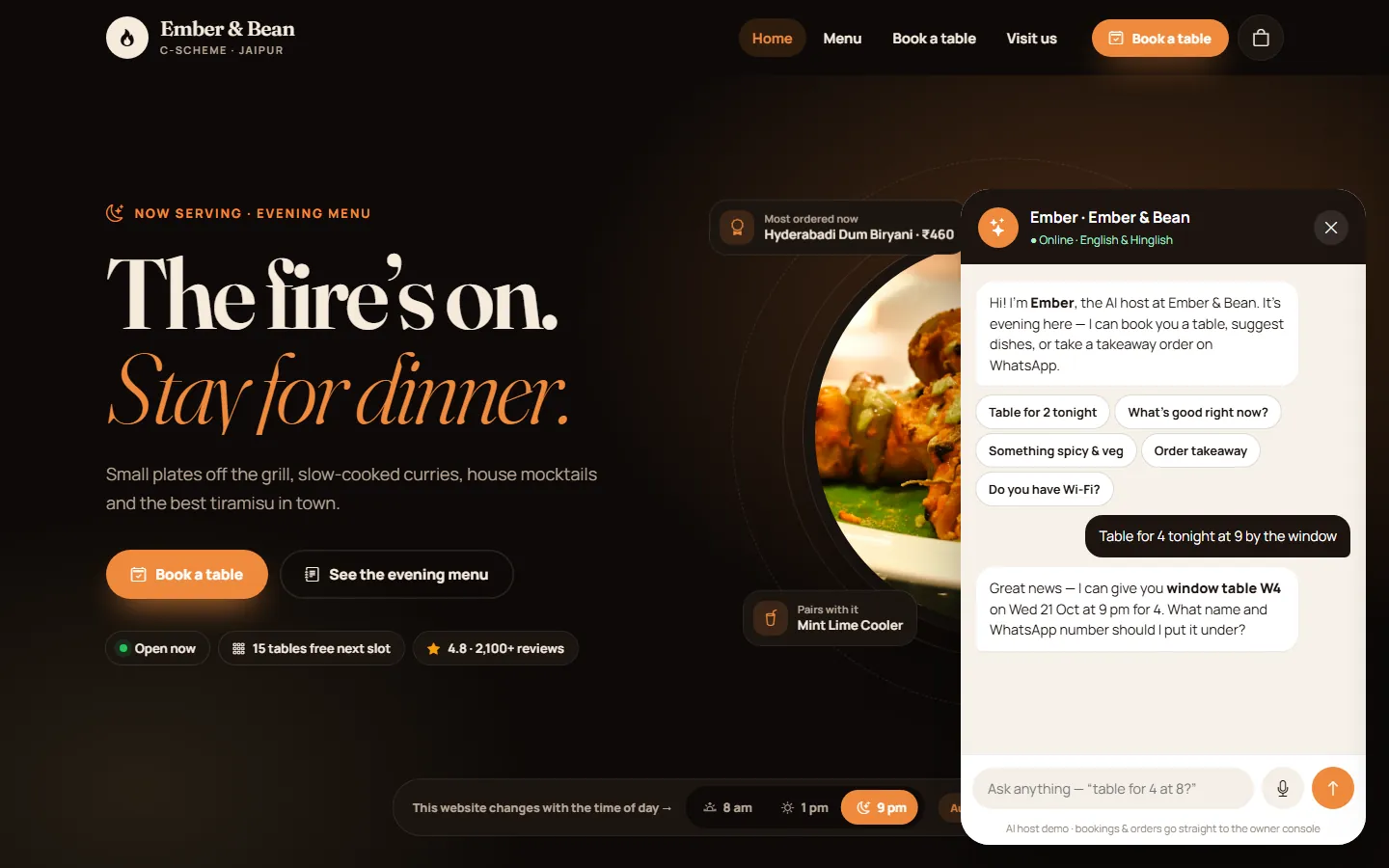 DinePilotA time-aware restaurant website, an AI host that takes bookings and WhatsApp orders, and an owner console — the same customer-plus-operator split most mobile app projects need.Open →
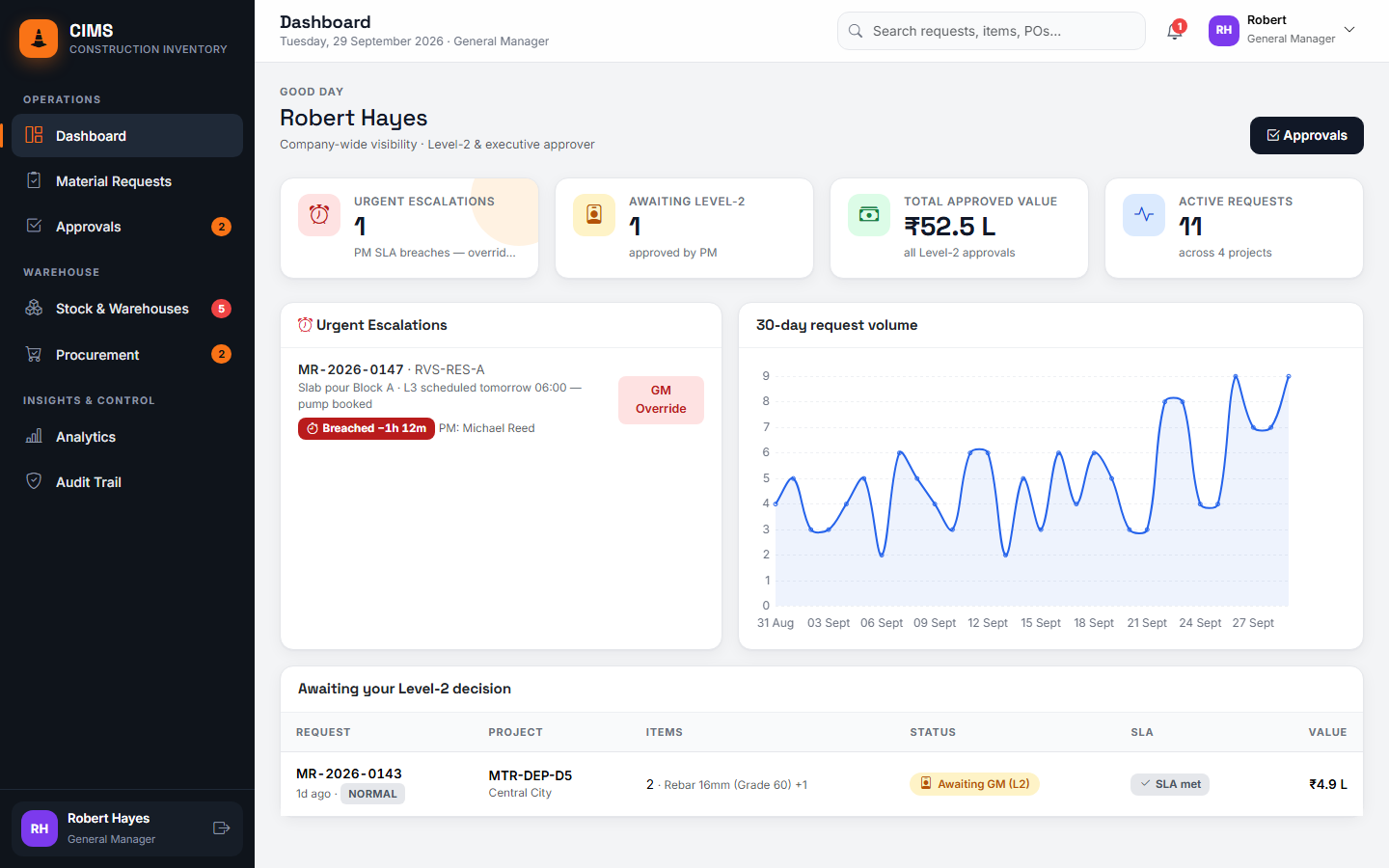 CIMSConstruction inventory with approvals, stock, dispatch and site receipt across eight role cockpits. Site receipt is exactly the kind of workflow we would ship offline-first.Open →
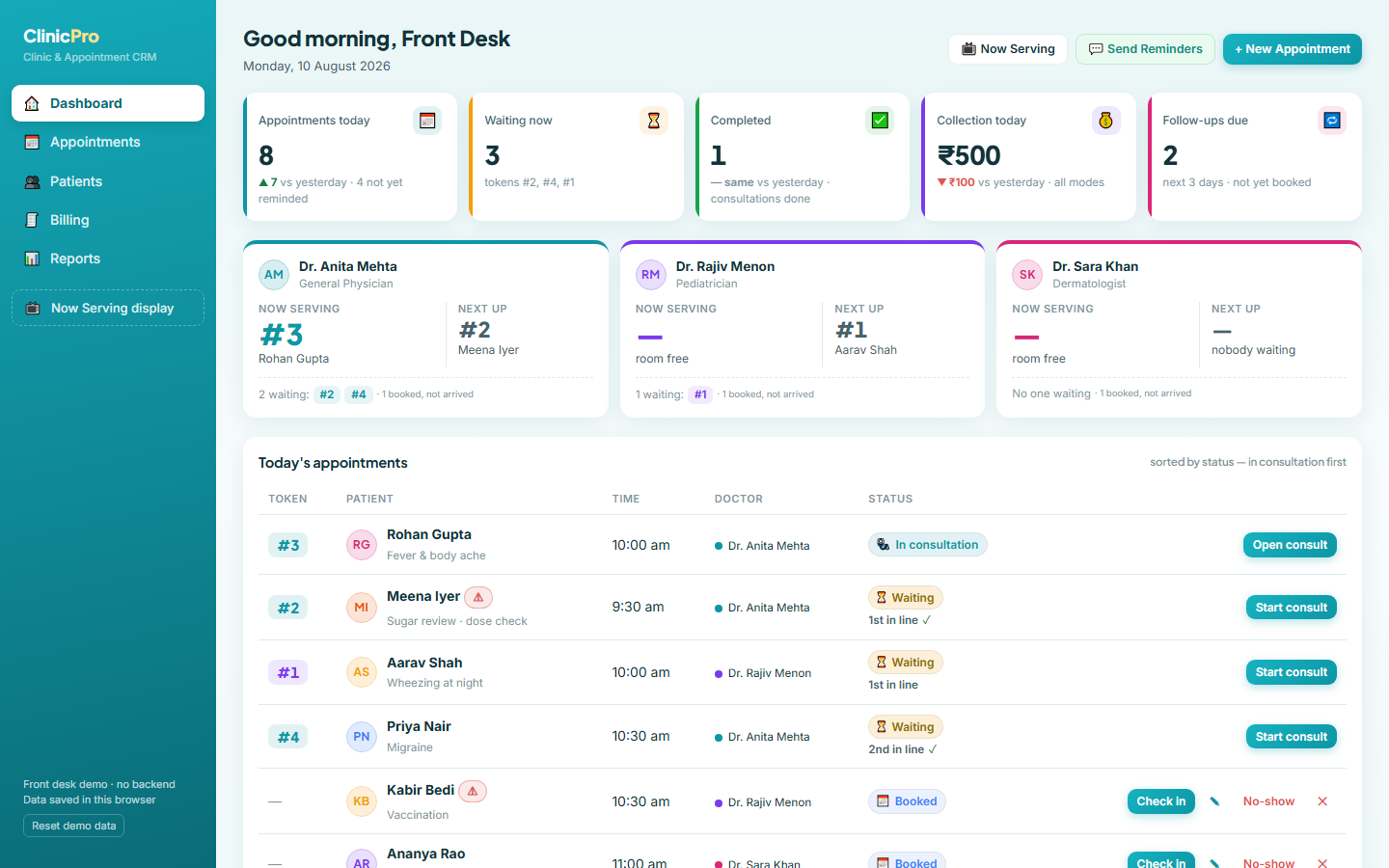 ClinicProA clinic CRM demo for front-desk and doctor workflows — the operator side that a patient-facing Flutter app would sync with, sharing one back end and one source of truth.Open →
Our stack for this work
Flutter app cost guide: what drives the price
We don’t publish a price list, because two ‘simple apps’ can differ several times over in effort. These are the drivers we price on; share your idea or feature list and we send a fixed quote for a defined scope.
A single-role app with a handful of flows is far smaller than one serving customers, staff and admins with different permissions.
Read-only offline caching is modest; full offline editing with conflict resolution is one of the biggest cost drivers in mobile work.
Using an existing API is cheapest. A new back end, admin panel and cloud setup is often as much work as the app itself.
Payments, maps, chat, video, WhatsApp, ERP or CRM sync each add build and testing time, especially where webhooks are involved.
Standard components are quick; bespoke, motion-heavy interfaces take longer to build and to test across devices.
A web build, tablet layouts, accessibility requirements or health and finance data rules all add scope.
Flutter app development company: questions people ask
Should we choose Flutter or React Native?
Choose React Native if you already have React developers and a React web app, because you can share code and people. Choose Flutter for design-led apps that need consistent custom UI across many devices, or when you are starting a mobile team fresh. Both are mature. We build in both, so we recommend based on your team, interface and roadmap rather than habit.
Can one app run on Android, iOS and the web?
Yes for Android and iOS — that is the main reason to use Flutter or React Native. The web is a qualified yes: Flutter web and React Native for Web work well for logged-in, app-like screens, but not for public pages that must rank on Google. For a marketing site or SEO content we usually build a separate Next.js site on the same back end.
How much does Flutter app development cost?
It depends on scope, not the framework. The biggest drivers are the number of user roles and screens, offline editing, whether you need a new back end and admin panel, integrations such as payments and chat, and how custom the design is. As a Flutter app development company we price a defined scope: send your feature list and we reply with a fixed quote.
Can you build apps that work offline?
Yes. We build offline-first apps where data is stored on the device, edits queue locally and sync when the network returns, with conflict rules agreed per record type. The server handles repeated sync requests safely, and the app shows users what is still pending. This suits field sales, inspections, deliveries, inventory and any team working with patchy coverage.
Do you publish the app on the Play Store and App Store?
Yes. We prepare signing, store listings, screenshots, privacy and data-safety declarations, and run closed testing on Play and TestFlight on iOS. We handle reviewer questions and rejections until the app is approved. Developer accounts should be in your company’s name so you own the listings; we guide you through setting them up.
What maintenance does a mobile app need after launch?
More than most owners expect. Google raises the required target SDK every year, Apple ships a new iOS, and libraries release security fixes; ignoring this eventually blocks updates or breaks the app. Our retainer covers OS and SDK updates, framework upgrades, crash fixes and small improvements, with staged rollouts.
Can you add AI features to our app?
Yes — assistants that answer from your own content, data extraction from documents and photos, smart search, summaries and recommendations built on LLMs. The app calls your back end, which calls OpenAI, Claude or an open-source model, so keys stay off the device and you control cost, logging and data retention.
Planning an app? Let’s scope it
WhatsApp or call +91 63774 18934, or email team@ezibelltech.com with your feature list. We’ll recommend a framework and send a fixed quote.