Generative AI Course Online — Build Real LLM Applications, Live
A live generative AI course online for developers, students and engineering teams. Learn how large language models behave, make their output reliable, ground them in your own data, give them tools and ship the result behind a real API, with weekly labs and code reviews by senior engineers.
Updated- Live online classes + recordings
- Senior Python developers as mentors
- Certificate with a verifiable ID
A generative AI course is only worth your time if it leaves you able to build software that uses large language models, not just write clever prompts in a chat window. That is the focus of the Ezibell AI Academy, the training arm of Ezibell Tech, a software company based in Jaipur that builds AI systems, backends and AWS workloads for clients. The same senior engineers teach the live online classes, so you can join from any city in India or from abroad.
Generative AI here means applied engineering. You learn how models such as GPT, Claude, Gemini and Llama respond to prompts, how to get structured JSON out of them, how to retrieve the right facts from your documents, how to let them call tools safely and how to measure whether a change made things better or worse. We do not teach machine learning, deep-learning theory or data science; those are different careers with different courses.
No single generative AI course fits everyone, so you pick a track. Developers with a year or more of experience take the 14-week AI Engineer Accelerator on weekends. Beginners start with the 20-week Python to AI Launchpad, which ends in Generative AI and RAG. Developers on AWS add the Bedrock programme, individuals can learn 1:1 with a mentor, and companies can book corporate upskilling. Fees and EMI options are shared on WhatsApp at +91 82097 16316.
What the generative AI course covers
How LLMs behave, and how to choose one
Tokens, context windows, temperature and top-p, streaming, and multimodal inputs such as images, documents and audio. You benchmark three models on a task of your own for cost, speed and quality, so you pick models on evidence and keep your skills portable across vendors.
Prompts that software can depend on
System prompts, roles, few-shot examples and when to ask for reasoning versus a direct answer. Then JSON-schema outputs, function calling, Pydantic validation with automatic retries and versioned prompt templates. Your lab is an extraction service that returns validated JSON.
Retrieval and RAG over your own data
Embedding models, chunking strategies and vector stores such as pgvector and Qdrant, with metadata filters and hybrid keyword-plus-vector search. You then build a RAG service with query rewriting, re-ranking, citations and an evaluation suite, plus a text-to-SQL assistant over a million-row database.
LangChain pipelines and LangGraph agents
Runnables and LCEL, retrievers and tracing in LangSmith, then agents built as LangGraph graphs: state, nodes, conditional routing, checkpoints, human approval steps and supervisor or swarm patterns. You also learn when a plain Python function is simpler than any framework.
Model Context Protocol servers
MCP is the open standard for connecting AI assistants to tools and data. You build a Python MCP server exposing tools, resources and prompts, connect it to Claude Desktop, an IDE and a LangGraph agent, and secure it with authentication and sensible limits.
Evals, guardrails and cost control
Evaluation datasets, LLM-as-judge with human review, regression tests for prompts, tracing in Langfuse and LangSmith, and dashboards for cost and latency. Guardrails cover prompt injection, jailbreaks and PII redaction, and caching keeps API bills sensible as usage grows.
Deployment, portfolio and certificate
FastAPI services that stream responses, queues for long-running AI jobs, Docker, and deployment with Lambda, Fargate and Amazon Bedrock. Five projects live in your own GitHub account, and a capstone reviewed by a team lead leads to a certificate verifiable at /certificates.
Choose your programme
Every track is live, mentor-led and project-based. Tap one for the full syllabus, duration and FAQ.
AI Engineer Accelerator
The main generative AI course: 14 weekend weeks and about 105 live hours on LLM foundations, structured outputs, RAG, LangChain, LangGraph agents, MCP, evals and AWS deployment, with five projects and a team-lead capstone review.
Students, freshers and career switchers who have not coded beforePython to AI Launchpad
Twenty weeks that teach Python properly, then databases and FastAPI, before a Generative AI and RAG module and a capstone study assistant that answers from your own notes with citations.
Python developers building on AWSAWS for Python Developers: Serverless, Containers & Bedrock
Twelve weekend weeks on serverless and containers, then Amazon Bedrock: the Converse API, Knowledge Bases, Guardrails, Bedrock Agents and AgentCore, so your generative AI runs on managed models inside AWS.
Learners who want a personal generative AI roadmap1:1 AI Career Mentorship
Four one-hour 1:1 video sessions a month with a senior engineer, a roadmap built around your goals, pull-request reviews and a monthly mock interview. Three months recommended.
Engineering managers and teams starting AI projectsCorporate AI & Cloud Upskilling
From a 2-day workshop to an 8-week programme, on-site or live online: RAG on your data, LangGraph agents, MCP and Bedrock, team AI guidelines and an optional pilot on your own use case.
What a good generative AI course should teach in 2026
A useful generative AI course teaches the whole path from a model call to a monitored production feature, because that is where the engineering work is. Calling an LLM API takes a few lines of code; making the answer correct, grounded, affordable and safe takes almost all of the effort, and that is the part employers and clients pay for.
Use the layers below as a checklist for any course you consider, including ours. A syllabus that stops at prompt engineering and a chatbot wrapping one API call is a starting point, not a career skill. Our week-by-week syllabus, with every lab, is published on each programme page so you can compare line by line before you speak to anyone.
- Model behaviour: context limits, sampling, and choosing on cost, latency, quality and privacy
- Reliability: structured outputs, validation, retries and versioned prompts
- Grounding: embeddings, hybrid retrieval, re-ranking and citations
- Action: tool calling, stateful agents, human approval and MCP
- Quality and delivery: evals, tracing, guardrails, streaming APIs and cloud deployment
Generative AI vs machine learning: what this course does not teach
This course does not teach machine learning or data science, and the difference matters when you choose. Machine learning courses train models from data, with statistics, feature engineering, neural networks and the maths behind them. Generative AI engineering, as we teach it, builds products on foundation models that already exist, through APIs and open-weight models, so school-level maths is enough.
Both are legitimate careers, but they lead to different jobs. If you want to research models or analyse datasets, look for a data science programme. If you want to add AI features to real software, such as document assistants, support bots, internal agents or AI search, you need strong Python, API design, retrieval, evaluation and deployment, which is what the Accelerator covers.
Why most generative AI demos never reach production
Most generative AI demos stall because nobody measured them. A prototype that answers ten hand-picked questions well tells you little; the same system can fail quietly on the eleventh, and you will not know without an evaluation set, tracing and regression tests on every prompt change. That is why evals get their own module rather than a slide at the end.
The other blockers are cost, latency, privacy and lock-in. A model that shines in testing can be too slow or expensive for real traffic, so you learn caching, cheaper models for simple steps, streaming and fallbacks. Some data must stay inside your environment, so you compare commercial APIs, open-weight models and Amazon Bedrock, and design so that swapping a model is a configuration change, not a rewrite.
How the course works
- 1Counselling call on WhatsApp
Message or call +91 82097 16316 with your background. A mentor checks your coding level and goals, then recommends a track, honestly, even if it differs from the one you asked about.
- 2Pick a track and batch
Choose the Accelerator, Launchpad, AWS programme, 1:1 mentorship or a corporate plan. The fee, EMI options and refund and batch-transfer terms are shared in writing before you pay.
- 3Live online classes
Attend live sessions with senior engineers, on weekends for the Accelerator and AWS programme. Every session is recorded, and a private mentor group handles doubts between classes.
- 4Labs and pull-request reviews
Most weeks end in a lab, from a model benchmark to an MCP server. You push it to GitHub and mentors review your architecture and code.
- 5Capstone and demo day
Scope and build an AI feature for a real business use case, with weekly mentor reviews, an architecture review by a team lead and a final demo.
- 6Certificate and interview prep
Your mentor signs off the work, your certificate is issued with a unique verification ID, alongside your track’s resume and interview preparation.
Why learn with us
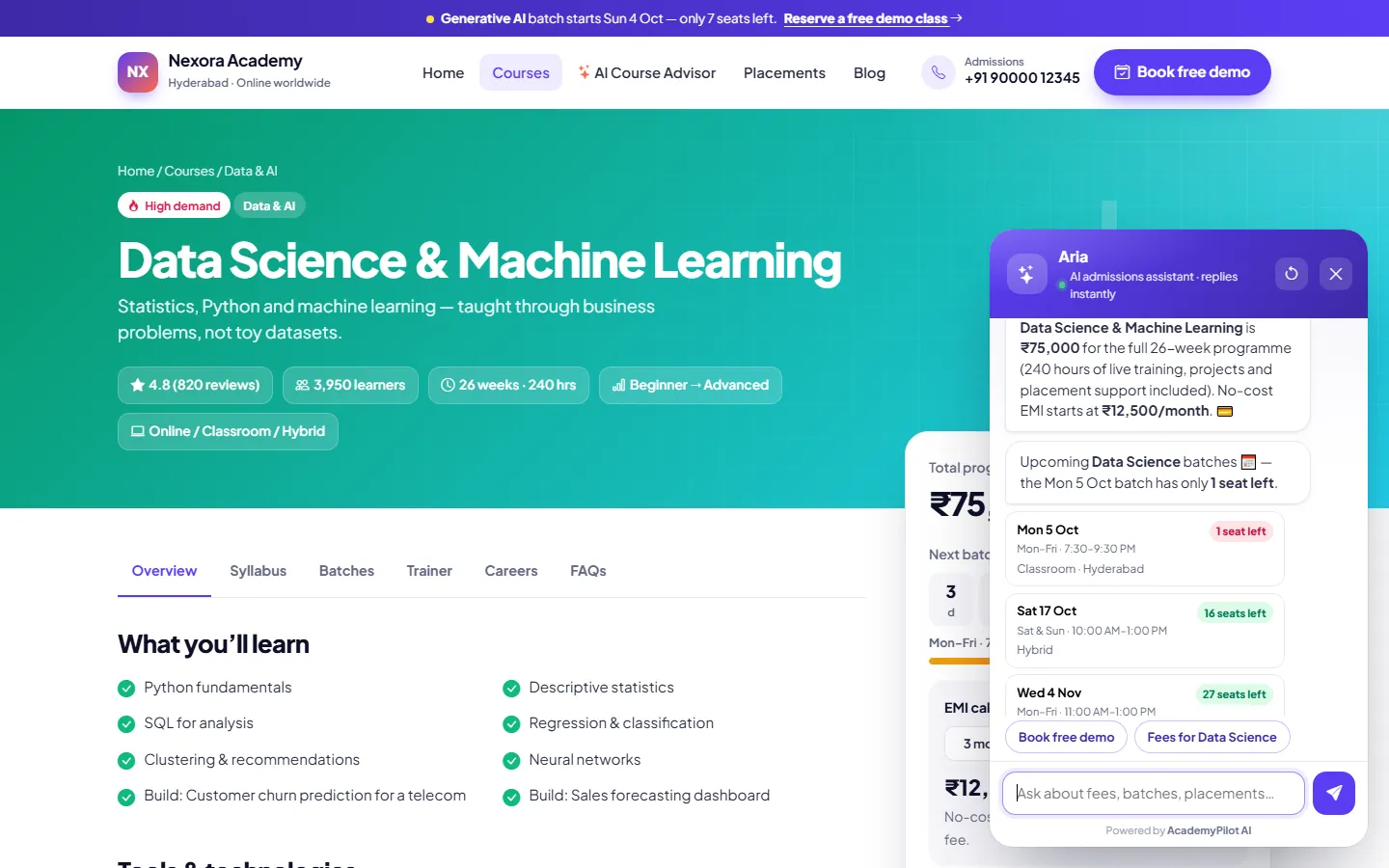 AcademyPilot demoAn in-house demo our team built: AI admissions chatbot, course advisor, lead scoring and blog writer for training institutes. It is an interactive demo you can try in your browser, and it shows the kind of GenAI product our mentors design.Open →
Certificate verificationEach certificate carries a unique ID that an employer can check on this public page, so anyone can confirm it was issued to you.Open →
What you’ll work with
What shapes the fee for a generative AI course
There is no single fee, because the tracks differ. These factors change it:
The Accelerator runs 14 weeks with about 105 live hours, the Launchpad 20 weeks with about 150, and the AWS programme 12 weeks with about 90.
If you already code professionally, you skip the Launchpad and join the Accelerator directly. Beginners need the Python foundations first, which adds time but makes the AI modules far easier.
A cohort shares mentor time in a small group. 1:1 mentorship is four one-hour sessions a month on your schedule. Corporate training is customised, from a 2-day workshop to an 8-week programme.
Your own LLM API and AWS usage is separate and small; mentors show you free credits, spending limits and billing alarms. Fees and EMI options are shared on WhatsApp.
Generative ai course: questions people ask
How long is the generative AI course?
The AI Engineer Accelerator, our main generative AI course, runs for 14 weeks with about 105 live hours on weekends. Beginners take the 20-week Python to AI Launchpad, about 150 live hours, which covers Generative AI and RAG in weeks 17 and 18. The AWS Bedrock programme is 12 weeks, and 1:1 mentorship runs month to month.
Do I need coding experience for a generative AI course?
For the Accelerator, yes: it expects at least a year as a developer. Python developers fit straight in, and Java, Node, .NET or PHP developers get a fast-track Python bridge in week one. If you have never coded, the Python to AI Launchpad starts from zero and needs only school-level arithmetic.
Is the generative AI course online or offline?
It is live online, with no classroom batch. Senior engineers teach in real time, and every class is recorded for revision. You can join from any city in India or from abroad. If you would like to meet the team in person before enrolling, WhatsApp us to arrange a time.
Are there weekend batches for working professionals?
Yes. The Accelerator and the AWS programme run on weekends and are built for working professionals, while the Launchpad runs on weekday evenings or weekends. Exact timings are shared before each batch starts, and 1:1 mentorship is scheduled around your calendar.
Is this a generative AI certification course? Is the certificate recognised?
You receive a professional training certificate, not an exam-based certification. Ezibell Tech, an MSME (Udyam) and GST registered company, issues it once your mentor signs off your labs and capstone, with a unique ID anyone can verify at /certificates. It is not a university degree or a government accreditation; its value is the projects behind it.
What projects will I build?
On the Accelerator you build five: a production RAG service with hybrid search, citations and an evaluation suite; a text-to-SQL assistant over a million-row database; a multi-tool LangGraph agent with human approval steps; your own MCP server; and a capstone AI feature for a real business use case, deployed on AWS.
Do you offer placement after the course?
No, we do not guarantee placement, and you should be wary of anyone who does. The Accelerator includes AI-engineer resume and interview preparation, the Launchpad includes resume, LinkedIn and mock-interview support, and mentors share opportunities from our network.
Which generative AI programme should I choose?
Choose by your current level. Working developers take the AI Engineer Accelerator; beginners and students take the Python to AI Launchpad; developers whose company runs on AWS add the Bedrock programme; anyone wanting personal guidance picks 1:1 mentorship; and engineering managers book corporate upskilling. A free counselling call on +91 82097 16316 settles it.
Ask a mentor which generative AI track fits you
WhatsApp or call +91 82097 16316 with your coding background and goal. A senior engineer will recommend a track, share the current fee and EMI options, and tell you when the next batch starts.