AI Course for Beginners — Learn AI from Scratch, Python First
An honest AI course for beginners, students and freshers with no coding background. Spend twenty weeks learning Python properly, then databases and APIs, then building Generative AI apps that answer from your own documents — in live online classes with mentors who review your code every week.
Updated- Live online classes + recordings
- Senior Python developers as mentors
- Certificate with a verifiable ID
Many listings for an AI course for beginners promise you will build AI in a weekend, then assume you can already code. The honest route is slower and works better: learn Python properly, then data and APIs, then build with large language models. That is the order of the 20-week Python to AI Launchpad at the Ezibell AI Academy, run by Ezibell Tech, the Jaipur-based software company whose developers build AI systems for clients.
Be clear about what “AI” means here. You learn to build applications with existing large language models — calling the OpenAI and Claude APIs, getting structured answers and searching your own documents with embeddings and RAG. Machine learning, model training, statistics and data science are not taught at the academy, and school-level arithmetic is enough. If you want a data-scientist role, this is the wrong course.
The Launchpad is about 150 live hours, taught live online on weekday evenings or weekends, with every session recorded. It is open to learners from commerce, science, arts and every engineering branch; what matters most is steady practice. If you would rather learn one-to-one, a mentor can build a personal roadmap instead. Fees and EMI options are shared on WhatsApp at +91 82097 16316.
What the AI course for beginners covers, week by week
Python from your first script
Weeks 1 to 3: installing Python and VS Code, syntax, variables, data types, operators, strings and f-strings, with Git and GitHub from day one. Labs include a unit converter, a bill splitter and a text analyser.
Collections, logic and functions
Weeks 4 to 7: lists, tuples, sets and dictionaries, conditions, loops and iterators, then functions in depth — arguments, scope, lambdas, recursion, generators, decorators and type hints. Labs include a student-grades manager and a tested utility library.
Object-oriented Python, testing and algorithms
Weeks 8 to 12: classes, inheritance and dataclasses, modules and virtual environments, exceptions, files, logging and pytest, then stacks, queues, trees, graphs, sorting and Big-O. You build a library-management system and an expense tracker with automated tests.
Working with data and databases
Weeks 13 and 14: NumPy, Pandas DataFrames, Matplotlib charts, MySQL with joins and MongoDB with PyMongo — the data handling every developer needs, not a data-science module. You learn when SQL or NoSQL suits a problem and report on a real public dataset.
Your first web API with FastAPI
Weeks 15 and 16: HTTP, REST and JSON, FastAPI routes, Pydantic models, database CRUD, token authentication basics, Swagger docs and API tests. The lab is a documented notes API with authentication — the plumbing every AI app sits behind.
Generative AI and RAG
Weeks 17 and 18: how LLMs handle tokens, context windows and temperature, prompt patterns, OpenAI and Claude APIs, structured outputs with Pydantic, embeddings and semantic search, RAG with citations, LangChain basics and an introduction to agents and tool calling.
Capstone and career launch
Weeks 19 and 20: Docker basics, cloud deployment and an AI study assistant that answers from your own notes, with weekly mentor reviews. Then resume, LinkedIn and GitHub reviews, a mock interview with a senior developer and a certificate verifiable at /certificates.
Choose your programme
Every track is live, mentor-led and project-based. Tap one for the full syllabus, duration and FAQ.
Python to AI Launchpad
Twenty weeks and about 150 live hours: Python, OOP, data structures and testing first, then MySQL, MongoDB and FastAPI, then LLM APIs, embeddings and RAG — ending with a deployed AI study assistant and a mock interview.
Beginners who want personal guidance instead of a batch1:1 AI Career Mentorship
Four one-hour 1:1 video sessions a month at your own pace, a written roadmap built around your goals, reviews on your GitHub pull requests and a monthly mock interview. Three months recommended.
Not for true beginners — for anyone who already codes professionallyAI Engineer Accelerator
If the counselling call shows you already write code at work, the Launchpad will feel slow. The 14-week weekend Accelerator moves straight into LLMs, production RAG, LangGraph agents and MCP.
How to start learning AI if you cannot code yet
Start with Python, not with AI tools. Every AI application you will build — a chatbot over your notes, a document search — is ordinary Python that sends text to a model and handles the reply. If you cannot read an error message or write a function, the AI part becomes copying code you do not understand. That is why the Launchpad spends twelve weeks on the language, data structures and testing first.
After Python come data and APIs. Real AI apps store information in databases, read files and talk to other services over HTTP, so weeks 13 to 16 cover MySQL, MongoDB, Pandas and your own FastAPI service. Only in weeks 17 and 18 do you call large language models, return structured answers, create embeddings and build retrieval-augmented generation — and by then the AI code reads like the rest of your work, not like magic.
What “AI” means on this course — and what it does not
On this course, AI means building software with large language models that already exist. You learn how models such as GPT and Claude handle tokens and context, how to write prompts that give consistent answers, how to get structured output you can validate, and how to make a model answer from your own documents with citations. It is the skill behind most AI features in apps today.
It does not mean machine learning or data science. You will not train models, study neural-network maths or build statistical forecasts, and the academy offers no course in those subjects. Pandas and Matplotlib appear because every developer handles data, not as a data-science track. If research, analytics or model training is what draws you, a university or specialist programme is the better route.
Time commitment and what a beginner can realistically build
Set aside eight to ten hours a week for twenty weeks, covering the live sessions and your own practice. Batches run on weekday evenings or weekends and are timed around college schedules. If exams clash, tell your mentor: you can catch up from the recordings, or pause and join the next batch’s matching module. A little practice on most days beats one long weekend session.
By the end, a committed beginner has reviewed work on GitHub: a student-grades manager and a library-management system, an expense tracker with automated tests, a MySQL and Matplotlib report on a public dataset, a FastAPI notes API, and a capstone AI study assistant that answers from your own notes using RAG. That is not a job offer, but it is concrete proof you can build — what interviewers look for.
How the course works
- 1Free counselling call
WhatsApp or call +91 82097 16316. A mentor asks what you study, what coding you have tried and what you want to build, then confirms whether the Launchpad or 1:1 mentorship fits.
- 2Set up your laptop
Any Windows, macOS or Linux laptop with 8 GB RAM and a stable internet connection is enough. Everything you install in week one is free.
- 3Live classes, weekday evenings or weekends
Join live online sessions, ask questions as you go and replay the recording later. Between classes, doubts go to the mentor group or the weekly doubt-clearing session.
- 4Weekly labs and code reviews
Almost every week ends in a hands-on lab pushed to your own GitHub. Mentors comment on your code, so beginner habits are corrected early, before they become hard to unlearn.
- 5Capstone and demo day
Build and deploy an AI study assistant that answers from your own notes, with weekly mentor reviews, then present it to mentors at demo day and explain how it works.
- 6Certificate and career launch
Your mentor signs off your work, your certificate is issued with a unique verification ID, and you get resume, LinkedIn and GitHub reviews plus a mock interview.
Why learn with us
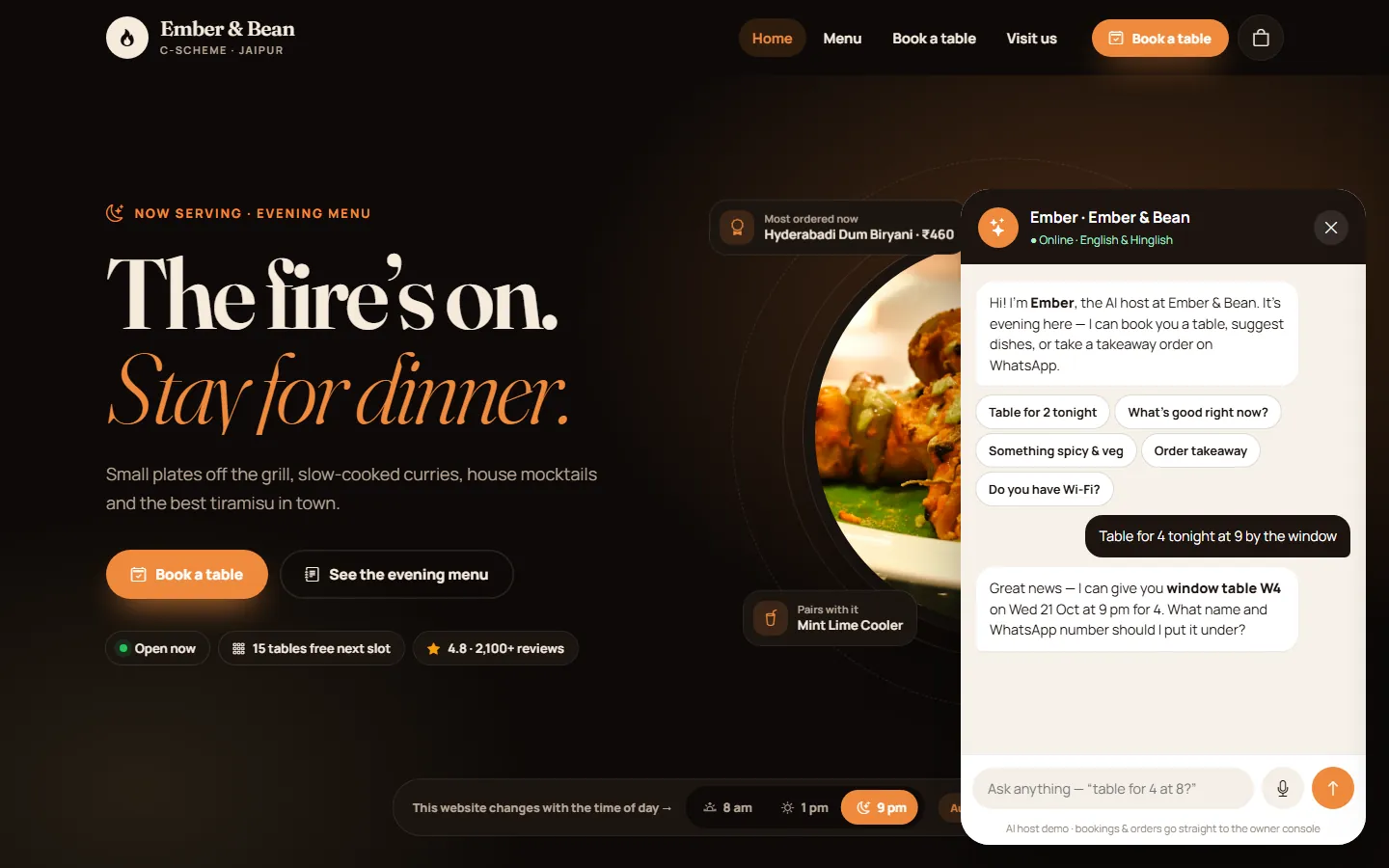 DinePilot demoA live product our engineers built: a café website with an AI host chatbot that takes bookings and replies in English and Hinglish. It shows what your mentors build, not a student project.Open →
Certificate verificationEvery certificate carries a unique ID that an employer, college or internship recruiter can check on this public page in seconds, with no phone calls needed.Open →
What you’ll work with
What affects the fee and the time you need
Here is what changes the cost and the time for a beginner. Current fees and EMI options are shared on WhatsApp.
The Launchpad is 20 weeks and about 150 live hours because it teaches Python properly before any AI. Shorter courses that skip the foundations often leave beginners stuck later.
A batch shares mentor time across a small group with a fixed syllabus. 1:1 mentorship is four one-hour sessions a month at your own pace, running month to month, with three months recommended.
If you already write Python confidently, the counselling call may place you in a shorter or more advanced programme instead, which saves both weeks and fees.
Ask about any student or early-bird discount and the instalment plans for your batch. The fee, EMI and refund terms are all confirmed in writing before you pay.
Ai course for beginners: questions people ask
Can I join an AI course without a coding background?
Yes. The Python to AI Launchpad is an AI course for beginners that starts from zero, with no coding needed. Learners from commerce, science, arts and every engineering branch can join, and school-level arithmetic is enough. Mentors review your code from week one.
How long does it take to learn AI from scratch?
On the Launchpad, 20 weeks and about 150 live hours take you from your first Python script to a deployed Generative AI app, with eight to ten hours a week including practice. Twenty weeks gives you solid foundations and a portfolio, not mastery of everything.
Do I need to be good at maths to learn AI?
No. School-level arithmetic is enough. The AI part of the course is about building applications with large language models — prompts, structured outputs, embeddings and RAG — not maths. Machine learning and data science, where heavier statistics and linear algebra come in, are not part of the course.
Is this AI course suitable for students and freshers?
Yes, it is built for them. Batches run on weekday evenings or weekends and are timed around college schedules, every session is recorded, and if exams clash you can pause and join the next batch’s matching module. Final-year students and graduates from any stream fit well.
What will I be able to build by the end?
You will build a portfolio of mentor-reviewed projects: a student-grades manager, a library-management system, an expense tracker with automated tests, a MySQL and Matplotlib data report, a FastAPI notes API and a capstone AI study assistant that answers from your own notes using RAG — all in your own GitHub account.
Are classes online or offline, live or recorded?
Classes are live online, not in a classroom. Mentors teach in real time, and every class is recorded for revision. Doubts between classes go to the mentor group. Teaching is in simple, clear English, with help in Hindi during doubt sessions if you ask.
Should I pick the Launchpad or 1:1 mentorship?
Pick the Launchpad if you want a structured class, a fixed syllabus and classmates to learn with. Pick 1:1 mentorship if you prefer personal guidance at your own pace: four one-hour sessions a month, a roadmap built around your goals and reviews on your code. A free counselling call will place you honestly.
Do I get a certificate, and is placement included?
You get a certificate with a unique ID that anyone can verify at /certificates once your labs and capstone are signed off. It is a professional training certificate, not a university degree or government accreditation. Placement is not promised; the Launchpad includes resume, LinkedIn and GitHub reviews, a mock interview and opportunities shared from our network.
What are the fees, and is EMI available?
Fees depend on the batch, so we share them on request. WhatsApp or call +91 82097 16316 for the current fee, EMI options and any student discount. Refund and batch-transfer terms come in writing before you pay; the only equipment you need is a laptop with 8 GB RAM.
Start learning AI the honest way
WhatsApp or call +91 82097 16316 with what you study and want to build. A mentor will tell you whether the Launchpad or 1:1 mentorship fits, and share the current fee, EMI options and next batch.