AI Course for Working Professionals — Live, on Weekends
A weekend AI course for working professionals who already write code. Build production features on large language models — RAG, LangChain, LangGraph agents and MCP servers — in live online sessions with senior engineers, with recordings for busy weeks and reviews on your own pull requests.
Updated- Live online classes + recordings
- Senior Python developers as mentors
- Certificate with a verifiable ID
An AI course for working professionals has to fit around a job, a codebase and limited free time, and it should teach skills you can use at work within weeks. The Ezibell AI Academy is the training arm of Ezibell Tech, a software company based in Jaipur whose senior Python developers and team leads build AI features for clients — and teach that same engineering in live weekend sessions.
The main track is the 14-week AI Engineer Accelerator, about 105 live hours, for developers with at least a year of professional experience. Java, Node, .NET and PHP developers get a fast-track Python bridge in week one. It is a generative AI course for software engineers: structured outputs, retrieval-augmented generation, LangChain, LangGraph agents, Model Context Protocol servers, evaluations and AWS deployment — application engineering, with no machine-learning theory or model training.
Every class is live online and recorded, so a release week costs you a recording to watch, not a gap in your knowledge. Developers on AWS can add the 12-week weekend AWS programme for Amazon Bedrock and AgentCore. If no batch fits your calendar, 1:1 mentorship runs on your schedule, and if your employer wants a whole team trained, corporate training is scoped around your stack. Fees and EMI options are shared on WhatsApp at +91 82097 16316.
What you build while you keep your job
LLM engineering habits that transfer to work
Model choice on cost, latency, quality and privacy across OpenAI, Anthropic Claude, Google Gemini and open-weight models, plus streaming, prompt versioning and JSON-schema outputs validated with Pydantic. You benchmark three models on a task from your own domain.
A production RAG service with evaluations
Ingestion pipelines, chunking strategies, pgvector and Qdrant, hybrid search, re-ranking, citations and multi-tenant access control, measured with an evaluation suite for faithfulness and relevance. A second project applies the same grounding discipline to text-to-SQL over a million-row database.
LangGraph agents with human approval
LangChain building blocks traced in LangSmith, then stateful LangGraph agents with tools, checkpoints, human-in-the-loop interrupts and supervisor or swarm patterns. Your multi-tool agent asks a person before a risky action — the design most teams insist on before an agent touches real systems.
Your own MCP server
A Model Context Protocol server in Python that exposes a database and an API to AI assistants over stdio or streamable HTTP, with authentication and security controls. You connect it to Claude Desktop, an IDE and your own LangGraph agent.
Evals, guardrails and cost control
Evaluation datasets, LLM-as-judge with human review, prompt regression tests, tracing with Langfuse and LangSmith, cost and latency dashboards, prompt-injection defences and PII redaction — the work that lets you defend an AI feature in a design review.
Shipping on AWS, plus a capstone
FastAPI services with streaming, queues for long jobs, Docker, and deployment with Lambda, Fargate and Amazon Bedrock behind rate limits and fallbacks. The capstone is an AI feature for a real business use case, reviewed by a team lead, with a certificate verifiable at /certificates.
Choose your programme
Every track is live, mentor-led and project-based. Tap one for the full syllabus, duration and FAQ.
AI Engineer Accelerator
Fourteen weekends, about 105 live hours: LLMs, structured outputs, production RAG, LangChain, LangGraph agents, MCP, evals and AWS deployment, with five portfolio projects and AI-engineer interview preparation.
Python developers whose company already runs on AWSAWS for Python Developers: Serverless, Containers & Bedrock
Twelve weekends, about 90 live hours: Lambda, Step Functions, Fargate and Amazon Bedrock — Knowledge Bases, Guardrails, Bedrock Agents and AgentCore — with budgets and billing alarms set up in week one.
Professionals whose workload makes a fixed batch impractical1:1 AI Career Mentorship
Four one-hour 1:1 video sessions a month, booked around your calendar, with a roadmap built around your job, pull-request reviews, chat support between sessions and a monthly mock interview.
Engineering managers and teams whose employer funds the trainingCorporate AI & Cloud Upskilling
From a 2-day workshop to an 8-week programme, on-site or live online, covering RAG, LangGraph agents, MCP and Amazon Bedrock with your team’s stack, GST invoices and an optional pilot on your data.
An AI course for working professionals that fits a full-time job
A part-time AI course online works alongside a full-time job only if the weekly load is stated honestly. The Accelerator’s 105 or so live hours over 14 weeks average roughly seven to eight hours of live sessions per weekend, plus a weekly lab in your own time. The AWS programme is similar, at about 90 live hours over 12 weekends. Block those hours in your calendar before the batch starts, not after the first missed session.
Recordings are the safety net, not the plan. A deployment weekend or a family function does not end your progress: you watch the session, finish the lab and bring questions to the private mentor group. If your workload swings from month to month, 1:1 mentorship — four one-hour sessions a month booked around your calendar — usually fits better than a batch.
From backend or Python developer to AI engineer
The move from backend developer to AI engineer is shorter than most people expect, because most AI engineering is backend engineering. Reliable APIs, data modelling, queues, retries, authentication and deployment are what turn an LLM demo into a feature users trust. What you add is a new layer: structured prompting, retrieval and re-ranking, agent state, tool security and evaluation. Good AI upskilling for developers builds on that existing skill rather than replacing it.
Experienced developers rarely struggle with the model calls themselves. The real gaps are evaluation — knowing whether a prompt change made answers better or worse — retrieval quality, cost and latency budgets, and security issues such as prompt injection and over-permissive tools. That is why the Accelerator gives whole modules to RAG evaluation, evals and guardrails, and human approval steps in agents.
Building a portfolio and pitching AI work inside your company
A working professional’s AI portfolio should show judgement, not just a chat window. The Accelerator projects cover the patterns teams hire for: a RAG service with an evaluation suite, a text-to-SQL assistant, a LangGraph agent with approval steps, your own MCP server and a deployed capstone. Each README should explain the trade-offs — which model and why, how retrieval was measured, what a request costs and what happens when the model fails.
At work, pitch a small, measurable problem rather than an “AI strategy”: a search assistant over internal documentation, a support-ticket triage helper or a text-to-SQL tool for an operations team. Bring a one-page design, an evaluation plan, a cost estimate from your own lab measurements and a human-approval step for anything the system changes. If leadership then wants the team trained, corporate training can run on your stack under NDA.
How the course works
- 1Free counselling call
WhatsApp or call +91 82097 16316 with your role, stack and years of experience. A mentor checks your level and suggests the Accelerator, the AWS programme, 1:1 mentorship or corporate training.
- 2Pick a weekend batch or a 1:1 slot
Choose the format that suits your calendar and workload. The current fee, EMI options and the refund and batch-transfer terms reach you in writing before any payment.
- 3Live weekend sessions
Join live online classes with senior engineers, put questions to them while the session runs and replay the recording later. Doubts between weekends go to the private mentor group.
- 4Labs and pull-request reviews
Most weeks end in a lab — a model benchmark, an extraction service, a RAG pipeline, an agent, an MCP server — and mentors comment on your architecture and code in your pull requests.
- 5Capstone on a real business use case
Scope and build an AI feature with weekly mentor reviews and an architecture review by a team lead, then deploy it and present it to mentors at demo day.
- 6Certificate and interview preparation
Once your mentor signs off your work, your certificate is issued with a unique verification ID, and the Accelerator adds AI-engineer resume and interview preparation.
Why learn with us
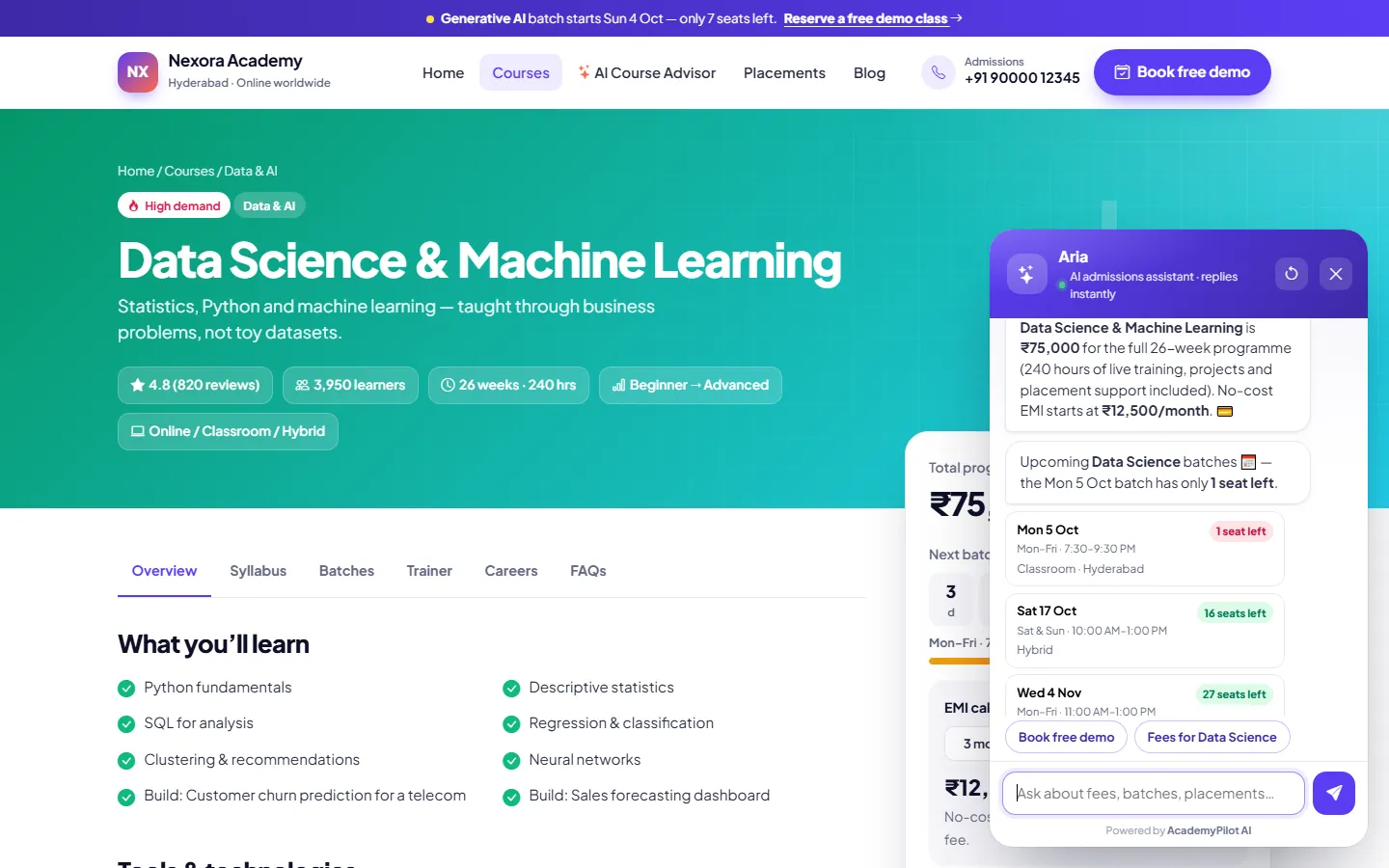 AcademyPilot demoA live product our engineers built: an AI admissions chatbot, AI course advisor and lead CRM with AI scoring. It shows the kind of LLM system your mentors design, not a student project.Open →
Certificate verificationEvery certificate carries a unique ID that an employer, a client or your own manager can check on this public page in seconds, without emailing anyone.Open →
What you’ll work with
What affects the fee for a working professional
These factors change the fee and the time you need; current fees and EMI options are shared on WhatsApp.
The Accelerator runs 14 weeks with about 105 live hours; the AWS programme runs 12 weeks with about 90. Taking both covers LLM engineering and AWS in depth, but roughly doubles the commitment.
Weekend batches share mentor time across a small group. 1:1 mentorship is four one-hour sessions a month, booked around your calendar, running month to month with three months recommended.
If your company sponsors a team, corporate upskilling runs from a 2-day workshop to an 8-week programme, on-site or live online, with GST invoices and an optional pilot on your own data. Individuals can join a weekend batch directly.
API spend during labs stays small: you are shown free credits, cheaper models for development and spending limits. Most AWS labs fit the Free Tier, with billing alarms set in week one.
Ai course for working professionals: questions people ask
Do you run a weekend AI course for working professionals?
Yes. The AI Engineer Accelerator runs live online on weekends for 14 weeks, about 105 live hours, and is built for working professionals; the 12-week AWS programme also runs on weekends. Every session is recorded, and exact timings are shared before each batch starts.
How many hours a week does the course take alongside a job?
Expect roughly seven to eight hours of live sessions per weekend on average, plus time for the weekly lab — about 105 live hours over 14 weeks on the Accelerator, or 90 over 12 weeks on the AWS programme. If your weekends are unpredictable, 1:1 mentorship at four one-hour sessions a month is lighter and flexible.
What experience do I need to join?
You need at least a year of professional development experience for the Accelerator. Python developers fit straight in, and Java, Node, .NET or PHP developers get a fast-track Python bridge in week one. No data-science or maths background is required. If you have never coded, the 20-week Python to AI Launchpad is the right place to start.
Is this a generative AI course for software engineers or a data science course?
It is a generative AI course for software engineers. You build applications on existing large language models — RAG, LangChain and LangGraph agents, MCP servers, evals and AWS deployment. Machine learning, model training, deep-learning theory and data science are not taught; if that is your goal, a mentor will say so honestly on the counselling call.
What projects will I have for my portfolio?
You finish with five projects in your own GitHub account: a production RAG service with hybrid search, citations and evaluations; a text-to-SQL assistant over a million-row database; a multi-tool LangGraph agent with human approval steps; your own MCP server; and a capstone that solves a real business use case, deployed on AWS and reviewed by a team lead.
Can my employer pay, and can I use problems from my job?
Yes to both. Ezibell Tech is GST-registered, so corporate training comes with proper GST invoices, and team programmes run from a 2-day workshop to eight weeks, built around your stack. As an individual, you can bring real work problems — without confidential details — to the capstone or to 1:1 mentorship.
Does the certificate count, and is placement included?
Your certificate carries a unique ID that anyone can verify at /certificates; it is a professional training certificate, not a university degree or government accreditation. There is no placement promise. The Accelerator includes AI-engineer resume and interview preparation, and your deployed projects matter more to employers than any certificate.
Find a weekend AI track that fits your job
WhatsApp or call +91 82097 16316 with your role, stack and weekly availability. A senior engineer will recommend the Accelerator, the AWS programme, 1:1 mentorship or team training, and share the current fee and EMI options.