Amazon Bedrock Course — Build Generative AI on AWS with Python
A live Amazon Bedrock course for Python developers who build on AWS. Call foundation models through the Converse API, build managed RAG with Knowledge Bases, add Guardrails, wire Bedrock Agents to Lambda and deploy production agents on Bedrock AgentCore — with IAM, budgets and cost control set up from week one.
Updated- Live online classes + recordings
- Senior Python developers as mentors
- Certificate with a verifiable ID
This Amazon Bedrock course is for developers whose company runs on AWS and who need to ship generative AI inside that account, not as a side project calling an outside API. Bedrock and AgentCore are taught in the 12-week AWS for Python Developers: Serverless, Containers & Bedrock programme at the Ezibell AI Academy, run by Ezibell Tech, a software company based in Jaipur.
Bedrock only makes sense in context, so the AWS foundations come first. Weeks 1 to 7 cover IAM, S3, Lambda with Powertools, API Gateway, SQS, SNS, EventBridge, Step Functions, ECS Fargate, DynamoDB, Aurora PostgreSQL and media pipelines. Weeks 8 and 9 are generative AI with Amazon Bedrock: model access, the Converse API, embeddings, Knowledge Bases, Guardrails, Bedrock Agents, Textract and prompt management. Week 10 is Bedrock AgentCore; week 11 covers security, observability and the CDK.
Classes are live online on weekends, recorded, and built for working professionals. You should be comfortable with Python and have your own AWS account; most labs fit within the Free Tier, with budgets and billing alarms set up in week one. For deeper LLM, RAG and agent engineering, pair it with the AI Engineer Accelerator; teams can book corporate training. Fees and EMI options are shared on WhatsApp at +91 82097 16316.
Inside the Amazon Bedrock course
Bedrock models and the Converse API
Work with Anthropic Claude, Meta Llama, Amazon Nova and other models on Bedrock, call them through the Converse API with streaming, and generate embeddings. You write model-agnostic code from the start, so changing a model is a configuration change rather than a refactor.
Knowledge Bases and Guardrails
Build managed RAG with Knowledge Bases for Amazon Bedrock on OpenSearch Serverless or Aurora pgvector, then add Guardrails for harmful content, denied topics and sensitive data. The lab is a document Q&A assistant that uses Textract to read scanned files.
Bedrock Agents with Lambda action groups
Create Bedrock Agents whose action groups are backed by Lambda, so the model can look up an order or raise a ticket only through code you control. You learn to describe actions precisely, validate every input and keep write actions behind approval.
Bedrock AgentCore in production
Deploy a LangGraph agent on AgentCore Runtime with short- and long-term Memory, turn APIs and Lambda functions into MCP tools with Gateway, secure access with Identity, use the Code Interpreter and Browser tools, and trace runs with AgentCore Observability.
Serverless plumbing for AI
Put AI behind API Gateway and Lambda, orchestrate multi-step jobs with Step Functions and its direct Bedrock integration, absorb bursts with SQS and react to S3 uploads through EventBridge. Human approval steps use Step Functions task tokens.
Security, observability and CDK
Least-privilege IAM, Cognito, KMS, Secrets Manager, VPC basics, CloudWatch and X-Ray — then the whole stack rebuilt as AWS CDK code in Python and deployed by GitHub Actions using OIDC instead of long-lived access keys.
Choose your programme
Every track is live, mentor-led and project-based. Tap one for the full syllabus, duration and FAQ.
AWS for Python Developers: Serverless, Containers & Bedrock
Twelve weekend weeks and about 90 live hours: IAM, Lambda, Step Functions, Fargate and data stores, then Bedrock, Knowledge Bases, Guardrails, Bedrock Agents and a LangGraph agent deployed on AgentCore.
Developers who want deeper LLM, RAG and agent engineeringAI Engineer Accelerator
Fourteen weekend weeks on structured outputs, production RAG with evals, LangChain, LangGraph, MCP and guardrails — the depth that makes Bedrock systems trustworthy, with AWS deployment included.
Engineering managers and teams adopting BedrockCorporate AI & Cloud Upskilling
A custom curriculum from a 2-day workshop to an 8-week programme, on-site or live online, on your own stack, with GST invoicing and an optional pilot on your data.
Amazon Bedrock vs calling OpenAI or Anthropic directly
Choose Bedrock when your data, identity and billing already live in AWS; call a provider directly when you need its newest features on launch day or you are not on AWS at all. With Bedrock, requests are authorised with IAM roles instead of a separate API key, traffic can stay on private VPC endpoints, usage lands on your AWS bill and logs sit in CloudWatch. AWS also states that Bedrock does not use your prompts and outputs to train models.
The trade-offs are real. Model and feature availability varies by region, a provider’s newest model or beta feature can reach its own API before Bedrock, and service quotas need watching as traffic grows. A direct API is often quicker for a throwaway prototype. Many teams use both, so the course teaches you to keep model calls behind a small interface of your own, making the provider a configuration choice rather than something baked into every function.
Serverless generative AI architecture on AWS
A reliable serverless GenAI system separates fast requests from slow work. API Gateway and Lambda handle short calls such as a chat turn or a classification, and can stream responses. Anything longer — ingesting a batch of PDFs, running Textract, generating a long report — goes through SQS or EventBridge to workers, so a slow model call never holds an HTTP request open or runs into gateway timeouts.
Step Functions is the backbone for multi-step AI workflows. Direct integrations call Bedrock, Lambda and ECS without glue code, Retry and Catch handle throttling declaratively, Distributed Map fans out across thousands of documents, and task tokens pause a workflow until a person approves an AI-generated decision. Agents that outgrow Lambda’s time and memory limits run on ECS Fargate or AgentCore Runtime instead.
Bedrock Knowledge Bases and Bedrock Agents are managed shortcuts, and the skill is knowing when to take them. A knowledge base handles ingestion, chunking, embeddings and retrieval from S3, which is ideal when you need a document assistant running quickly. When you need custom re-ranking, strict multi-tenant filtering or unusual chunking, building retrieval yourself gives more control. Bedrock Agents suit simple tool use through Lambda action groups; framework agents on AgentCore suit complex, stateful flows.
Security, IAM and cost control for Bedrock workloads
Treat model access like database access: grant it per role, per model, and log it. A Lambda execution role should allow invoking only the models that function needs, secrets belong in Secrets Manager and data at rest is encrypted with KMS. Guardrails add a policy layer for content and sensitive information, and Bedrock’s model invocation logging, when switched on, gives you an audit trail of prompts and responses.
Generative AI costs scale with tokens, so cost control is an engineering task, not a month-end surprise. Use smaller models for classification and routing and larger ones only for hard reasoning, cap output length, cache repeated context where the model supports it, and send non-urgent bulk jobs to batch processing. Set budgets and billing alarms before the first lab, as week one of the programme does, and tag resources so you can see which feature is spending money.
How the course works
- 1Free counselling call
WhatsApp or call +91 82097 16316. A mentor checks your Python and AWS experience and recommends the AWS programme, the AI Engineer Accelerator, both, or corporate training for your team.
- 2Safe account setup
Week 1 secures your AWS account with IAM roles, least privilege, budgets, billing alarms and the Free Tier, so you can experiment freely without surprise bills.
- 3Serverless foundations
Weeks 2 to 7 build the platform AI runs on: Lambda, API Gateway, event-driven queues and rules, Step Functions, Fargate containers, DynamoDB, Aurora and media pipelines.
- 4Bedrock and AgentCore labs
Weeks 8 to 10 cover the Converse API, Knowledge Bases, Guardrails, Bedrock Agents and Textract, then deploying a LangGraph agent on AgentCore with memory, tools and tracing.
- 5Production practice and capstone
Week 11 rebuilds your stack as CDK code with CI/CD and observability. Week 12 is a capstone AWS system with an AI component, reviewed by a team lead.
- 6Certificate and next steps
Your mentor signs off your work and your certificate is issued with a unique ID at /certificates, alongside AWS interview and certification-path guidance for your next step.
Why learn with us
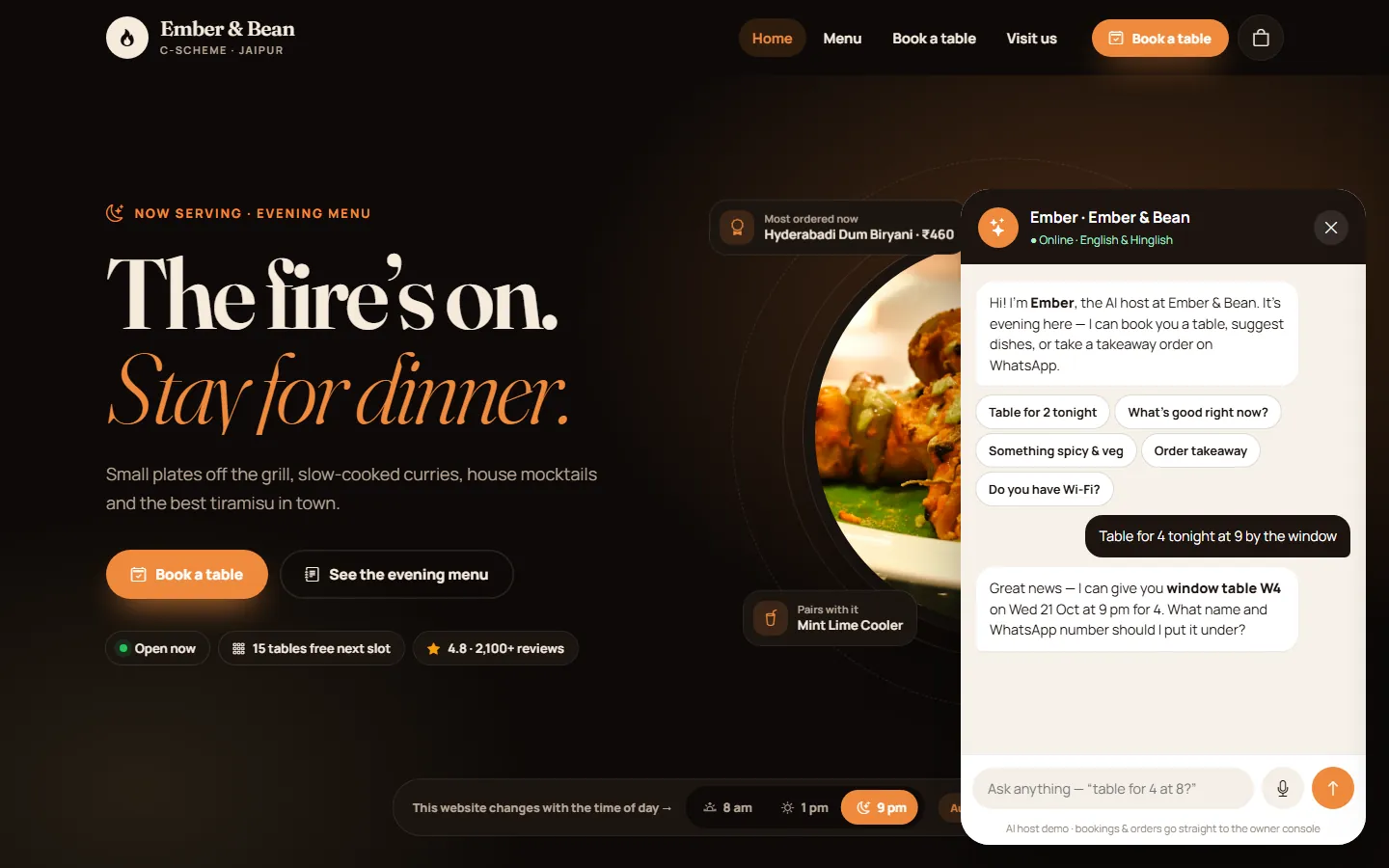 DinePilot demoA live product our team built: a café website with an AI host that takes bookings and takeaway orders. Open it to see the kind of AI system your mentors design.Open →
Certificate verificationEvery certificate carries a unique ID that an employer can check on this public page in seconds — useful evidence alongside the AWS projects in your portfolio.Open →
What you’ll work with
What affects the fee for AWS Bedrock training
The fee depends on the route and format you choose; AWS usage is billed separately to your own account:
The 12-week AWS programme, about 90 live hours, covers Bedrock and AgentCore with full serverless foundations. The 14-week AI Engineer Accelerator adds RAG, LangGraph and evals depth as a separate track.
Cohort batches share mentor time in a small group, 1:1 mentorship is four one-hour sessions a month, and corporate training runs from a 2-day workshop to an 8-week programme.
Most labs fit the Free Tier. Bedrock and a few other services charge per use, so those labs stay small, the cost is shown first, and every lab ends with a clean-up step.
Labs on your own stack, use cases under NDA and an optional 2–4 week pilot change the scope. GST invoices are issued, and fees and EMI options are shared on WhatsApp.
Amazon bedrock course: questions people ask
What does the Amazon Bedrock course cover?
It covers Bedrock models and model access, the Converse API and streaming, embeddings, Knowledge Bases, Guardrails, Bedrock Agents with Lambda action groups, Textract, Comprehend and prompt management, then a full week on Bedrock AgentCore. It sits inside a 12-week AWS programme that also teaches Lambda, Step Functions, Fargate and the CDK.
What is Bedrock AgentCore, and is it covered?
Amazon Bedrock AgentCore is a set of AWS services for running AI agents in production, and it gets a full week. You deploy a LangGraph agent on AgentCore Runtime, give it memory, expose APIs and Lambda functions as MCP tools through Gateway, secure it with Identity and trace it with Observability.
Do I need AWS experience before starting?
No prior AWS experience is required, but you should be comfortable with Python. Week one covers regions, IAM, the AWS CLI, boto3, budgets and S3 before anything else. If you are new to Python, take the Python to AI Launchpad or the Backend programme first.
Will the AWS labs cost me money?
Most labs fit within the AWS Free Tier, and you set up budgets and billing alarms in week one. Services such as Bedrock charge per use, so those labs are kept small and the cost is shown before you run them. AWS needs a card to open an account; if that is a problem, talk to us.
Is this an AWS generative AI course or a machine learning course?
It is an AWS generative AI course for developers, not a machine-learning course. You build applications on foundation models through Bedrock — RAG, agents, guardrails and serverless workflows — with no model training, data science or maths-heavy theory. If you need to train your own models, this programme is not the right fit.
Does it prepare me for an AWS certification?
It covers much of what the AWS Certified Developer – Associate exam tests, and mentors share a study path in the capstone week. The exam itself is booked and taken separately with AWS. The programme focuses on building real systems, which also gives you concrete projects to discuss in interviews.
Is the course live online, and can our team join together?
Yes. The AWS programme runs live online on weekends for working professionals, with every class recorded and a private mentor group for doubts. Teams can book Corporate AI and Cloud Upskilling instead: an AWS serverless and Bedrock track, on-site or live online, from a 2-day workshop to an 8-week programme on your own stack.
Do I get a certificate, and is placement guaranteed?
You get a certificate; placement is not guaranteed. Complete the labs and capstone, your mentor signs off your work, and Ezibell Tech issues a certificate with a unique ID verifiable at /certificates. It is a professional training certificate, not an AWS certification. Support includes architecture reviews and AWS interview guidance.
Plan your Amazon Bedrock learning path
WhatsApp or call +91 82097 16316 with your Python and AWS background. A senior engineer will recommend the right track, share the current fee and EMI options, and confirm the next weekend batch.