LangChain Course — LangGraph Agents, LCEL and LangSmith Evals
A live, project-based LangChain course for developers who want to ship LLM applications, not just run notebook demos. Learn LCEL and runnables, retrievers and tool calling, stateful LangGraph agents with human approval, and LangSmith tracing and evals — taught online by senior engineers who build AI systems for clients.
Updated- Live online classes + recordings
- Senior Python developers as mentors
- Certificate with a verifiable ID
A good LangChain course should teach you two things: how to use the framework well, and when not to use it. Most free walkthroughs stop at a chain that summarises one PDF, written against an API that has since changed. At the Ezibell AI Academy, the training arm of Ezibell Tech, a software company based in Jaipur, LangChain and LangGraph are taught inside the 14-week AI Engineer Accelerator by senior developers who build retrieval systems and agents for clients.
The order is deliberate. You first build LLM calls, structured outputs, embeddings and a complete RAG pipeline with plain Python and the provider SDKs. In week 7 you rebuild that RAG service with LangChain Expression Language and trace every step in LangSmith, so you see exactly what the framework adds and what it hides. Weeks 8 and 9 move to LangGraph agents with state, checkpoints, conditional routing and human approval, and week 10 plugs MCP tools into them.
Classes are live online on weekends, built for working developers anywhere in India or abroad, and every session is recorded. You need about a year of development experience; Java, Node, .NET and PHP developers get a fast-track Python bridge in week one. If you cannot code yet, the Python to AI Launchpad teaches Python from zero and ends with LangChain basics. Fees and EMI options are shared on WhatsApp at +91 82097 16316.
What you build on the LangChain course
LCEL chains and runnables
Compose prompt templates, chat models, output parsers and retrievers with LangChain Expression Language. You learn how runnables share one invoke, batch and stream interface, how to run branches in parallel, and how to add retries and fallbacks without burying logic in callbacks.
Retrievers and RAG, rebuilt with LangChain
Document loaders, text splitters and retrievers wired to pgvector or Qdrant. You rebuild your earlier RAG service with LangChain, keep its citations and evaluation suite, and compare it line by line with the plain-Python version, so the trade-offs are visible rather than theoretical.
Tools, tool calling and memory
Define tools with typed inputs, let chat models call them, parse results into validated Pydantic objects and pick a memory pattern that fits the conversation. This is where most production bugs hide: malformed arguments, silent retries and tools that do too much.
Agent development with LangGraph
State, nodes, edges and conditional routing; checkpoints so an agent can resume; interrupts for human approval; supervisor and swarm multi-agent patterns; and MCP tools from your own MCP server. The lab is a multi-tool research and action agent that waits for your sign-off before it acts.
LangSmith tracing and evals
Trace every chain and agent run in LangSmith to see prompts, retrieved documents, tool calls, tokens and latency. Then build evaluation datasets, combine LLM-as-judge with human review and run prompt regression tests. Langfuse is covered too, so you are not tied to one tool.
Shipping, plus a reviewed capstone
Serve chains and agents behind FastAPI with streaming, queue slow work, containerise with Docker and deploy on AWS with monitoring and cost alerts. The capstone is an AI feature for a real business use case, reviewed by a team lead.
Choose your programme
Every track is live, mentor-led and project-based. Tap one for the full syllabus, duration and FAQ.
AI Engineer Accelerator
Fourteen weekend weeks and about 105 live hours: RAG first, then LangChain with LangSmith tracing, two weeks of LangGraph agents, MCP, evals and AWS deployment, ending in a team-lead capstone review.
Students and beginners who cannot code yetPython to AI Launchpad
Twenty weeks that build Python properly, then databases and FastAPI, finishing with LLM APIs, embeddings, RAG with citations and LangChain basics — the groundwork the Accelerator expects.
Developers with a LangChain or LangGraph project of their own1:1 AI Career Mentorship
Four one-hour 1:1 sessions a month with a senior engineer, a personal roadmap, reviews on your pull requests and a monthly mock interview. Three months recommended.
What LangChain is good at — and where it gets in the way
LangChain is good at giving you standard interfaces for the parts every LLM application repeats: chat models from different providers, prompt templates, document loaders, splitters, retrievers, tools and output parsers. Swapping OpenAI for Anthropic Claude or an open-weight model becomes a change of one class rather than a rewrite, and the integrations save real time when you meet an awkward file format or a new vector store.
It gets in the way when the abstraction is thicker than the problem. A single prompt with a structured output often needs nothing more than the provider SDK and Pydantic, and a framework only adds layers to debug. Nested chains can also hide the exact prompt sent to the model, which is why tracing starts in the first LangChain lab. Our mentors’ rule: adopt LangChain where it removes code you would otherwise maintain, not where it replaces ten clear lines with one opaque one.
- Good fit: RAG pipelines with several loaders, retrievers and model providers
- Good fit: teams that want a shared vocabulary and consistent tracing
- Poor fit: one-off prompts and small scripts where the SDK is clearer
- Poor fit: latency-critical paths that need full control of every request
LangChain vs LangGraph vs plain SDK calls
Use plain SDK calls when the flow is a straight line, LangChain when you are assembling standard components, and LangGraph when the application needs state, loops or a human in the middle. A reply generator that turns a support ticket into JSON is a straight line. A RAG service with query rewriting, hybrid retrieval, re-ranking and citations is a set of standard components that LangChain keeps readable and traceable.
An agent that researches, calls tools, decides what to do next, waits for a manager to approve a refund and resumes the next day is a graph. LangGraph models that explicitly: a typed state object, nodes that do work, conditional edges that decide what runs next, and checkpoints that persist progress. Black-box agent loops have largely given way to graphs like this, because teams need to see and control every step an agent can take.
LCEL is LangChain’s way of composing runnables with the pipe operator, and its real value is the shared interface, not the syntax. Every runnable — prompt, model, retriever, parser or your own function — supports invoke, batch and stream, plus async versions, so a chain built in a notebook can stream tokens through a FastAPI endpoint unchanged. RunnableParallel, RunnablePassthrough and RunnableLambda cover most composition, and with_retry and with_fallbacks add resilience in one place.
Tracing, evals and keeping up with a fast-moving framework
LangSmith answers the question every LLM developer eventually asks: why did it say that? A trace records each step of a run — the rendered prompt, retrieved documents, tool calls, tokens and latency — so you debug from evidence, and it can trace plain-Python code too. Evals turn that visibility into a quality gate: a dataset of real questions, scored by LLM-as-judge and human review, rerun whenever you change a prompt, model or retriever.
LangChain’s APIs change faster than most libraries, so the course teaches habits rather than a frozen snapshot. Pin versions in your lock file, keep provider packages such as langchain-openai and langchain-anthropic as separate dependencies, read release notes before upgrading, and keep a regression suite that tells you within minutes whether an upgrade broke anything. Code written against the documented core interfaces ages far better than code copied from an old LangChain tutorial course.
How the course works
- 1Free counselling call
WhatsApp or call +91 82097 16316. A mentor checks your coding experience and goals, then recommends the Accelerator, the Launchpad first, or 1:1 mentorship — honestly, even when that is the longer route.
- 2Foundations before frameworks
Weeks 1 to 6 cover typed async Python, LLM behaviour, structured outputs, embeddings and production RAG with plain code, so you understand what LangChain abstracts before you rely on it.
- 3LangChain and LangGraph labs
Week 7 rebuilds your RAG service with LCEL and LangSmith tracing, weeks 8 and 9 build a LangGraph agent with checkpoints and human approval, and week 10 connects your own MCP server.
- 4Code and architecture reviews
Mentors review your pull requests and design choices every week, question framework use where plain code would be clearer, and point out failure modes before production finds them.
- 5Evals, deployment and capstone
Add evals, tracing and guardrails, deploy with monitoring and cost alerts, then build a capstone AI feature for a real business use case with a team-lead architecture review.
- 6Certificate and interview preparation
Your mentor signs off your work, your certificate is issued with a unique ID on /certificates, and you get AI-engineer resume and interview preparation before you finish.
Why learn with us
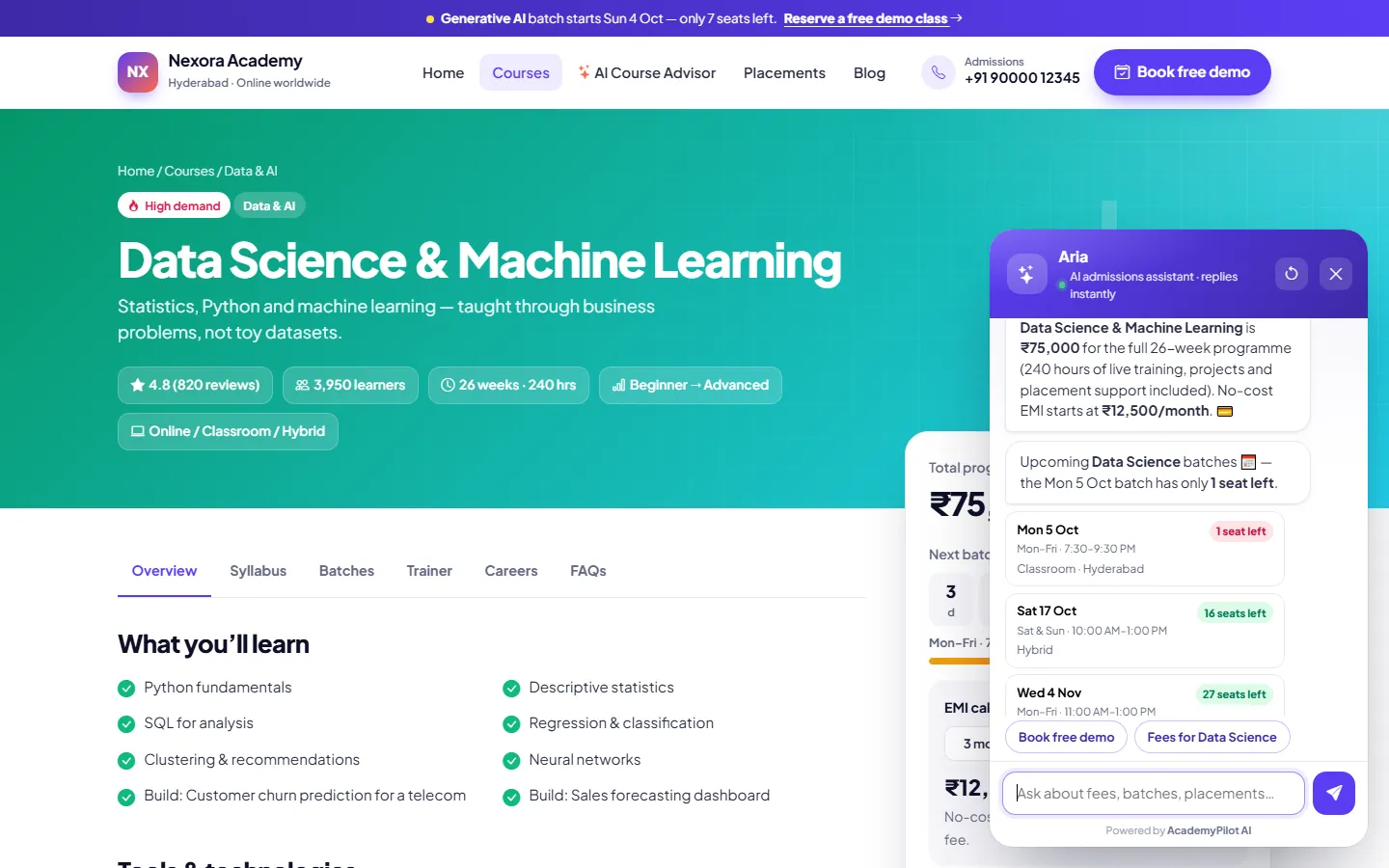 AcademyPilot demoA live product our team built, with an AI admissions chatbot, an AI course advisor and lead scoring. Open it to see the kind of LLM system your mentors design and ship.Open →
Certificate verificationEvery certificate carries a unique ID that an employer can check on this public page, so your LangChain and LangGraph work is backed by something verifiable.Open →
What you’ll work with
What affects the fee for LangChain training
The fee depends on your route and how much mentor time you need:
Developers with a year or more of experience join the 14-week Accelerator directly. Beginners take the 20-week Launchpad first, which adds time but builds the Python LangChain assumes.
Cohort batches share mentor time in a small group. 1:1 mentorship is four one-hour sessions a month, focused on your own LangChain or LangGraph project.
To deploy agents on Bedrock AgentCore or build managed RAG on Bedrock, the 12-week AWS programme adds that depth as a separate track.
Team training is scoped from a 2-day workshop to an 8-week programme on your own stack. For individuals and teams, fees and EMI options are shared on WhatsApp.
Langchain course: questions people ask
How long is the LangChain course?
LangChain and LangGraph are taught inside the 14-week AI Engineer Accelerator, about 105 live hours on weekends. LangChain is week 7, LangGraph agents take weeks 8 and 9, and MCP, evals and deployment follow before a two-week capstone. There is no separate LangChain-only batch; for focused help, 1:1 mentorship runs month to month.
Do I need to know Python before learning LangChain?
You need about a year of development experience. Python developers fit straight in, and Java, Node, .NET or PHP developers get a fast-track Python bridge in week one. If you have never coded, start with the 20-week Python to AI Launchpad, which teaches Python from zero and introduces LangChain basics in its Generative AI module.
Is this also a LangGraph course?
Yes. LangGraph gets two full weeks: the ReAct agent loop, state, nodes, edges and conditional routing, persistence and checkpoints, human-in-the-loop interrupts, supervisor and swarm multi-agent patterns, long-running agents and agent evaluation. You build a multi-tool agent with human approval steps, then connect MCP tools to it in week 10.
Will I learn LangSmith?
Yes. LangSmith tracing starts in the LangChain week, when you trace every step of your rebuilt RAG service. In the evals week you build evaluation datasets, use LLM-as-judge and human review and run prompt regression tests, with both LangSmith and Langfuse covered.
How is this different from a free LangChain tutorial?
A free tutorial teaches syntax; this LangChain training teaches judgement and production habits. You build the same system with and without the framework, get pull requests reviewed by senior engineers, add evals and tracing, deploy to AWS and defend your design in a team-lead review.
Are classes live online, and are there weekend batches?
Yes to both. The Accelerator runs live online on weekends for working professionals, with mentors answering questions in the session. Every class is recorded, doubts between classes go to a private mentor group, and exact timings are shared before each batch starts.
Do I get a certificate, and do you guarantee a job?
You get a certificate, not a job guarantee. Complete the labs and capstone, your mentor signs off your work, and Ezibell Tech issues a certificate with a unique ID verifiable at /certificates — a professional training certificate, not a degree or accreditation. Support includes reviewed projects, a resume review and AI-engineer interview preparation.
Ask a mentor if the LangChain track fits you
WhatsApp or call +91 82097 16316 with your experience and what you want to build. A senior engineer will recommend the right track, share the current fee and EMI options, and confirm the next weekend batch.