Generative AI Development Company in India for Real Products
As a generative AI development company in India, we add LLM features to products that already exist: OpenAI, Claude and open-source model integration, copilots, document extraction, fine-tuning and private deployment, engineered for predictable cost, measurable quality and no single-vendor lock-in.
- Team in Jaipur, India
- MSME & GST registered
- Live product demos you can try
Ezibell Tech is a generative AI development company in India for teams that want working LLM features, not another proof of concept that stalls in a slide deck. We integrate models from OpenAI, Anthropic and the open-source ecosystem into Django, FastAPI and Next.js applications, build copilots that sit inside your product, turn unstructured documents into structured data and set up content workflows with human review. Every feature ships with the unglamorous parts that decide whether it survives contact with users: evaluations, guardrails, cost controls and monitoring.
Most generative AI projects that disappoint do so for predictable reasons. The use case was chosen for novelty rather than value, the team picked the largest model by default and was surprised by the bill, nobody defined what a good output looks like, or the feature was a thin wrapper that a model provider made redundant months later. Our GenAI consulting starts with those questions: where AI removes real effort, which model is good enough at what cost, how quality will be measured and what defensible value sits around the model.
Our senior Python engineers handle strategy, design, engineering, launch and support under one roof, for clients across India and worldwide. A useful first step is a short ROI blueprint, then architecture and security, a rapid MVP and a scale-up phase, which typically fits within our standard 2–8 week window for a focused feature. We work on AWS, Azure and GCP, including AWS Bedrock for private model access, and your data is never used to train public models.
What you get from a generative AI development company in India
LLM integration services
OpenAI and Claude API integration into your existing backend, with streaming responses, structured outputs validated by schema, retries and fallbacks between providers, rate limiting and per-customer usage metering. Built as a clean service layer your developers can extend, not prompts scattered across the codebase.
AI copilot development
In-app assistants that draft, summarise, explain and fill in forms using the context of the user’s own data and permissions. The copilot suggests and the user accepts, so value arrives quickly without handing irreversible decisions to a model. Designed with your product team, not bolted on as a chat bubble.
GenAI consulting and roadmap
Use-case triage by value, feasibility and risk; build-versus-buy analysis against existing tools; model and hosting recommendations; and a costed roadmap. Where helpful we build a quick prototype on your data, so decisions rest on evidence rather than vendor demos.
LLM fine-tuning
Fine-tuning when it is justified: consistent classification or extraction at high volume, strict output formats, or distilling a large model’s behaviour into a smaller, cheaper one. We curate and clean the dataset, train with LoRA on open models or through provider fine-tuning, and prove the gain on a held-out evaluation set.
Document intelligence and extraction
Invoices, contracts, forms, CVs and reports turned into structured JSON validated against a schema, with confidence scoring and a human review queue for uncertain fields. Results flow straight into your database, ERP or workflow instead of being retyped.
AI content workflows
Drafting blogs, product descriptions, emails and translations in your brand voice, grounded in your own source material, with editorial review, fact-check prompts and publishing integration. Content generation supports your editors rather than replacing their judgement.
Private and open-source deployment
Models accessed through AWS Bedrock inside your own AWS account and region, or open-weight models served on your own GPU servers. Suitable when data cannot leave your environment, when compliance requires it, or when steady high volume makes self-hosting cheaper than per-token pricing.
Choosing a model: OpenAI, Claude or open-source
There is no single right model, only a right model for each task at a given cost and risk. Frontier models from OpenAI and Anthropic are strongest at complex reasoning, long documents, coding and nuanced writing, and are quickest to start with. Smaller hosted models handle classification, extraction, routing and short summaries at a fraction of the cost and latency. Open-weight models such as Llama, Mistral and Qwen can run inside your own infrastructure and be fine-tuned freely, at the cost of operating them yourself.
We decide with data. For each task we build a small evaluation set from your real inputs, run several candidate models against it and compare quality, latency and cost per thousand requests. The result is often a routing design: a small, fast model handles most requests and escalates the hard ones to a frontier model. A specialised small model frequently beats a giant general one on a narrow task, which is good news for both your bill and your privacy.
- Complex reasoning, long context, nuanced writing: frontier API models
- Classification, extraction, routing at volume: small hosted or fine-tuned models
- Strict data residency or air-gapped needs: open-weight models on your servers or Bedrock
- Mixed workloads: route by difficulty, escalate only when needed
Controlling LLM cost and avoiding vendor lock-in
LLM bills grow with tokens, and tokens grow quietly: bloated system prompts, entire documents pasted where three paragraphs would do, chat histories that are never summarised, retries that resend everything. We control cost at the architecture level with prompt caching for stable instructions, retrieval that sends only relevant context, conversation summarisation, batch APIs for non-urgent jobs, response caching for repeated questions and model routing. Per-tenant and per-feature budgets with alerts mean a runaway loop or a heavy user cannot surprise you at month end.
Lock-in is the other hidden cost. Providers change prices, deprecate models and alter behaviour between versions. We keep the model behind a thin internal interface, version prompts alongside code, avoid provider-only features unless they earn their keep, and maintain an evaluation suite that can score a replacement model on your tasks within a day. Switching providers then becomes a measured engineering decision rather than a rewrite.
- Prompt caching, context trimming and summarisation
- Model routing and batch processing for non-urgent work
- Per-tenant budgets, usage metering and alerts
- Provider-agnostic interface, versioned prompts, portable evaluations
Privacy, private deployment, evaluations and guardrails
Privacy options range from enterprise API terms that exclude training on your data, through AWS Bedrock where requests stay within your AWS account and chosen region, to open-weight models running on your own hardware with nothing leaving your network. We pick the lightest option that satisfies your compliance requirements, then add PII redaction before prompts, encryption, access logging and data retention rules. Self-hosting is not automatically more private if servers are poorly secured, so we treat it as a proper infrastructure project.
Quality and safety are engineered, not hoped for. Outputs that feed systems are validated against schemas and rejected or retried when they fail. Input and output guardrails catch prompt injection, off-topic requests and sensitive data. Evaluation sets built from real cases measure accuracy, tone and policy compliance, and they run before every prompt change or model upgrade. In production we sample outputs for human review and track user corrections, which become the next round of test cases.
- Bedrock or self-hosted models when data must stay in your environment
- PII redaction, encryption, access logs and retention rules
- Schema validation for every machine-consumed output
- Regression evaluations before prompt changes and model upgrades
How we work
- 1ROI blueprint
In the first few days we shortlist use cases, estimate value and running cost, check data availability and risks, and agree the success metric for the first feature.
- 2Architecture and security
In the first week we choose models, hosting, data flows and guardrails, design the integration into your product and confirm privacy and compliance requirements before building.
- 3Rapid MVP
We build the feature end to end on your real data, with an evaluation set and cost tracking from the first day, so you see quality and unit economics early.
- 4Evaluate and refine
We compare models and prompts on the evaluation set, tune for quality, latency and cost, and run user testing with a small group of real users before wider release.
- 5Scale and impact
We roll out with monitoring, budgets and alerts, measure the agreed metric against the baseline, and plan the next features based on what the results actually show.
Why teams choose us
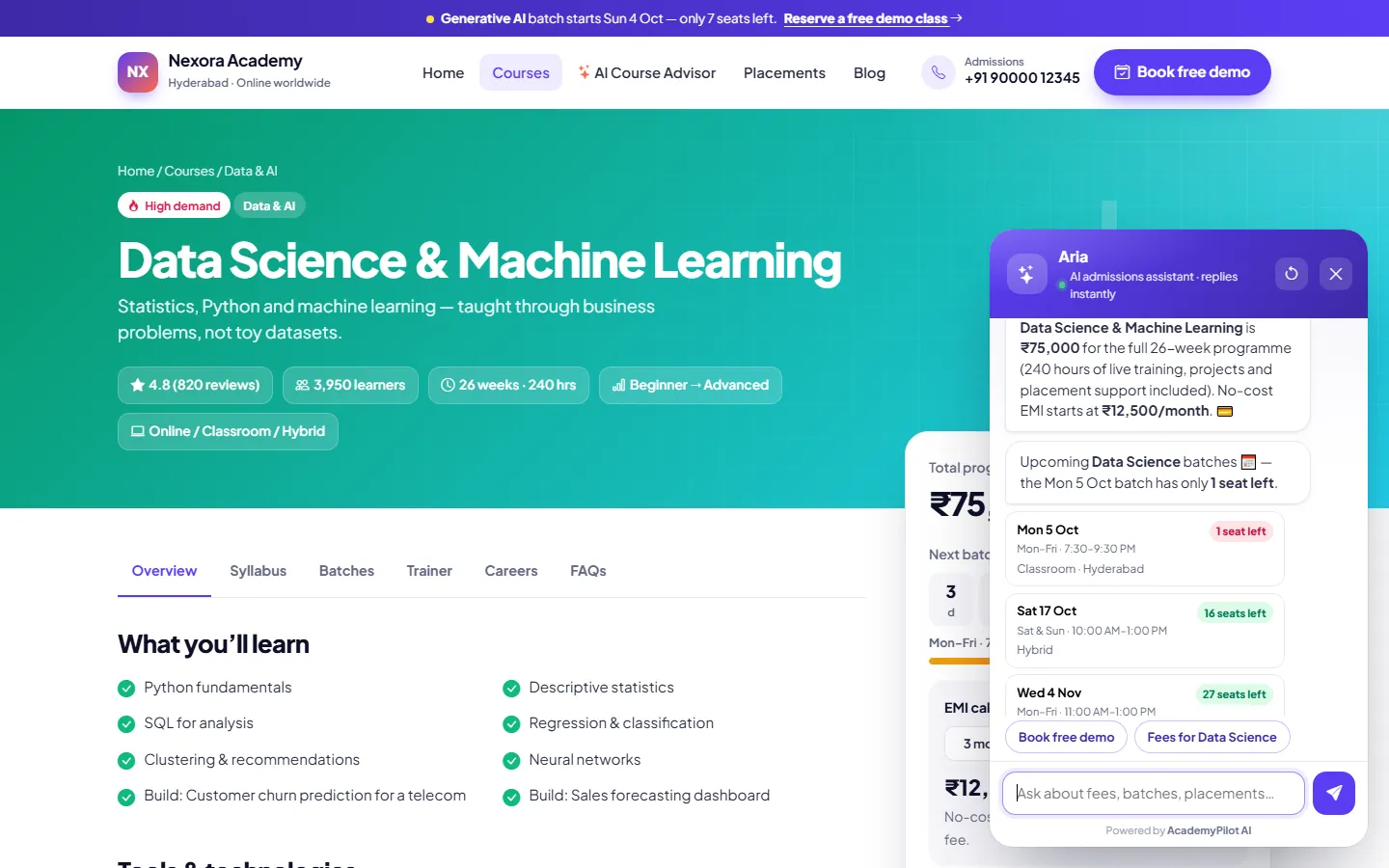 AcademyPilotFour generative AI features in one product: an admissions chatbot, an AI course advisor, AI lead scoring in the CRM and an AI blog writer that drafts posts for review.Open →
 DinePilotAn AI host that converses in English and Hinglish, takes bookings on a live floor plan and handles WhatsApp takeaway orders: LLM understanding wired into real transactions.Open →
Our stack for this work
What drives generative AI development cost
We quote each build at a fixed price from a defined scope and estimate running costs separately. These factors matter most.
A single summarisation endpoint is light. Multi-step copilots, agents that take actions or features that combine retrieval, extraction and generation need more design, testing and evaluation.
Clean, accessible data speeds things up. Scattered, scanned or inconsistent data needs ingestion, cleaning and labelling work before any model can use it well.
Managed APIs are quickest to launch. Bedrock setups, fine-tuning or self-hosted open-source models add infrastructure and MLOps work but can lower running costs or meet strict privacy rules.
Internal tools tolerate occasional errors; customer-facing or regulated features need larger evaluation sets, guardrails, human review queues and more tuning.
Embedding AI into your product’s UI, permissions, billing and workflows takes more work than a standalone tool, but it is usually where the value is.
Expected requests, context size and latency targets determine model mix, caching strategy and infrastructure, which drive monthly running costs.
Generative ai development company in india: questions people ask
What can generative AI do for my existing product?
The most reliable wins are features that remove repetitive effort for your users: drafting and summarising, answering questions from their own data, extracting fields from documents, classifying and routing requests, and copilots that pre-fill forms or suggest next actions. We start by looking at where users spend time on language-heavy tasks, then pick the feature with clear value and measurable quality.
Which LLM should we use: OpenAI, Claude or open-source?
It depends on the task, cost and privacy requirements, so we test rather than guess. Frontier models from OpenAI and Anthropic suit complex reasoning and writing; smaller models handle classification and extraction cheaply; open-weight models suit strict data residency or self-hosting. We run candidates against an evaluation set from your data and often combine models with routing.
Should we use fine-tuning or RAG?
Use RAG when the model needs your facts, such as policies, products or documents, especially when they change, need citations or have access restrictions. Use fine-tuning to change behaviour: a consistent format, tone or classification at high volume, or to make a smaller model perform like a larger one. Many products need RAG first and fine-tuning later, if at all.
How do you control LLM costs?
By design rather than by monitoring alone. We send only relevant context, cache stable prompts and repeated answers, summarise long conversations, route easy requests to smaller models, batch non-urgent work and set per-feature and per-tenant budgets with alerts. We estimate running costs from your expected volume before building, then track actual cost per request after launch.
Can we run models privately on our own servers?
Yes. Options include AWS Bedrock, where requests stay within your AWS account and region, and open-weight models such as Llama, Mistral or Qwen served on your own GPU servers or private cloud. Self-hosting gives maximum control but adds operational work, so we compare it with managed options on privacy, quality and total cost before recommending it.
How do we avoid LLM vendor lock-in?
Keep the model behind your own interface, version prompts with your code, avoid provider-specific features unless they add clear value, and maintain an evaluation suite that can score alternative models on your real tasks. With those in place, switching providers or adding an open-source fallback is a measured change, not a rewrite.
Why work with a generative AI development company in India?
You get senior engineering at a cost structure that makes iteration affordable, with time-zone overlap for Asia, the Middle East and Europe and workable hours for US teams. With Ezibell Tech you also work with an MSME-registered company that handles strategy, engineering, launch and support under one roof, on fixed-price, hourly or retainer terms.
How do you stop AI from producing wrong or unsafe output?
We combine grounding in your data, schema validation for structured outputs, input and output guardrails for injection and sensitive content, and evaluation sets that measure accuracy and policy compliance before each release. Uncertain outputs go to human review, and production sampling catches drift. No model is perfect, so we design workflows where mistakes are caught before they cause harm.
Bring us one AI idea, and we will test it on your data
WhatsApp or call +91 63774 18934, or email team@ezibelltech.com. Tell us the feature you have in mind and the data behind it. We will reply with a recommended model and architecture, expected running cost drivers and a fixed quote for the build.